

The ecommerce industry has become more competitive than ever before, and choosing the right platform can determine whether your online business thrives or struggles. Among dozens of ecommerce solutions available today, Shopify continues to dominate conversations about online store creation. Millions of merchants across the globe rely on Shopify because it combines simplicity, powerful selling tools, and enterprise-level scalability within a single ecosystem. During 2026, Shopify has expanded its AI-powered features, refined its pricing structure, and introduced smarter automation tools designed to help businesses of every size sell more efficiently. Industry reviews consistently praise Shopify for its ease of use, multichannel selling capabilities, and extensive app ecosystem, while recent reports also highlight major investments in artificial intelligence and international expansion.
Table of Contents
ToggleThis comprehensive Shopify Review 2026 explores everything you need to know before investing your money. We’ll examine the latest features, pricing, advantages, disadvantages, security, SEO capabilities, customer support, and comparisons with competing ecommerce platforms. Whether you’re launching your very first online business or migrating an established store from another platform, this guide will help you decide if Shopify deserves your investment.
What Is Shopify and Why Does It Matter in 2026?
The ecommerce industry is moving faster than ever, and online businesses now need much more than a simple website to stay competitive. Customers expect lightning-fast page speeds, personalized shopping experiences, secure payments, AI-powered product recommendations, and seamless purchasing across multiple channels. This is exactly where Shopify has positioned itself as one of the strongest ecommerce ecosystems available today. Rather than offering only a website builder, Shopify delivers a complete business platform that combines store creation, inventory management, payment processing, marketing, analytics, shipping, customer relationship management, and artificial intelligence into one unified dashboard. This all-in-one approach eliminates much of the technical complexity that traditionally prevented entrepreneurs from launching successful online businesses. Recent industry reports indicate that Shopify now powers over 5 million online stores worldwide and processed approximately $292 billion in gross merchandise volume (GMV) during 2024, demonstrating its enormous influence in global ecommerce.
What makes Shopify especially relevant in 2026 is its aggressive investment in AI. The platform has expanded native tools like Shopify Magic and Sidekick, allowing merchants to generate product descriptions, write marketing emails, design store pages, create FAQs, and even receive intelligent business recommendations without relying on third-party software. Shopify has also focused heavily on international commerce, making it easier for merchants to sell across borders using localized currencies, languages, taxes, and payment methods. At the same time, improvements in checkout optimization, inventory synchronization, and omnichannel selling have strengthened Shopify’s reputation among businesses ranging from small startups to global brands. Instead of spending months configuring servers, installing plugins, and worrying about security patches, merchants can launch a professional store in just a few hours. That simplicity has become one of Shopify’s greatest competitive advantages in a market where speed often determines success.
Shopify's Evolution Over the Years
Shopify started as a relatively straightforward ecommerce platform focused on helping entrepreneurs sell products online without coding knowledge. Over time, it transformed into a complete commerce operating system. Earlier versions primarily emphasized store creation and payment processing, but today’s Shopify ecosystem extends far beyond those basic capabilities. The platform now includes enterprise-grade infrastructure, integrated fulfillment services, AI-powered automation, B2B selling tools, advanced analytics, subscription commerce, social media integrations, and point-of-sale solutions for physical retail stores. Every major update has reflected changing consumer expectations, allowing merchants to adapt without rebuilding their businesses from scratch.
The most significant shift during 2026 has been Shopify’s transition from simply providing software to acting as an intelligent business assistant. Features like Shopify Magic automatically generate SEO-friendly content, while Sidekick answers business questions, recommends improvements, analyzes store performance, and simplifies daily operations using conversational AI. According to recent reports, usage of Shopify’s AI assistant has grown rapidly, with weekly active merchants increasing substantially as more businesses adopt AI-driven workflows. Shopify has also reported significant increases in AI-generated customer traffic and orders, reinforcing its commitment to integrating artificial intelligence throughout the merchant experience.
Who Should Use Shopify?
One of Shopify’s greatest strengths is its flexibility. Unlike some ecommerce platforms designed only for beginners or exclusively for large enterprises, Shopify successfully serves businesses at virtually every stage of growth. New entrepreneurs appreciate its user-friendly dashboard and guided onboarding process, while established companies benefit from enterprise scalability, advanced reporting, automation, and global selling capabilities. Whether someone is launching a clothing boutique, electronics store, digital product business, subscription service, print-on-demand brand, or dropshipping operation, Shopify provides the infrastructure necessary to support each business model.
Shopify is particularly well suited for merchants who prioritize growth rather than technical maintenance. Business owners no longer need to manage hosting environments, security certificates, server updates, or software compatibility because Shopify handles these responsibilities automatically. This allows entrepreneurs to spend their time developing products, improving customer service, optimizing marketing campaigns, and increasing sales instead of solving technical problems. Businesses planning to expand internationally or sell simultaneously through websites, marketplaces, retail locations, and social media channels will also find Shopify’s centralized management system extremely valuable. While advanced developers still enjoy deep customization through Shopify’s Liquid framework and APIs, non-technical users can build impressive online stores without writing a single line of code.

Shopify Features That Stand Out
Features ultimately determine whether an ecommerce platform becomes a long-term business partner or simply another website builder. Shopify has consistently distinguished itself by offering a balanced combination of simplicity and advanced functionality. Rather than overwhelming merchants with complicated configurations, Shopify organizes powerful capabilities into an intuitive interface that remains accessible even for first-time users. During 2026, several major improvements have elevated Shopify beyond traditional ecommerce software, particularly through artificial intelligence, enhanced automation, and stronger multichannel selling capabilities. These innovations help merchants reduce manual work while creating better shopping experiences for customers.
Perhaps the biggest competitive advantage is Shopify’s unified ecosystem. Instead of depending on dozens of unrelated plugins to manage payments, shipping, email marketing, analytics, SEO, inventory, customer support, and reporting, merchants can perform most business activities directly inside Shopify’s dashboard. This integrated environment improves efficiency while reducing compatibility issues commonly experienced with self-hosted ecommerce platforms. Performance also benefits because Shopify optimizes hosting, security, and checkout infrastructure centrally rather than leaving merchants responsible for technical maintenance. Combined with thousands of optional apps for specialized functionality, Shopify offers both convenience and flexibility, making it suitable for businesses with simple requirements as well as highly customized operations.
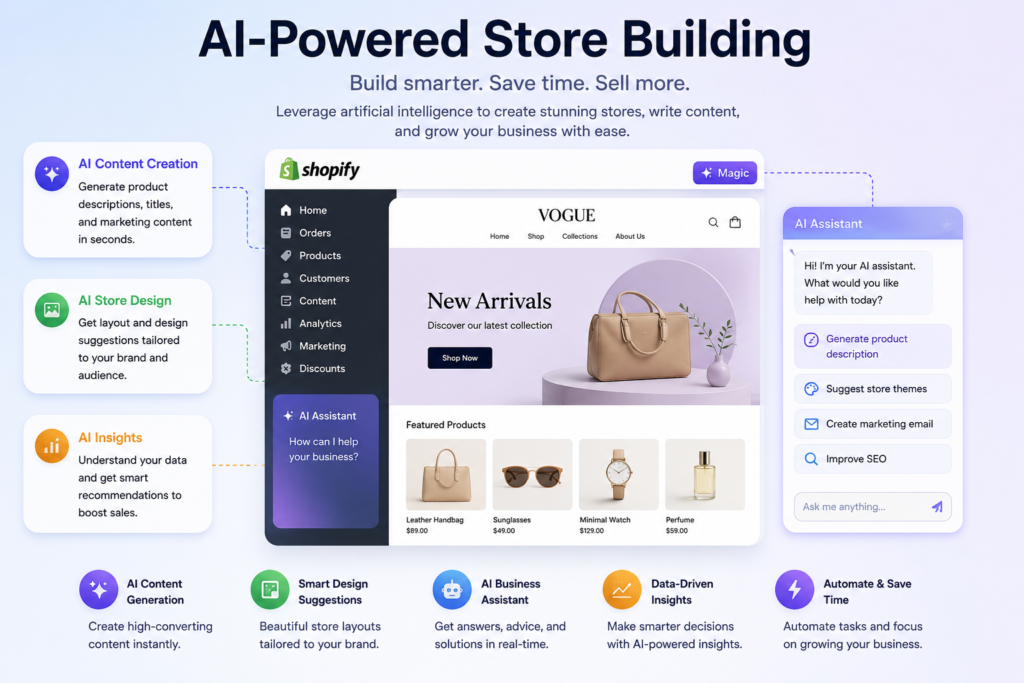
AI-Powered Store Building
Artificial intelligence has become one of Shopify’s most valuable strengths in 2026. Instead of simply offering a drag-and-drop website builder, Shopify now provides AI tools that actively assist merchants in building, managing, and growing their businesses. Two of the platform’s flagship innovations—Shopify Magic and Sidekick—have significantly reduced the time required to launch and operate an online store. Shopify Magic helps generate compelling product descriptions, write email campaigns, create blog content, suggest SEO-friendly metadata, and improve customer communication. Rather than staring at a blank screen wondering what to write, merchants can generate polished content in seconds and then customize it to match their brand voice. This is especially valuable for small businesses that lack dedicated marketing or content teams.
Sidekick functions as an AI-powered business assistant capable of answering questions, analyzing sales trends, recommending inventory adjustments, explaining reports, and helping merchants navigate Shopify’s extensive feature set. Instead of searching through documentation, users can ask conversational questions such as, “Why did sales decline this week?” or “Which products should I promote this month?” and receive intelligent recommendations. This dramatically shortens the learning curve for beginners while helping experienced merchants make data-driven decisions more quickly. AI also improves customer experience by enabling personalized product recommendations, automated customer support responses, and smarter merchandising strategies. These features collectively allow merchants to focus on growing their business rather than spending hours on repetitive administrative tasks.
Beyond content generation, Shopify has integrated AI into store design and operational workflows. Merchants can receive suggestions for homepage layouts, product categorization, discount strategies, and marketing campaigns based on store performance and customer behavior. AI-driven analytics help identify best-selling products, predict inventory needs, and uncover opportunities for upselling or cross-selling. As ecommerce competition continues to intensify, these intelligent tools provide merchants with a measurable advantage by transforming raw business data into practical actions. Rather than replacing human creativity, Shopify’s AI capabilities act as a productivity partner that helps businesses operate more efficiently and respond more effectively to changing market conditions.
Themes, Customization, and Design
A professional-looking storefront is essential for building trust and encouraging conversions, and Shopify excels in this area by offering a wide range of beautifully designed themes. The Shopify Theme Store includes both free and premium templates that cater to industries such as fashion, electronics, furniture, beauty, food, digital products, and many others. Every theme is mobile responsive by default, ensuring that customers enjoy a smooth shopping experience regardless of whether they browse from a desktop computer, tablet, or smartphone. Since mobile commerce now accounts for a significant share of online sales worldwide, this responsive design approach has become a necessity rather than a luxury.
Customization is another area where Shopify strikes an impressive balance between simplicity and flexibility. Beginners can modify colors, typography, layouts, banners, and product pages using an intuitive visual editor without touching any code. Business owners can rearrange sections through drag-and-drop controls, preview changes in real time, and publish updates instantly. This enables merchants to create attractive, professional storefronts even without web design experience. At the same time, developers have access to Shopify’s Liquid templating language, APIs, custom CSS, and JavaScript, allowing them to build highly customized shopping experiences for brands with unique requirements.
Performance remains a major advantage of Shopify’s themes. Because all themes are optimized for Shopify’s hosting infrastructure, merchants benefit from fast loading speeds, clean code, and reliable compatibility across updates. Regular theme updates also ensure continued security, performance improvements, and support for newly released Shopify features. Businesses seeking stronger brand identity can further customize their stores with custom fonts, animations, interactive product galleries, and enhanced navigation while maintaining excellent usability. This combination of user-friendly design tools and advanced developer capabilities makes Shopify suitable for entrepreneurs launching their first online store as well as established brands seeking sophisticated ecommerce experiences.
Inventory and Order Management
Efficient inventory management is crucial for maintaining customer satisfaction and preventing costly mistakes, and Shopify provides a comprehensive suite of tools designed to simplify this process. Merchants can monitor stock levels in real time, organize products into collections, manage multiple product variants such as size and color, and receive automatic notifications when inventory reaches predefined thresholds. This minimizes the risk of overselling popular products or unexpectedly running out of stock. Businesses with multiple warehouses or retail locations can also synchronize inventory across different sales channels, ensuring that stock information remains accurate regardless of where purchases occur.
Order management within Shopify is equally streamlined. Every customer order appears in a centralized dashboard where merchants can process payments, print invoices, generate shipping labels, fulfill orders, and communicate with customers throughout the purchasing journey. Automated workflows further reduce manual effort by assigning fulfillment tasks, updating order statuses, sending shipping confirmations, and triggering follow-up emails. These capabilities become increasingly valuable as businesses scale because they reduce administrative workload while maintaining operational accuracy. Integration with major shipping carriers allows merchants to compare shipping rates, purchase discounted labels, and track deliveries without leaving the Shopify dashboard.
Another significant advantage is Shopify’s support for multichannel inventory synchronization. Whether products are sold through the online store, physical retail locations, marketplaces, or social commerce platforms, Shopify automatically updates stock quantities across all connected channels. This centralized inventory management prevents discrepancies that can damage customer trust and simplifies reporting by consolidating sales data into one location. Combined with barcode support, purchase order management, inventory forecasting, and advanced analytics available through various apps, Shopify equips businesses with the operational infrastructure necessary to support sustainable growth.
Marketing and SEO Tools
Creating an attractive online store is only the beginning; attracting customers is equally important. Shopify addresses this challenge by providing a wide range of integrated marketing and SEO tools that help merchants increase visibility, attract qualified traffic, and improve conversion rates. Built-in SEO features automatically generate clean URLs, customizable title tags, meta descriptions, XML sitemaps, canonical tags, and mobile-friendly page structures that align with modern search engine optimization best practices. Merchants can optimize product pages, collections, blog articles, and landing pages without requiring specialized technical knowledge.
Shopify also supports content marketing through its integrated blogging platform, enabling businesses to publish educational articles, buying guides, industry news, and promotional content that attracts organic search traffic. Combined with AI-assisted writing tools, merchants can consistently produce optimized content while maintaining their brand voice. Integration with analytics platforms provides valuable insights into visitor behavior, conversion rates, traffic sources, and customer demographics, helping businesses refine their marketing strategies based on real performance data instead of assumptions.
Marketing automation further strengthens Shopify’s capabilities. Merchants can create email campaigns, recover abandoned carts, launch promotional discounts, build customer segments, and schedule seasonal campaigns directly within the platform. Native integrations with social media platforms enable businesses to sell products through Facebook, Instagram, TikTok, and other digital channels while synchronizing inventory and order data automatically. Thousands of additional marketing applications are available through the Shopify App Store, covering influencer marketing, loyalty programs, referral systems, subscriptions, SMS campaigns, customer reviews, and advanced SEO optimization. This extensive ecosystem allows businesses to expand their marketing capabilities as they grow without migrating to another platform.
Shopify Pricing Explained
Pricing plays a significant role when selecting an ecommerce platform because long-term operating costs can directly affect profitability. Shopify offers multiple subscription plans designed to accommodate businesses of different sizes, ranging from individual entrepreneurs launching their first online store to multinational enterprises processing millions of dollars in annual sales. Each plan includes secure hosting, unlimited products, abandoned cart recovery, sales channel integrations, analytics, and continuous software updates, although advanced reporting, staff accounts, and automation features increase with higher-tier subscriptions.
Plan | Best For | Key Features |
Basic | New businesses | Online store, payment processing, reporting |
Grow | Growing businesses | Lower transaction fees, better analytics |
Advanced | Scaling businesses | Advanced reports, international selling tools |
Plus | Enterprise brands | Custom checkout, automation, B2B capabilities |
Beyond the monthly subscription fee, merchants should also consider transaction fees, premium themes, paid applications, custom development, domain registration, and marketing expenses. Although Shopify includes many built-in capabilities, specialized businesses often install additional apps to extend functionality, which can gradually increase operating costs. Premium themes may require a one-time purchase, while advanced marketing or inventory management apps frequently operate on recurring subscription models.
Even with these additional expenses, many businesses find Shopify cost-effective because it eliminates hosting fees, server maintenance, security updates, software licensing, and many technical responsibilities associated with self-hosted ecommerce platforms. Instead of hiring developers to manage infrastructure, merchants can focus their budgets on customer acquisition, product development, and business expansion. When evaluating total cost of ownership rather than subscription price alone, Shopify often proves to be an efficient investment for businesses seeking reliability, scalability, and operational simplicity.
Hidden Costs to Consider
Although Shopify is transparent about its subscription plans, it’s important to understand that running a successful ecommerce business involves more than paying the monthly platform fee. Depending on your business needs, additional costs may arise from premium themes, third-party apps, domain registration, email marketing tools, custom development, and advertising campaigns. While Shopify includes many essential features, businesses with complex requirements often rely on apps for advanced SEO, subscriptions, loyalty programs, product customization, or accounting integrations. Since many apps charge monthly fees, merchants should periodically review their installed apps to avoid paying for tools they no longer use.
Payment processing fees are another consideration. Merchants using Shopify Payments generally avoid extra transaction fees, while those choosing external payment gateways may incur additional charges depending on their subscription plan. Businesses selling internationally should also consider currency conversion fees and cross-border payment costs. Shipping expenses can vary based on carrier rates, package dimensions, destination countries, and fulfillment strategies. Shopify partners with major shipping providers to offer discounted shipping labels, helping reduce logistics costs, but merchants should still calculate these expenses when planning their pricing strategy.
Marketing represents another significant investment. Building an online store does not automatically generate customers, so businesses often allocate budgets for Google Ads, social media advertising, influencer partnerships, email marketing, and content creation. Fortunately, Shopify integrates seamlessly with major marketing platforms, making campaign management much easier. Even with these additional costs, many merchants find Shopify offers strong value because hosting, security, updates, scalability, and technical maintenance are already included in the subscription, reducing the need for separate infrastructure expenses.
Shopify Pros and Cons
Every ecommerce platform has strengths and weaknesses, and Shopify is no exception. Understanding both sides helps merchants determine whether it aligns with their specific business goals rather than relying solely on marketing claims.
Advantages
Shopify’s biggest advantage is its ease of use. Entrepreneurs can launch a professional-looking online store without needing programming knowledge, making it accessible for beginners while still offering advanced customization for developers. The platform provides secure cloud hosting, automatic updates, SSL certificates, unlimited bandwidth, and reliable uptime, allowing business owners to focus on sales instead of server management. Its intuitive interface, combined with AI-powered tools like Shopify Magic and Sidekick, significantly reduces the time required to create product listings, marketing content, and customer communications.
Another major benefit is scalability. Shopify supports businesses ranging from small startups to global enterprises processing millions of orders annually. Features such as multichannel selling, international commerce, inventory synchronization, subscription management, and enterprise-grade checkout infrastructure enable merchants to expand without switching platforms. The extensive Shopify App Store further enhances flexibility, offering thousands of integrations covering marketing, accounting, fulfillment, customer service, analytics, and automation.
Security is another standout strength. Shopify maintains PCI DSS compliance, automatic security updates, fraud analysis tools, encrypted payment processing, and reliable cloud infrastructure. These features reduce the technical burden on merchants while improving customer trust. Combined with excellent mobile optimization, fast page loading speeds, and strong SEO foundations, Shopify provides a comprehensive ecosystem for modern ecommerce businesses.
Disadvantages
Despite its many strengths, Shopify is not perfect. Monthly subscription costs may become relatively expensive for very small businesses compared to some open-source alternatives, especially after adding premium themes and paid applications. Businesses with highly specialized requirements may also need custom development or third-party apps, increasing ongoing operating expenses.
Content management capabilities, while improving, remain less flexible than dedicated website platforms such as WordPress. Businesses focused heavily on publishing complex editorial content may find Shopify’s blogging system somewhat limited. Custom checkout modifications are also restricted on lower-tier plans, with certain advanced features reserved for Shopify Plus merchants.
Some merchants also feel constrained by Shopify’s ecosystem compared to fully self-hosted solutions. While the platform emphasizes simplicity and stability, developers seeking unrestricted server access or deep backend customization may prefer open-source alternatives. However, for the vast majority of businesses prioritizing reliability, security, and ease of management, these limitations are relatively minor compared to the benefits Shopify provides.
Shopify Performance, Security, and Support
Performance directly affects customer experience, search engine rankings, and conversion rates, making it one of Shopify’s strongest competitive advantages. Since Shopify operates on a globally distributed cloud infrastructure, stores benefit from fast loading speeds, automatic scaling during traffic spikes, content delivery networks (CDNs), and optimized image delivery. Merchants do not need to configure caching systems or upgrade hosting servers during busy shopping seasons because Shopify manages infrastructure automatically behind the scenes.
Security remains equally impressive. Every Shopify store includes SSL encryption, secure payment processing, PCI DSS compliance, automatic software updates, fraud detection tools, and continuous monitoring against emerging threats. This proactive security approach significantly reduces the risk of data breaches compared to self-managed ecommerce platforms where merchants are responsible for applying updates and maintaining server security. Customers gain greater confidence knowing their payment information is processed through a trusted and secure environment.
Customer support is available 24/7 through live chat, email, and extensive online documentation. Shopify’s Help Center contains thousands of articles, tutorials, and step-by-step guides covering everything from store setup to advanced customization. The Shopify Community Forum also provides valuable peer support where experienced merchants share solutions and best practices. Businesses requiring specialized assistance can hire certified Shopify Experts for custom development, marketing, store optimization, or migration projects.
Shopify vs Competitors
Choosing an ecommerce platform often involves comparing Shopify with other popular solutions. Each platform offers unique strengths, but Shopify consistently performs well across usability, scalability, and integrated functionality.
Feature | Shopify | WooCommerce | Wix | BigCommerce |
Ease of Use | ⭐⭐⭐⭐⭐ | ⭐⭐⭐ | ⭐⭐⭐⭐⭐ | ⭐⭐⭐⭐ |
Hosting Included | Yes | No | Yes | Yes |
AI Features | Excellent | Limited | Good | Good |
Scalability | Excellent | Excellent | Moderate | Excellent |
App Ecosystem | Extensive | Extensive | Moderate | Good |
Technical Maintenance | Very Low | High | Very Low | Low |
Shopify vs WooCommerce
WooCommerce provides greater flexibility because it is open source, but merchants must manage hosting, security, updates, backups, and plugin compatibility themselves. Shopify removes these responsibilities by offering a fully managed cloud platform, making it ideal for entrepreneurs who prefer focusing on business growth rather than technical maintenance.
Shopify vs Wix
Wix excels as a beginner-friendly website builder but offers fewer advanced ecommerce features compared to Shopify. Businesses planning long-term growth generally benefit from Shopify’s superior inventory management, international selling capabilities, automation tools, and app marketplace.
Shopify vs BigCommerce
BigCommerce is a capable enterprise-focused platform with strong built-in features. However, Shopify typically offers a more intuitive interface, larger developer community, richer app ecosystem, and broader selection of themes, making it the preferred choice for many growing businesses.
Is Shopify Worth It in 2026?
For most entrepreneurs, the answer is yes. Shopify continues to be one of the strongest ecommerce platforms available because it successfully balances simplicity, performance, scalability, and innovation. Beginners can launch stores quickly without technical expertise, while established businesses benefit from enterprise-grade infrastructure capable of supporting global operations. The platform’s continuous investment in artificial intelligence, automation, and international commerce demonstrates a clear commitment to future growth rather than merely maintaining existing functionality.
Businesses that prioritize reliability, fast deployment, secure payments, and integrated marketing tools will find exceptional value in Shopify. Although additional costs from apps and premium services should be considered, the platform often reduces overall operational complexity enough to justify the investment. Instead of spending valuable time maintaining servers or troubleshooting software conflicts, merchants can concentrate on attracting customers, improving products, and expanding their brand.
Whether you’re starting your first ecommerce business or migrating from another platform, Shopify provides a well-rounded solution capable of supporting long-term success. Its extensive ecosystem, continuous innovation, and strong reputation make it one of the safest investments for online entrepreneurs entering 2026.
Conclusion
Shopify remains one of the most complete ecommerce platforms available in 2026, offering an outstanding combination of ease of use, powerful features, AI-driven automation, secure infrastructure, and impressive scalability. From launching a simple online boutique to managing a global enterprise selling across multiple channels, Shopify provides the tools necessary to support every stage of business growth. Its constantly expanding ecosystem of themes, apps, integrations, and AI assistants ensures merchants can adapt to changing customer expectations without abandoning the platform.
While businesses should carefully evaluate subscription costs, premium applications, and marketing expenses, Shopify continues to deliver exceptional value through reliable hosting, automatic security updates, excellent performance, and comprehensive business management tools. For entrepreneurs seeking a future-ready ecommerce platform that minimizes technical complexity while maximizing growth opportunities, Shopify remains one of the strongest choices available today.
Read Also:
Frequently asked questions
Yes. Shopify is specifically designed for users without coding experience and offers an intuitive interface, AI assistance, and step-by-step store setup.
Absolutely. Shopify supports multiple currencies, international domains, localized payment methods, and global shipping integrations.
Yes. Every Shopify subscription includes secure cloud hosting, SSL certificates, automatic updates, and unlimited bandwidth.
Yes. Shopify provides built-in SEO features such as customizable meta tags, clean URLs, XML sitemaps, mobile optimization, and fast-loading pages.
For most businesses, yes. The platform combines ease of use, scalability, security, AI-powered tools, and extensive integrations, making it an excellent long-term investment for online sellers.