
Building a website today is easier than ever, but creating a successful online presence requires more than just designing attractive pages. Every website needs two essential foundations: a domain name and reliable web hosting. Think of your domain as your digital address and web hosting as the land where your online home is built. Without both working together, visitors cannot find or access your website properly.
For businesses, freelancers, bloggers, and entrepreneurs, choosing the right hosting provider can directly influence website speed, security, uptime, and user experience. A slow or unreliable website can quickly drive visitors away, while a professional hosting environment can help a brand establish trust and improve online visibility.
Among the many hosting providers available in Spain, Hostalia ES has become a recognized option for users looking for domain registration, hosting solutions, email services, and digital tools to create and manage websites. The platform focuses on helping individuals and businesses establish their online identity without requiring advanced technical knowledge.
This complete guide explores everything you need to know about web hosting, domains, and Hostalia ES services. Whether you are launching your first website, creating an online store, or looking for better hosting for an existing project, understanding these concepts will help you make smarter decisions.
Table of Contents
ToggleUnderstanding Web Hosting and Domains
Before choosing any hosting provider, it is important to understand how websites actually work. Many beginners purchase a domain and hosting package without knowing the difference between them. Although they are connected, they perform completely different roles.
A website needs a place where its files, images, databases, and applications can be stored. This storage service is called web hosting. When someone enters your website address into a browser, the hosting server delivers your website content to that visitor.
A domain name, on the other hand, is the address people type to reach your website. Instead of remembering complicated numerical IP addresses, users can simply enter an easy-to-remember name such as yourbrand.com.
Together, hosting and domains create the complete foundation of a website. The domain helps people discover you, while hosting ensures your website is available whenever visitors arrive.
What Is Web Hosting and Why Does Your Website Need It?
Web hosting is a service that provides server space where your website files are stored and managed. A hosting company maintains powerful computers called servers that remain connected to the internet continuously. These servers allow visitors from anywhere in the world to access your website.
Imagine opening a physical shop. Before customers can visit, you need a location, electricity, security, and maintenance. Web hosting works in a similar way. It provides the digital environment where your website operates.
Different websites have different hosting requirements. A personal blog with a few visitors each day does not need the same resources as a large online store receiving thousands of customers.
Common types of hosting include:
- Shared Hosting: Multiple websites share resources on one server. It is affordable and suitable for beginners.
- VPS Hosting: A virtual private server provides dedicated resources and more control.
- Dedicated Hosting: An entire server is reserved for one website, offering maximum performance.
- Cloud Hosting: Website resources are distributed across multiple servers for better flexibility and reliability.
For new website owners, shared hosting is often the starting point because it provides essential features at a lower cost. As a website grows, users can upgrade to more powerful solutions.
A good hosting provider should offer fast loading speeds, strong security, regular backups, technical support, and high uptime. These factors affect not only visitor experience but also search engine performance because website speed and reliability are important ranking considerations.
What Is a Domain Name and How Does It Work?
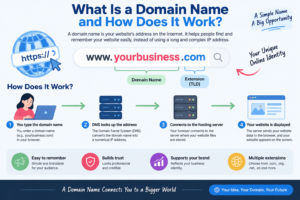
A domain name is the unique address that identifies your website on the internet. Every website needs a domain because it allows visitors to find and remember the site easily.
Without domains, users would need to enter complex IP addresses to access websites. Domains simplify this process by converting technical server information into human-friendly names.
A domain usually contains two main parts:
- Name: The unique identity of your website.
- Extension: The ending part such as .com, .es, .org, or .net.
For businesses operating in Spain, a country-specific extension like .es can help create a stronger local connection with Spanish customers. A domain extension can influence how users perceive a website and can support regional branding strategies.
Choosing the right domain name is similar to selecting a company name. It should be simple, memorable, easy to spell, and connected with your brand or purpose.
A strong domain name can help users remember your business and return later. A confusing or complicated domain may make it harder for potential customers to find you again.
Introducing Hostalia ES: A Spanish Web Hosting and Domain Provider
Hostalia ES is a Spanish digital service provider focused on helping individuals and businesses create their online presence. The company provides solutions related to domain registration, web hosting, professional email, website creation tools, and online business services.
For many small businesses, the biggest challenge is not only creating a website but managing the technical requirements behind it. Hosting providers like Hostalia aim to simplify this process by offering integrated solutions where users can purchase domains, connect hosting, create email accounts, and manage websites from one platform.
The advantage of using a local provider is that customers may receive services designed for their regional market, including Spanish-language support and domain options suitable for local businesses.
Hostalia’s Role in Helping Businesses Build an Online Presence
A modern business website acts as a digital storefront. Whether a company sells products, provides professional services, or shares information, having a reliable online platform helps customers discover and interact with the brand.
Hostalia ES supports this process by providing tools that allow businesses to move from an idea to a functioning website.
For example, a small business owner can:
- Register a suitable domain name.
- Select a hosting plan according to website requirements.
- Create professional email addresses.
- Install website management platforms.
- Maintain online services through hosting tools.
This approach reduces the technical barriers that often discourage beginners from creating websites.
A reliable hosting provider becomes a long-term technology partner. As businesses expand, their hosting needs may also change. Having flexible upgrade options allows websites to grow without requiring a complete migration to another platform.

Main Services Offered by Hostalia ES
When choosing a hosting provider, users usually look beyond basic server space. A complete digital solution should include everything required to launch, manage, and maintain a website. Hostalia ES provides a range of services designed to support different types of users, from individuals creating their first website to companies managing professional online platforms.
One of the main services offered is domain registration. A domain is the first step toward creating an online identity because it gives businesses a recognizable address on the internet. Hostalia allows users to search for available domain names and register extensions suitable for different purposes, including business websites, personal projects, and local Spanish businesses.
Another important service is web hosting, which provides the infrastructure needed to store website files and make them accessible online. Hosting plans are generally designed around different levels of website requirements. A small portfolio website, a growing business website, and an online store all require different amounts of storage, performance, and technical resources.
Professional email services are also an essential part of business communication. Instead of using generic email addresses, companies can create custom email accounts connected to their domain. For example, an address like contact@yourbusiness.com creates a more professional image compared with free email services.
Website security is another major consideration. Modern hosting solutions often include features such as SSL certificates, backups, malware protection, and account management tools. These features help protect websites from common online threats while improving visitor confidence.
Types of Web Hosting Available with Hostalia ES
Selecting the right hosting plan depends on the size, purpose, and expected traffic of a website. Choosing too little capacity can create performance problems, while choosing unnecessary resources can increase costs without providing extra benefits.
Understanding different hosting options helps website owners select a solution that matches their current needs while allowing room for future growth.
Shared Hosting for Beginners and Small Websites
Shared hosting is one of the most common choices for beginners because it provides an affordable way to start a website. In this type of hosting, multiple websites operate on the same physical server and share resources such as processing power, memory, and storage.
For new bloggers, small businesses, freelancers, and personal websites, shared hosting is often enough to handle normal visitor traffic. Users do not need advanced server management skills because the hosting provider handles much of the technical maintenance.
The biggest advantage of shared hosting is simplicity. A beginner can purchase a plan, connect a domain, install a content management system, and start publishing content without dealing with complicated server configurations.
However, shared hosting also has limitations. Since resources are shared between multiple websites, very high-traffic websites may experience performance challenges. As a website grows, upgrading to a more powerful hosting solution may become necessary.
Shared hosting works best for:
- Personal blogs
- Small company websites
- Portfolio websites
- Local business pages
- Informational websites
For many users starting their online journey, shared hosting provides the right balance between affordability and functionality.
VPS Hosting for Growing Online Projects
A Virtual Private Server (VPS) provides a more advanced hosting environment compared with shared hosting. Although multiple websites may still exist on the same physical server, each VPS receives dedicated resources and operates in an isolated environment.
VPS hosting is suitable for businesses that need more control, better performance, or additional customization options. Developers, online stores, and growing websites often choose VPS solutions because they provide greater flexibility.
With VPS hosting, users can usually configure software environments, manage applications, and optimize server settings according to their requirements. This makes VPS hosting popular among users who have technical knowledge or need specialized solutions.
The benefits of VPS hosting include:
- Better performance compared with shared hosting
- More control over server settings
- Improved scalability
- Dedicated resources
- Enhanced stability
For a website experiencing increasing visitors or requiring special applications, VPS hosting can provide the additional power needed to maintain a smooth user experience.
Common Mistakes to Avoid When Buying Hosting and Domains
Many beginners make mistakes when starting their first website. Understanding these mistakes can save time, money, and frustration.
Choosing a Domain Without Planning
A domain name should support your brand identity. Changing domains later can confuse customers and affect online visibility.
Avoid selecting random names that do not represent your business purpose.
Buying Hosting Based Only on Price
Low-cost hosting can appear attractive, but extremely cheap plans may lack important features such as security tools, reliable support, or sufficient resources.
The goal should be finding good value rather than simply choosing the lowest price.
Ignoring Website Security
Some website owners focus only on design and content while ignoring security. This can create serious problems.
Using SSL protection, strong passwords, backups, and updated software helps protect your website.
Not Planning for Growth
A website that succeeds may need more resources in the future. Choosing a provider with upgrade options prevents unnecessary migration problems.
A hosting decision should consider where your website is today and where it could be tomorrow.
Choosing the Right Domain Name with Hostalia ES
A domain name is more than just a website address. It represents a brand, creates the first impression, and helps customers remember a business. Selecting the right domain requires careful consideration because changing a domain later can affect branding and online visibility.
A good domain should be short, meaningful, and easy to communicate. If customers cannot easily remember or spell a domain, they may struggle to return to the website.
For example, a company selling handmade products would benefit from a domain related to its brand identity rather than a random combination of letters and numbers.
Domain Extensions and Their Importance
Domain extensions are the letters that appear after the main domain name. They provide additional information about the website’s purpose or location.
Common examples include:
Domain Extension | Common Purpose |
.com | General businesses and international websites |
.es | Spanish websites and businesses targeting Spain |
.org | Organizations and communities |
.net | Technology and network-related websites |
.shop | Online stores |
For businesses focused on Spanish customers, a .es domain can create stronger local recognition. Customers often feel more connected to websites that match their region or language.
However, the best extension depends on the business strategy. A company planning global expansion may prefer an international extension, while a local Spanish business may find a country-specific domain more suitable.
Tips for Selecting a Professional Domain Name
Choosing a domain name requires creativity and planning. Many popular names are already registered, so businesses need to find alternatives that remain memorable.
Useful tips include:
- Keep it simple: Short names are easier to remember.
- Avoid complicated spelling: Customers should be able to type it easily.
- Use brand-focused words: A domain should represent your business identity.
- Avoid unnecessary numbers and symbols: They can create confusion.
- Think long-term: Choose a name that can support future business growth.
A domain is a long-term digital asset. A carefully selected name can strengthen brand recognition and improve customer trust.
Comparing Web Hosting Options Before Making a Decision
The hosting market includes many different providers and solutions. Before making a decision, users should compare important factors instead of choosing only based on advertisements or low prices.
Hosting Type | Best For | Main Advantage | Possible Limitation |
Shared Hosting | Beginners and small websites | Affordable and easy to manage | Limited resources |
VPS Hosting | Growing businesses | More control and performance | Requires more technical knowledge |
Dedicated Hosting | Large websites | Maximum resources | Higher cost |
Cloud Hosting | Flexible projects | Scalability and reliability | Pricing can vary |
A good hosting provider should offer a balance between performance, affordability, security, and customer support.
Businesses should also consider the provider’s reputation, available features, and ability to support future growth.
Step-by-Step Guide to Creating a Website with Hostalia ES
Creating a website may seem complicated at first, but modern hosting platforms have simplified the process. With the right steps, beginners can launch a professional website without needing advanced programming knowledge.
Step 1: Choose and Register Your Domain Name
The first step is selecting a domain name that represents your brand or project. The domain should be memorable, relevant, and easy for visitors to type.
Before registering, check whether the domain is available. If your preferred name is already taken, consider alternative versions while keeping the brand identity clear.
A strong domain creates the foundation for your online presence.
Step 2: Select a Suitable Hosting Plan
After choosing a domain, the next step is selecting hosting according to your website requirements.
Consider questions like:
- How many visitors do you expect?
- Will you upload many images or videos?
- Do you plan to create an online store?
- Do you need special software or databases?
A simple blog may require fewer resources than an e-commerce website with hundreds of products.
Choosing the right hosting plan prevents unnecessary expenses while ensuring good performance.
Step 3: Connect Your Domain with Hosting
After purchasing hosting, the domain needs to be connected to the server where your website files will be stored.
This process allows browsers to understand where your website is located. Once the connection is completed, visitors can access your website using your domain name.
Hosting dashboards usually provide tools to simplify domain management, making this process easier for beginners.
Step 4: Install or Build Your Website
The next step is creating website content. Users can choose different approaches depending on their technical knowledge.
Options may include:
- Using a content management system like WordPress
- Creating a custom website with coding
- Using website-building tools
- Hiring a professional developer
A content management system is often preferred by beginners because it allows users to create pages, publish articles, and manage content without extensive coding.
Step 5: Secure and Optimize Your Website
After launching the website, security and performance optimization become ongoing tasks.
Important actions include:
- Activating SSL protection
- Creating regular backups
- Updating website software
- Compressing images
- Monitoring website performance
A website is not something that can simply be created and forgotten. Regular maintenance keeps it secure and effective.
Key Features That Make Hostalia ES a Popular Choice
A hosting provider’s quality depends on more than just offering server space. Website owners need reliability, security, customer support, and tools that simplify website management.
Hostalia ES focuses on providing solutions that make website creation and management accessible for different types of users.
Website Performance and Reliability
Website speed plays an important role in user experience. Visitors expect pages to load quickly, and slow websites can negatively affect engagement.
Reliable hosting infrastructure helps websites remain accessible and responsive. Important performance factors include server resources, optimization tools, uptime, and technical maintenance.
A website that loads quickly creates a better experience for visitors. It also helps businesses maintain professional credibility because customers often associate website quality with business reliability.
For online stores, performance is especially important. A slow checkout process or unavailable website can result in lost sales and frustrated customers.
Security Tools and Backup Solutions
Online security has become one of the biggest concerns for website owners. Websites can face risks such as malware attacks, unauthorized access attempts, and data loss.
Good hosting providers include security features that help reduce these risks. These may include:
- SSL certificates for encrypted connections
- Regular backups
- Account protection tools
- Malware monitoring
- Secure server environments
Backups are especially important because unexpected issues can happen at any time. A backup allows website owners to restore their website if files are accidentally deleted or damaged.
Security should not be considered optional. A website represents a business’s reputation, customer information, and digital assets.
How Hostalia ES Supports Businesses and Entrepreneurs
The digital world has changed the way businesses communicate with customers. A website is no longer just an optional marketing tool; it has become an essential platform for building trust, sharing information, generating leads, and selling products or services. Whether someone runs a small local business, a startup, or an established company, having a reliable online presence can create new opportunities.
Hostalia ES supports businesses by providing tools that simplify the process of creating and managing websites. Many entrepreneurs have excellent ideas but hesitate to build websites because they believe technical skills are required. Modern hosting platforms reduce this complexity by combining domain registration, hosting services, email solutions, and website management tools in one place.
For small businesses, professional email addresses connected to a domain can make a significant difference. Customers often view domain-based communication as more trustworthy because it reflects a serious business identity. A message from a branded email address creates a stronger impression than a general free email account.
Entrepreneurs can also benefit from hosting solutions that allow their websites to grow gradually. A new business may begin with a simple informational website, but as customer demand increases, it may require additional features such as online stores, booking systems, customer portals, or advanced applications.
A flexible hosting provider allows businesses to upgrade resources as their needs change. Instead of rebuilding everything from the beginning, companies can expand their online infrastructure while maintaining their existing brand identity.
For freelancers and professionals, a website hosted with a reliable provider can serve as a digital portfolio. Designers, developers, consultants, photographers, and other professionals can showcase their work, attract clients, and create stronger personal branding.
Future of Web Hosting and Domain Services
The web hosting industry continues to evolve as businesses demand faster, safer, and more flexible digital solutions. New technologies such as cloud computing, automation, artificial intelligence, and advanced security systems are changing how websites are created and managed.
Cloud-based infrastructure is becoming increasingly important because it allows websites to handle changing traffic levels more efficiently. Instead of depending on a single server, cloud solutions can distribute resources across multiple systems.
Artificial intelligence is also influencing website management. AI-powered tools can help with website optimization, security monitoring, customer support, and content management.
Security will remain a major priority as cyber threats continue to develop. Hosting providers are expected to invest more in automated protection systems, better backup solutions, and stronger monitoring tools.
Domains are also becoming more diverse. Businesses now have access to many specialized domain extensions that allow them to create more targeted digital identities.
For companies like Hostalia ES, the future involves providing simple, secure, and scalable solutions that allow more people to participate in the digital economy.
Conclusion
Web hosting and domains are the foundation of every successful website. A domain gives your business a recognizable online identity, while hosting provides the technology needed to make your website accessible to visitors around the world.
Hostalia ES offers solutions designed to help individuals, entrepreneurs, and businesses create and manage their online presence. From domain registration and hosting services to professional email and website management tools, these services help simplify the process of building a digital platform.
Choosing the right hosting provider requires understanding your goals, comparing available features, and considering future growth. A website is not just a collection of pages; it is a long-term investment in your brand, communication, and business development.
Whether you are starting a personal blog, launching a company website, or expanding an online business, selecting reliable hosting and the right domain name is an important step toward creating a strong digital future.
Read Also:
Why Businesses Are Exploring Digital Solutions Offered by Z.com
Top Features to Look for When Shopping at Backfire Boards
Discover Trending Asian Beauty Products and Skincare at Stylevana
Trending Outfit Ideas and Style Inspiration from Hello Molly UK
Top Benefits of Choosing Jackery UK for Portable Energy Needs
Frequently asked questions
A domain is the address people use to find your website, while web hosting is the service that stores your website files and makes them available online. Both are required for a website to function properly.
Yes, hosting providers like Hostalia ES are designed to support beginners by offering domain registration, hosting management tools, and services that reduce technical complexity.
A small business website usually starts well with shared hosting because it provides essential features at an affordable cost. As the business grows, upgrading to VPS or more advanced hosting may become necessary.
A professional domain improves brand recognition, creates trust, and makes it easier for customers to remember and find your business online.
Not always. Consider customer reviews, rental conditions, vehicle size, and total costs before making your final choice.