

Discover why OFX is a popular choice for international money transfers, offering competitive exchange rates, global currency support, convenient online transactions, and dedicated customer support. Explore the key features, fees, security measures, and benefits of OFX to understand how it helps individuals and businesses manage cross-border payments efficiently.
Table of Contents
ToggleUnderstanding OFX and Its International Transfer Services
Sending money across borders can be complicated by exchange rates, bank charges, payment delays, and different financial regulations. Whether you are supporting family overseas, paying an international supplier, or managing savings after relocating to another country, choosing the right transfer provider can make a difference. OFX is an international money transfer and foreign exchange company that helps individuals and businesses send money between countries. Its services provide an alternative to arranging international payments exclusively through traditional banks.
OFX has operated for more than 25 years and reports serving over one million customers, with transfers available in more than 50 currencies across over 180 countries. Its services include international bank transfers, foreign currency exchange, and currency management solutions for businesses. These features make it particularly relevant to people and organisations that transfer larger amounts, make regular overseas payments, or manage international financial commitments.
One of OFX’s main attractions is its combination of online convenience and customer assistance. Customers can request exchange rate quotes, arrange transfers, and monitor payments digitally. Customer support is also available for people who need help with their transactions. However, fees, transfer limits, supported currencies, and eligibility requirements depend on the country and account involved, so it is important to review the applicable terms before sending money.
Why OFX Appeals to International Money Transfer Users
The popularity of an international money transfer service often depends on a few practical questions. How much will the recipient receive? How long will the transfer take? Is the service reliable? Can someone provide assistance if a payment encounters a problem? OFX aims to address these concerns through foreign exchange pricing, international payment coverage, online account management, and customer support. These features can be particularly useful when transferring substantial amounts or arranging recurring payments.
Another reason customers consider OFX is that international transfers involve more than the advertised transaction fee. A provider might charge a low upfront fee but offer a less favourable exchange rate, reducing the final amount received by the beneficiary. OFX provides customers with an exchange rate quote before they confirm a transfer, allowing them to review the conversion details in advance.
Exchange rates can have a significant effect on international payments. Imagine paying overseas university fees, purchasing property abroad, or settling an invoice for imported goods. Even a small difference in the exchange rate can change the final cost. OFX allows customers to examine the quoted rate and applicable charges before proceeding, helping them make a more informed decision. However, comparing quotes from different providers remains essential because the most suitable option depends on the specific transaction.
Competitive Exchange Rates and Transparent Fees
Exchange rates are among the most important factors influencing international transfer costs. When money moves from one currency to another, the exchange rate determines how much the recipient receives. Banks and specialist transfer providers may use different pricing models, meaning two services can produce different results even when their advertised fees appear similar. OFX promotes competitive exchange rates and enables customers to review the rate offered for their transaction.
It is important to understand the difference between the market exchange rate and the rate offered to a customer. The market rate provides a useful benchmark, but it is not necessarily the rate available for an individual transfer. OFX’s customer exchange rate includes a margin, and the exact rate may vary depending on the currencies, transfer amount, and market conditions.
Transfer fees also deserve attention. Depending on the market and transaction, OFX may charge a separate transfer fee or offer a transfer without one. Intermediary banks and recipient banks may also deduct charges on certain payment routes. Before confirming a payment, check the exchange rate, the amount you must pay, any applicable fees, and the estimated amount the recipient will receive. This approach provides a clearer understanding of the total cost than choosing a provider based on a single advertised claim.

Support for Multiple Currencies and Countries
International payments become more complicated when the sender and recipient use different currencies or banking systems. A provider that supports numerous destinations can simplify the process by allowing customers to arrange payments through one service instead of searching for a different solution for every country. OFX advertises support for more than 50 currencies and over 180 countries, although the available currency combinations and payment options depend on the transaction.
This international coverage can be useful for people living abroad, families with members in different countries, property owners, and businesses working with overseas suppliers. For example, a company based in the United States might need to pay a supplier in euros, while someone living in the United Kingdom may need to transfer money to an account in Australia. A provider with broad international coverage can make these payments easier to organise.
However, global coverage does not mean every currency is available for every customer. Some transfers may be restricted by local regulations, banking arrangements, or account eligibility requirements. Before opening an account, check whether OFX supports the currency you want to send and the destination account you intend to pay. This simple step can help prevent unnecessary delays.
A Convenient Platform for Individuals and Businesses
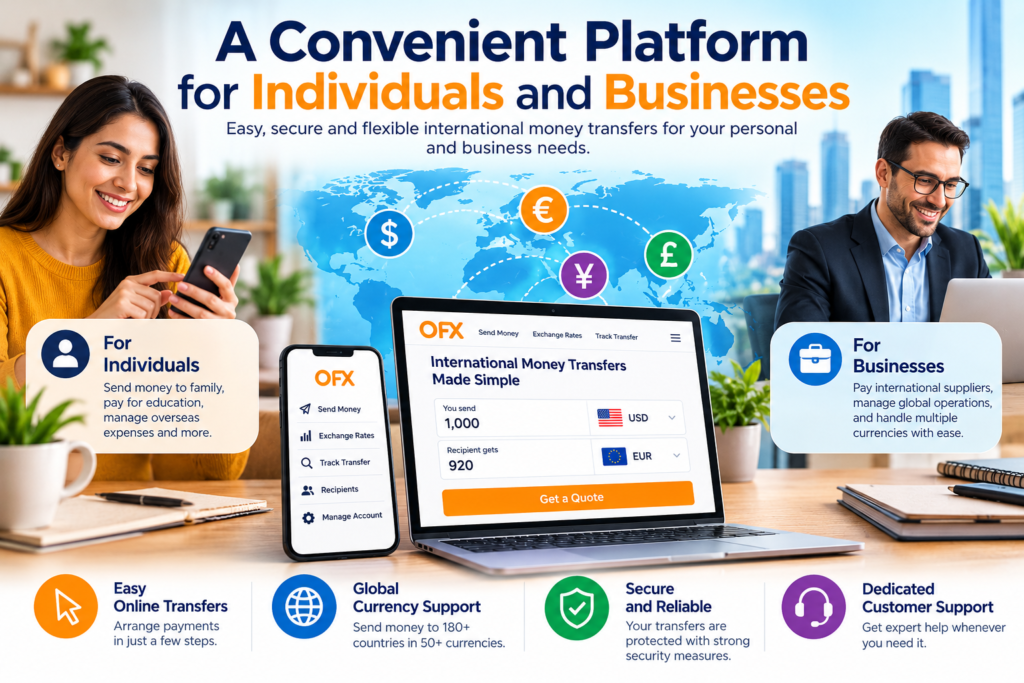
Convenience is another reason OFX attracts customers who regularly make international payments. Traditional bank transfers can involve multiple steps, unfamiliar charges, and uncertainty about payment progress. Online transfer platforms aim to reduce this complexity by bringing exchange rate quotes, beneficiary information, payment instructions, and transaction tracking into a digital environment. OFX provides online account access and tools intended to make international payments easier to manage.
For individuals, this can mean arranging an overseas payment without visiting a bank branch. For businesses, it can mean managing supplier payments and foreign currency transactions through a more organised process. Digital access is especially valuable when the sender and recipient are in different time zones and international financial tasks do not fit neatly into normal business hours.
An online platform does not automatically make every transfer instant. Customers may need to verify their identities, provide information about the payment’s purpose, or complete additional checks before a transaction proceeds. Nevertheless, bringing these activities together in one account can simplify recurring payments and reduce the confusion sometimes associated with international banking.
Online Transfers and Account Management
An online account gives customers a central place to arrange and review international payments. Depending on the account and market, users may be able to manage beneficiary details, request exchange rate quotes, review transfer information, and check payment progress. These features are useful for people with ongoing financial commitments, such as tuition fees, overseas property payments, or regular family support.
OFX also offers mobile access for customers who prefer managing payments away from a desktop computer. Depending on the country and available service, features may include checking exchange rates, arranging payments, and tracking transfers. Having transaction information available on a phone can be particularly convenient for business owners who need to confirm payments while travelling.
The main benefit is better organisation rather than a guarantee of immediate settlement. International payments can still take time because of banking arrangements, compliance checks, and destination-country processing requirements. Customers should enter recipient information carefully, confirm the currency and amount, and review the payment confirmation before submitting a transfer.
Dedicated Customer Support
Automated systems are useful when everything goes according to plan. However, international payments sometimes raise questions that cannot be resolved through a simple status message. A beneficiary’s bank may request additional information, a payment may require further verification, or a customer may want to understand an exchange rate. In these situations, access to a support representative can be particularly valuable.
OFX advertises customer support by phone and email around the clock. This can be helpful when customers are dealing with substantial transfers or coordinating payments across different time zones. Having someone available to explain the next steps can make an unfamiliar process easier to understand.
Good customer support does not mean every problem will be resolved immediately. Some cases require investigation by banks or compliance teams, and resolution times can vary. Customers should keep their transfer references, payment confirmations, and relevant correspondence available when contacting support. They should also use verified contact details to avoid scams involving people pretending to represent the company.
Security, Compliance, and Trust
Security is a fundamental consideration whenever money moves internationally. A reliable transfer service needs procedures to verify customers, protect account access, monitor suspicious activity, and comply with applicable financial regulations. OFX describes security measures designed to help protect customer accounts and financial information. Its regulatory obligations and registrations depend on the jurisdictions in which it operates.
Customers may be asked to provide identity documents, proof of address, or information about the source and purpose of their funds. These requirements can feel inconvenient when someone wants to send money quickly, but they are part of the wider process used to comply with financial regulations and help prevent financial crime. Providing accurate information and responding promptly to legitimate verification requests can help avoid unnecessary delays.
Customers should also take responsibility for protecting their own accounts. Use a strong, unique password, secure your email account, and avoid clicking suspicious links requesting banking credentials. Before sending money, verify the recipient’s account details independently, especially if payment instructions have recently changed. No financial provider can eliminate every risk, so safe transfers depend on both the provider’s security measures and the customer’s own precautions.
Tools for Managing Currency Fluctuations
Exchange rates change as financial markets respond to economic data, interest rates, political developments, and investor expectations. If you need to make a large foreign currency payment several months from now, waiting until the last moment can create uncertainty about the final cost. Currency management tools can help eligible customers plan ahead instead of reacting to daily market movements.
OFX offers forward contracts for eligible customers and transactions. These contracts allow customers to agree on an exchange rate for a future payment under specified conditions. Availability, minimum transfer amounts, contract periods, and other requirements vary by market and account type.
Consider someone planning to pay a property deposit in another country in six months. A forward contract may help make the currency cost more predictable, reducing uncertainty about how much domestic currency will be required. However, locking in a rate can also mean missing out if the market later moves in a more favourable direction. Some contracts create obligations to complete the transaction under agreed conditions, so customers should understand the terms before committing.
OFX for Personal International Payments
Personal international transfers involve much more than sending money to relatives. People relocate for employment or education, purchase property overseas, manage retirement income, and maintain financial commitments in more than one country. These situations can involve substantial payments or recurring transfers, making exchange rate differences particularly important. OFX’s personal transfer service helps eligible individuals arrange international bank payments while reviewing currency conversion details before completing a transaction.
Imagine a family paying university fees for a student studying overseas. The family may need to transfer money at the beginning of each semester, and the amount required in the destination currency may be significant. Comparing exchange rates and applicable fees before each payment can help the family plan its budget more accurately. Similarly, someone purchasing an overseas property may want to explore currency management options before moving a deposit or paying the final balance.
OFX can be worth considering for these situations, but suitability depends on the payment amount, destination, urgency, and account eligibility. Someone sending a small amount to a friend may prefer a service that offers instant transfers or convenient card payments. Someone making a larger bank-to-bank transfer may place greater importance on the exchange rate and access to customer support. Understanding your priorities helps you choose a provider that fits your needs.
OFX for Businesses and Global Operations
Businesses operating internationally face challenges that differ from those experienced by individual customers. They may need to pay overseas suppliers, settle invoices in foreign currencies, receive payments from international clients, or coordinate transactions across multiple markets. Currency movements can affect costs and profit margins, while delayed payments may disrupt supplier relationships and cash flow. OFX provides business-focused international payment and currency management services designed to help companies manage these responsibilities.
The company has also been expanding its business offering beyond currency transfers into areas such as financial operations, accounts payable automation, and spend management. These services reflect the growing demand for platforms that help businesses manage payments and related financial activities in a more organised way. The availability of individual features depends on the country and product.
For example, a small business importing equipment from Europe might need to pay a supplier in euros while maintaining its main operating account in another currency. A currency specialist can help the business obtain a quote, organise the transfer, and explore eligible options for managing future exchange rate exposure. For companies making regular international payments, a consistent process can be more valuable than arranging each transaction independently.
Businesses should still assess OFX against their accounting systems, approval procedures, payment deadlines, and compliance requirements. Comparing its overall cost with existing banks and alternative providers is also important. A convenient platform is useful only when it fits the company’s workflow and delivers enough value to justify its use.
Understanding OFX Transfer Costs
The true cost of an international transfer is not always obvious from the first price displayed. A provider may charge a separate transaction fee, include a margin in the exchange rate, or pass along certain third-party charges. In some cases, an intermediary bank or the recipient’s bank may deduct fees before the money reaches the beneficiary. OFX explains different cost components in its published pricing information.
A useful way to compare providers is to focus on the amount the recipient is expected to receive rather than looking only at the sender’s fee. Suppose two providers quote different exchange rates for the same transfer amount. Even if one advertises no transfer fee, the other might still deliver better value if its conversion rate is more favourable. The most reliable comparison involves obtaining quotes for the same currencies, amount, destination, and approximate transfer time.
Cost factor | What it means | What to check |
Exchange rate | Determines the converted amount | Compare customer rates across providers |
Transfer fee | A separate charge for arranging the payment | Check fees for your country and transaction |
Exchange rate margin | Difference between the customer rate and market benchmark | Compare the final converted amount |
Intermediary bank fee | A possible charge when banks route payments through another institution | Check whether deductions may apply |
Recipient bank fee | A charge imposed by the beneficiary’s bank | Review the recipient bank’s international payment terms |
Return or correction fee | A possible charge if a payment is returned or requires correction | Check the relevant terms before sending |
Costs can vary according to the country, currency, transfer amount, and payment route. Pricing information for customers in one country should not automatically be applied to customers in another. Review the relevant local pricing details and final quote before proceeding. This habit can help you avoid surprises and determine whether OFX offers a genuine cost advantage for your transaction.
How OFX Compares With Banks and Other Providers
OFX competes with traditional banks and specialist money transfer companies. Each option can be appropriate in different circumstances, so there is no single provider that is always best. Banks may offer the convenience of arranging payments within an existing account, while specialist providers may focus more heavily on currency conversion, international payment workflows, or customer support. Digital remittance services may be more convenient for smaller personal transfers.
The most useful comparison considers how each service handles your particular transaction. Check the exchange rate, transfer fee, funding method, expected delivery time, supported destination, and available assistance. Consider whether the provider allows you to schedule future transfers or manage exchange rate risk if these features matter to you. OFX’s advertised strengths include international currency coverage, online transfers, business payment tools, and access to customer support.
Feature | OFX | Traditional bank | Other transfer provider |
Main focus | International transfers and currency management | Broad banking services | Varies by provider |
Exchange rates | Customer rate includes a margin | Rates and margins vary | Rates and margins vary |
Transfer fees | Depend on market and transaction | May apply | Depend on provider |
Currency coverage | More than 50 currencies advertised, subject to availability | Depends on the bank | Depends on the provider |
Customer support | Phone and email support advertised around the clock | Depends on the bank | Varies by provider |
Business tools | International payments and financial management services | May include business banking tools | Depends on the service |
Best comparison method | Review the specific quote and available features | Review the specific quote and banking conditions | Review the specific quote and available features |
This comparison is a general overview rather than a guarantee that every feature is available to every customer. Pricing and service quality vary, and exchange rates change over time. Before deciding, compare current quotes for the exact transaction you intend to make. For a large payment, even a small difference in the final converted amount can matter more than a minor difference in convenience.
Potential Limitations of Using OFX
Although OFX offers several attractive features, it is not necessarily the right choice for every international payment. Its suitability depends on transfer size, destination, currency availability, and urgency. Someone who needs to send a very small amount immediately may find another service more suitable, particularly if it supports a preferred card payment method or provides a convenient instant transfer option.
Another consideration is that a competitive exchange rate does not eliminate all transfer costs. Depending on the transaction, a separate fee or third-party bank deduction may apply. The final amount received can also be affected by the destination bank’s policies and the payment route. Customers should avoid assuming that an advertised rate or general statement about fees applies to every transaction.
Transfer timing is another factor. International payments can require time for account verification, funding, currency conversion, banking cut-off periods, and local processing. Public holidays, compliance reviews, or inaccurate beneficiary information may cause additional delays. If a payment has a firm deadline, arrange it early and confirm the estimated delivery window rather than assuming that every international transfer will arrive on the same day.
Customers should also understand the conditions attached to currency management tools such as forward contracts. These tools may offer predictability, but they can also involve commitments and restrictions. Read the relevant terms carefully, especially if the payment date or amount might change. A service is most useful when its features, costs, and limitations are understood before money is sent.
Conclusion
OFX has become a recognised option for international money transfers by combining foreign currency exchange, international payment services, digital account management, and customer support. Its coverage of more than 50 currencies and over 180 countries, together with services designed for individuals and businesses, makes it worth considering for people who regularly move money across borders.
Its appeal is particularly strong for customers who want to compare exchange rates before making a substantial payment, manage recurring overseas obligations, or explore tools for reducing uncertainty around future currency costs. Businesses may also benefit from its broader payment and financial management services. However, OFX is not automatically the cheapest or fastest choice for every transaction, and its fees, available currencies, transfer times, and eligibility requirements can vary.
The smartest approach is to compare an actual OFX quote with offers from other providers for the same amount, destination, and currency. Consider the exchange rate, applicable fees, expected delivery time, and quality of support before making your choice. Ultimately, OFX is a popular choice because it combines international reach, currency expertise, and digital convenience, but the best transfer service is the one that delivers the right balance of cost, reliability, and flexibility for your needs.
Read Also:
The Ultimate Guide to Luxury Escapes: Membership Benefits, Deals, and Booking Tips
Can Blinkist Improve Your Reading Habits? Benefits, Limitations, and Tips
How Businesses Can Simplify Digital Document Workflows Using pdfFiller
Can WinZip Make File Compression and Storage Management Easier?
Tips for Promoting Digital Gaming Products Effectively with UniPin Affiliate Hub
Frequently asked questions
OFX is an international money transfer and foreign exchange service used by individuals and businesses to send money between countries. Common uses include overseas property payments, tuition fees, family support, supplier invoices, and other international financial commitments. Available services depend on the customer's country, account type, currency, and destination.
OFX may offer a more competitive overall cost than a traditional bank for some transfers, but the result depends on the specific transaction. Compare the customer exchange rate, any separate transfer fee, and possible intermediary or recipient bank charges. The final amount the recipient receives is one of the most useful measures for comparing providers.
OFX advertises international transfers in more than 50 currencies to over 180 countries. However, not every currency is available for every destination or customer type. Customers should check the service availability applicable to their location before arranging a payment.
Transfer times vary according to the currencies involved, destination country, banking arrangements, payment method, verification requirements, and local processing schedules. Some payments may arrive relatively quickly, while others take longer. Check the estimated delivery time provided for your specific transfer and allow extra time if the payment has a strict deadline.
OFX describes security measures designed to protect customer accounts and monitor unusual activity. It also operates under applicable regulatory requirements in its markets. However, no financial service can guarantee zero risk. Use strong account security, verify beneficiary details independently, and confirm any unexpected changes to payment instructions before sending money.