

Discover how Blinkist can help improve your reading habits through short book summaries, flexible learning options, and practical tips. Explore its key benefits, limitations, and ways to build a consistent learning routine while deciding whether Blinkist is the right choice for your personal growth.
Table of Contents
ToggleUnderstanding Blinkist and How It Works
What Is Blinkist?
Blinkist is a digital learning platform that helps people explore the main ideas of nonfiction books in less time. Instead of reading an entire book, users can access condensed summaries called Blinks, which highlight important concepts, arguments, and practical lessons. The platform covers a wide range of subjects, including personal development, psychology, business, productivity, science, history, and finance. Most summaries are designed to take around 15 minutes to read or listen to, making them suitable for people with busy schedules. This approach allows readers to discover new ideas without committing several hours to a single book.
Imagine wanting to improve your time management skills but having only a short break during your working day. Instead of postponing learning until the weekend, you can use that time to explore a summary about productivity or building better habits. Blinkist also provides audio summaries, allowing users to listen while commuting, walking, or completing simple household activities. However, the real value of the platform depends on how you use the information you discover. Reading numerous summaries without remembering or applying their lessons may not produce meaningful results. Using Blinkist with a clear learning goal can help you turn short sessions into a useful part of your daily routine.
How Blinkist Fits Into a Busy Lifestyle
One of the biggest challenges in developing a reading habit is finding enough time to read consistently. Work responsibilities, studies, family commitments, and digital distractions can make it difficult to complete traditional books. Blinkist addresses this problem by offering shorter learning sessions that are easier to fit into everyday life. A 15-minute summary can become part of your morning routine, lunch break, or evening relaxation time. Rather than waiting for the perfect opportunity to read, you can make progress through small, manageable sessions.
For example, a working professional might listen to a summary about communication skills while travelling to the office. A student could explore a summary about concentration before beginning a study session. Someone interested in personal finance could use a short reading session to discover budgeting strategies and identify one technique to try during the week. These activities help make learning a regular part of life instead of an occasional task. Still, convenience alone does not guarantee a strong reading habit. To achieve better results, choose a consistent time, select topics that interest you, and spend a few minutes reflecting on what you have learned.
The Main Benefits of Blinkist for Reading Habits
Building a Consistent Daily Learning Routine
A strong reading habit develops through regular practice rather than occasional bursts of motivation. Many people start reading with enthusiasm but gradually stop because their goals are too ambitious or their schedules become demanding. Blinkist can make the process easier by reducing the amount of time required for each learning session. Completing one short summary may feel more achievable than reading several chapters of a long book. When learning feels manageable, it becomes easier to return to it regularly.
To develop a routine, choose a specific time of day for reading or listening. You might spend 15 minutes learning after breakfast or before beginning your evening study session. Keep a simple record of the summaries you complete and write down one useful lesson from each session. This creates a visible record of your progress and encourages you to continue. You do not need to complete several summaries every day to benefit from the platform. One thoughtful session can be more useful than multiple summaries consumed without attention. The main objective is to make learning a sustainable habit that fits your lifestyle and supports your personal or professional goals.
Discovering New Ideas and Subjects
Blinkist makes it easier to explore subjects that you might not normally consider. Reading a complete book requires a greater investment of time, so people often hesitate to explore unfamiliar topics. Short summaries provide an introduction to different ideas and help readers decide which subjects deserve further attention. You might begin with productivity, discover an interest in psychology, and then explore leadership, communication, or financial planning. This variety can make learning more engaging and encourage curiosity.
Consider someone who wants to improve their professional skills but does not know where to begin. Exploring summaries about decision-making, teamwork, negotiation, and time management can help identify areas for improvement. After finding a particularly interesting idea, the reader can explore the original book or practise the suggested technique. In this way, Blinkist becomes a starting point for deeper learning rather than a replacement for it. However, a summary provides only a condensed version of the author’s work. It may leave out important evidence, explanations, and limitations. Use it to discover new interests, identify useful questions, and choose your next learning step instead of assuming that a short summary provides complete knowledge.
Combining Reading and Audiobooks
Another advantage of Blinkist is the flexibility to learn through text or audio. Some people prefer reading because it allows them to pause, highlight important ideas, and review difficult passages. Others enjoy listening because it fits more naturally into their daily routines. Audio summaries can be useful during a walk, a commute, or another activity that does not require full visual attention. Text summaries, meanwhile, can help readers concentrate on unfamiliar concepts and take notes.
You can combine both formats to improve your learning experience. For example, listen to a summary first and then review its main ideas in text. Write down any concepts that seem particularly relevant to your goals and revisit them later. This approach provides another opportunity to process the information rather than relying on a single listening session. However, avoid treating background listening as equivalent to focused learning. If you are concentrating on a demanding task, you may not remember much of the audio. After each session, try explaining the central idea in your own words. This simple exercise helps you determine whether you genuinely understood the content.
Limitations of Blinkist You Should Know
Why Book Summaries Cannot Replace Full Books
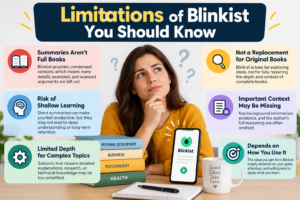
The biggest limitation of Blinkist is that summaries cannot include everything contained in a complete book. Authors often develop their arguments through research, case studies, examples, personal experiences, and detailed explanations. Condensing a book into a short summary requires selecting only its most important ideas, which means some supporting information may be excluded. As a result, readers may understand the general message without fully appreciating the reasoning behind it.
Imagine reading a summary about investing. You might discover basic principles related to financial planning and risk management, but miss important details about market conditions, investment strategies, and individual circumstances. Similarly, a summary of a psychology book might introduce an interesting concept without presenting all the evidence needed to evaluate it. This does not make summaries useless; it simply means they serve a different purpose. Use Blinkist to explore ideas, refresh your knowledge, and discover books worth reading in full. When you need comprehensive understanding, detailed research, or information for an important decision, consult complete books and reliable sources that provide sufficient context.
The Risk of Shallow Learning
Short summaries can create the impression that you are learning more than you actually remember. Finishing several summaries may feel productive, but the number of titles completed does not necessarily reflect your understanding. Information that is consumed quickly without reflection can be forgotten, particularly when you move immediately from one topic to another. This problem can affect any learning method, including traditional reading, online courses, and educational videos.
To avoid shallow learning, focus on understanding rather than completion. After reading a summary, close it and ask yourself what the central idea was, why it matters, and how you could apply it. Write a short explanation without looking at the original text. If the concept relates to your work or studies, try using it in a real situation. For example, a summary about time management becomes more valuable when you test a planning technique during the following week. Review the results and decide whether the technique helped. This process turns passive information consumption into active learning and helps you build knowledge that is useful beyond the reading session.
Practical Tips for Getting More From Blinkist
Set Realistic Reading Goals
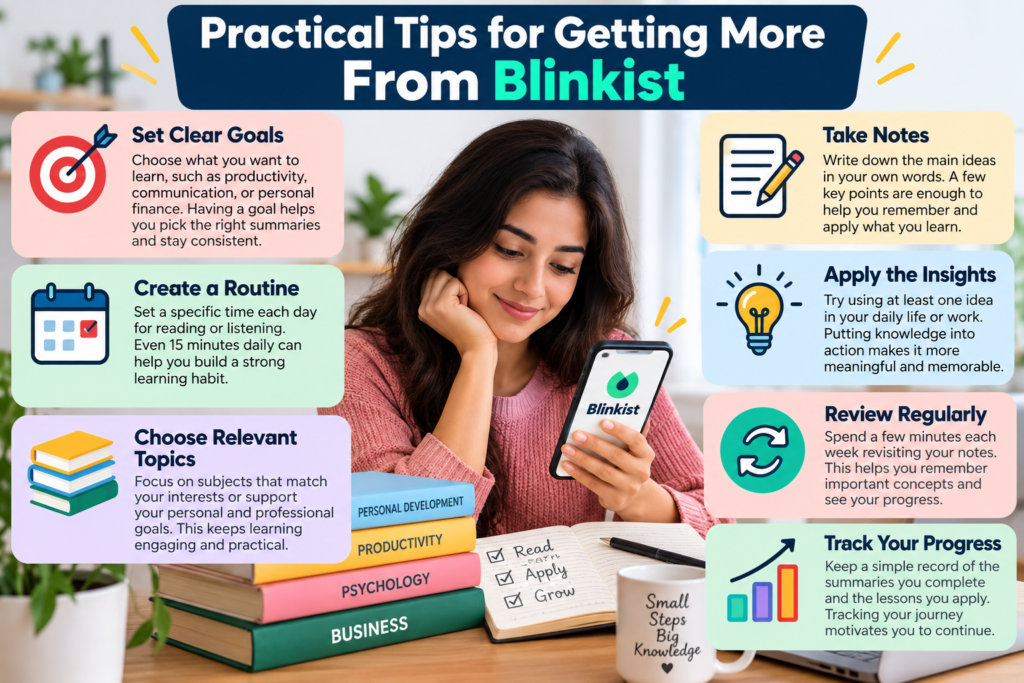
A realistic reading goal makes it easier to maintain consistency without creating unnecessary pressure. If you are beginning a new routine, trying to complete ten summaries every day may be difficult to sustain. Missing your target could make you feel discouraged, even when you have learned something useful. Instead, start with one summary per day or a few sessions each week. Once the routine becomes comfortable, you can increase the frequency according to your schedule.
First, identify your main learning objective. You might want to improve your communication skills, develop better study habits, understand personal finance, or become more productive at work. Choose summaries that support that objective instead of selecting titles randomly. You can also create a simple weekly plan with different topics assigned to specific days. Leave time for reviewing previous lessons so that your learning does not become a race to finish more content. The purpose is to create a routine that feels rewarding and manageable. Remember that consistency matters more than an impressive reading streak. A realistic plan that you follow for several months is usually more useful than an ambitious plan that lasts only a few days.
Take Notes and Apply What You Learn
Taking notes can help you remember important concepts and connect them with your everyday experiences. You do not need to write a lengthy review after every summary. A few sentences explaining the main idea, its importance, and a possible application may be enough. Write in your own words rather than copying sentences directly from the summary. Explaining an idea independently encourages you to think about its meaning and identify anything you do not fully understand.
Suppose you read a summary about reducing distractions. You might learn that frequent phone notifications can interrupt focused work. Instead of simply recording this observation, choose one practical action, such as silencing unnecessary notifications during a study session. Try the change for several days and evaluate whether it improves your concentration. If it works, continue using it. If it does not, consider what needs to change. You can organise your notes in a notebook or a digital document, whichever is more convenient. Over time, these notes become a personal collection of ideas that you can revisit whenever you need them. The goal is to transform information into useful behaviour rather than allowing it to disappear after a single reading session.
Create a Weekly Review Habit
Reviewing what you have learned is an important part of developing better reading habits. Without revision, an interesting idea from one day may quickly be forgotten when you encounter new information. A weekly review gives you an opportunity to revisit important concepts and decide which ones deserve more attention. It also encourages you to focus on meaningful lessons instead of counting how many summaries you have completed.
Set aside 10 to 15 minutes at the end of each week to review your notes. Select two or three ideas that seem most useful and try to recall them before reading your explanations again. Think about whether you applied any of those ideas during the week. Perhaps a communication technique helped you during a conversation, or a planning strategy made your study routine more organised. If an idea remains confusing, revisit the summary or explore a more detailed source. If an idea has proved useful, decide how you can continue practising it. This simple habit helps you connect new information with previous knowledge and makes your reading sessions more purposeful.
Who Should Use Blinkist?
Blinkist can be useful for busy professionals, students, curious learners, and people who want to explore nonfiction subjects more efficiently. If you enjoy learning about productivity, leadership, psychology, business, or personal development but struggle to find time for full-length books, short summaries can offer a convenient starting point. The audio format may appeal to people who prefer listening during routine activities, while the text format suits readers who want to review important points. The platform is particularly useful when you approach each session with a clear purpose and make an effort to remember what you learn.
However, Blinkist may not be suitable as your primary learning resource for every subject. Readers who need detailed scientific explanations, academic research, or comprehensive technical knowledge may find summaries too limited. Developing practical skills such as programming, mathematics, or engineering also requires exercises, experimentation, and problem-solving. Reading about a concept is not the same as being able to apply it successfully. Blinkist can introduce useful ideas and reinforce existing knowledge, but it cannot replace the practice needed to develop expertise. Before using the platform, consider what you want to achieve, how you prefer to learn, and how much time you can realistically dedicate to the process.
Is Blinkist Worth the Cost?
Whether Blinkist is worth paying for depends on your learning goals, budget, and frequency of use. The platform offers different subscription options, including a free Basic plan with limited access and paid plans that provide broader access to its content and additional features. Features can vary by plan and may include audio summaries, offline access, and other learning tools. Before subscribing, review the available options and decide whether they match your needs.
A paid subscription will not automatically turn you into a regular reader. If you rarely open the app or finish summaries without remembering their lessons, paying for more content may not solve the problem. Start with the free option if it is available and evaluate your experience before committing to a paid plan. If you consider a trial, check its duration, renewal terms, cancellation requirements, and the price charged afterward.
Option | Best suited for | Main consideration |
Free Basic | Beginners exploring the platform | Limited content access |
Premium | Regular users who want broader access | Subscription cost |
Pro | Users interested in additional AI summarisation features | Whether extra features justify the price |
Traditional books | Readers seeking detailed explanations | Time and individual book costs |
Subscription prices can vary according to location, billing period, promotions, and platform. Check the current price displayed in your account before making a purchase. If you use Blinkist consistently, learn useful concepts, and apply them in your daily life, a paid plan may provide value. If your usage is irregular, focus on building a sustainable routine before spending money. Your goal should be to invest in meaningful learning rather than simply adding another subscription to your monthly expenses.
Blinkist Compared With Traditional Reading
Blinkist and traditional reading have different strengths. Blinkist focuses on delivering selected ideas quickly, while complete books provide greater depth, context, and detail. Traditional reading may be particularly valuable when you want to understand complex arguments or enjoy an author’s storytelling. Blinkist can be more convenient when you want to explore unfamiliar topics or learn during short breaks.
Feature | Blinkist | Traditional Reading |
Time required | Usually around 15 minutes per summary | Depends on book length and reading speed |
Depth of information | Focuses on selected ideas | Provides the complete content |
Convenience | Suitable for short learning sessions | May require longer periods of concentration |
Exploring subjects | Helps introduce multiple topics quickly | Requires more time for each book |
Learning experience | Condensed and focused | Detailed and immersive |
Best purpose | Discovering ideas and refreshing knowledge | Developing deeper understanding |
Neither approach automatically guarantees better learning. Someone can finish an entire book without remembering its central message, while another person can learn a valuable lesson from a short summary and apply it successfully. The outcome depends on attention, reflection, practice, and prior knowledge. For many people, combining both methods offers the best balance. Start with Blinkist to explore a subject, then read the complete book when you want to understand its arguments in greater detail. This approach allows you to explore broadly without sacrificing the opportunity for deeper learning.
Conclusion
Can Blinkist improve your reading habits? Yes, it can help when you use it as a learning tool rather than a shortcut to knowledge. Its short summaries, flexible audio options, and variety of nonfiction subjects can make regular learning easier to fit into a busy lifestyle. For people who struggle to finish books, a manageable daily session can be a useful starting point for developing a consistent reading routine.
However, reading more summaries does not necessarily mean understanding more. Condensed content leaves out details, and information that is never reviewed or applied can quickly lose its value. To get better results, set realistic goals, take short notes, review important ideas, and explore full-length books whenever you need deeper understanding.
Start with one interesting summary, spend around 15 minutes exploring its ideas, and identify one lesson you can apply in your daily life. Practise that lesson before moving on to another topic. Over time, this approach can help you build a reading habit that supports curiosity, continuous learning, and personal growth. Ultimately, the best reading habit is not the one that helps you finish the most content. It is the one that helps you understand more, think clearly, and use what you learn.
Read Also:
How Businesses Can Simplify Digital Document Workflows Using pdfFiller
Can WinZip Make File Compression and Storage Management Easier?
Tips for Promoting Digital Gaming Products Effectively with UniPin Affiliate Hub
The Economist Asia-Pacific Review: Key Features, Insights, and Subscription Benefits
Can Reolink Help Protect Your Home and Business? Features and Benefits
Frequently asked questions
Yes. Blinkist offers short summaries that can fit into a daily routine more easily than lengthy reading sessions. Choose a consistent time, begin with a manageable goal, and record one useful takeaway from each session. Regular practice and reflection can help you develop a sustainable learning habit.
Neither approach is universally better. Blinkist is useful for discovering ideas quickly and exploring unfamiliar subjects. Full books provide greater detail, context, and supporting evidence. Combining both approaches can help you balance convenience with deeper understanding.
Blinkist offers a free Basic plan with limited access to selected content. Wider access and additional features generally require a paid subscription. Available plans, features, and prices may change, so check the current options before subscribing.
Around 15 minutes is a reasonable starting point because that is the approximate duration of a typical summary. Beginners can start with a few sessions per week and increase the frequency when comfortable. Spend a little extra time reflecting on the main ideas rather than rushing immediately into another summary.
Write down the central idea in your own words, explain why it matters, and identify one practical way to use it. Revisit your notes after a few days and try to recall the lesson without looking. Applying ideas to real situations can help make your learning more meaningful and memorable.