
Science, technology, engineering, and mathematics are often presented as subjects students need to understand, memorize, and reproduce in examinations. However, real STEM learning is much more interesting than memorizing definitions from a textbook. Science is about asking questions, testing ideas, observing unexpected results, solving problems, making mistakes, and trying again. When students experience these processes themselves, a difficult concept can become something they can see, touch, build, investigate, and discuss.
This is where MEL Science can play an interesting role in making STEM education more engaging. MEL Science combines physical experiment and construction kits with digital learning experiences, including interactive app guidance, augmented reality, virtual reality, videos, and educational challenges. Instead of separating digital learning from practical activities, the platform attempts to connect the two experiences. A student may build something physically, observe what happens, and then use digital content to understand the scientific principle behind the result.
Engagement is especially important because effective STEM education is not simply about keeping students entertained. Students need opportunities to become curious, ask questions, investigate evidence, and explain what they observe. Modern approaches to science education increasingly emphasize these skills alongside traditional academic knowledge. When children are given opportunities to investigate real problems and experiment with ideas, STEM can feel less like a collection of difficult facts and more like a way of understanding the world around them.
Table of Contents
ToggleWhy STEM Education Needs More Engagement
Traditional STEM education can sometimes create a gap between what students study and what they experience. A learner might memorize information about electricity, forces, chemical reactions, light, energy, or molecules without having many opportunities to see those concepts working in the real world. This can make science feel abstract, particularly for younger students who learn effectively through observation and physical interaction.
Engagement helps close this gap. Instead of beginning with a definition and asking students to memorize it, educators can begin with a question, problem, demonstration, or experiment. Students can make a prediction, perform an activity, observe the result, and then connect their observations to a scientific explanation. This sequence creates a more active learning experience because students are participating in the learning process rather than simply receiving information.
Moving Beyond Memorization
Memorization has a legitimate role in education. Students need to remember scientific vocabulary, formulas, basic principles, and important facts. The problem occurs when memorization becomes the primary way students experience science. If every lesson revolves around reading information and answering questions, students may understand what a scientific term means without understanding why the concept matters.
MEL Science approaches many STEM topics through practical activities. Its educational materials combine physical kits with guided instructions, videos, and digital explanations. Depending on the kit and subject, students can build models, conduct experiments, investigate physical principles, and explore scientific concepts through interactive content.
This approach can help transform a scientific statement into an experience. Rather than simply reading that energy can change from one form to another, students can observe an example and discuss what happened. Instead of only reading about forces, they can work with a model and consider why it moves in a particular way.
The important point is not that practical learning should replace textbooks. Rather, practical activities can provide the experience that makes textbook explanations easier to understand and remember.
Turning Abstract Ideas Into Experiences
Many STEM concepts are difficult because students cannot directly see the processes involved. Molecules, atoms, electromagnetic effects, energy transfer, forces, waves, and microscopic structures are often represented using diagrams and animations because they are difficult to observe directly.
This is where a combination of physical and digital learning can become useful. A student might perform a physical experiment and then use an animation or augmented reality experience to visualize what is happening at a smaller or invisible scale.
The physical activity provides evidence, while the digital experience can provide an explanatory model. When these two elements are connected carefully, students have an opportunity to move from observation to explanation.
Technology should not be used simply because it looks impressive. Its educational value comes from helping students understand something that would otherwise be difficult to visualize, manipulate, or investigate.
The Role of Curiosity in Science Learning
Curiosity is one of the most important ingredients in scientific learning. Scientists rarely begin an investigation because they already know the answer. They begin because they want to understand something.
Children naturally ask questions. Why does something move? Why does ice melt? Why does a bulb light up? Why does one material behave differently from another? Why does a chemical reaction produce a particular change?
Good STEM education should preserve this natural curiosity instead of replacing it with a constant focus on correct answers.
Experiment-based learning can create opportunities for students to ask their own questions. An unexpected result can be particularly valuable because it creates a reason to investigate further. A student who wonders why an experiment did not produce the expected outcome is already beginning to think scientifically.
MEL Science activities can support this process by giving learners a practical starting point. Instead of asking students to imagine every scientific process from a textbook description, an experiment can give them something concrete to observe and question.
What Is MEL Science?
MEL Science is an educational platform that combines hands-on science activities with digital learning experiences. Its educational offerings cover areas such as STEM, physics, chemistry, and other science-related subjects, with age ranges and available products varying according to the specific learning pathway.
One of the platform’s main characteristics is the combination of physical materials and digital guidance. Students can receive experiment kits or construction materials and then use digital resources to understand the activity. These resources can include step-by-step instructions, educational videos, interactive activities, augmented reality, and virtual reality experiences.
This combination is designed to make science more interactive. A learner is not only reading about a concept but also working with materials and seeing a scientific idea in action.
Hands-On Science Kits
Hands-on learning is at the center of the MEL Science experience. Physical kits give students the opportunity to manipulate objects, build models, perform experiments, and observe results.
This can be especially useful for learners who find purely theoretical explanations difficult. Physical activities provide sensory information that textbooks cannot always provide. Students can see movement, observe changes, compare results, and physically interact with a model.
Hands-on experiments can also encourage discussion. When two students obtain slightly different results, they have an opportunity to ask why. They can compare their methods, examine their observations, and decide what they might change in another attempt.
This turns science into an active process rather than a passive lesson.
Digital Learning With AR and VR
Digital technology adds another dimension to the learning experience. Augmented reality and virtual reality can help students visualize concepts that are difficult to observe in ordinary classroom environments.
For example, chemistry involves processes at the molecular and atomic levels that students cannot see directly. Digital visualization can provide a model of these invisible structures and processes.
Physics and STEM activities can also benefit from digital demonstrations. An interactive environment can allow learners to explore relationships between variables, observe simulations, or receive additional explanations.
However, the strongest use of digital learning occurs when it complements hands-on investigation. A screen should not replace physical exploration when physical exploration is possible. Instead, digital content can help students interpret what they have already observed.
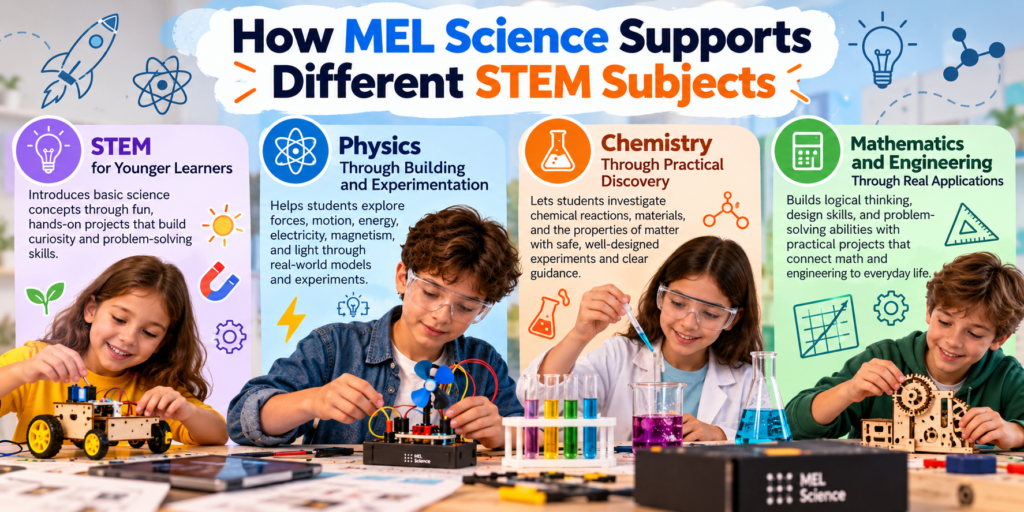
How MEL Science Supports Different STEM Subjects
STEM education covers a broad range of subjects, and different learners may respond to different types of activities. Younger students may benefit from simple construction and exploration activities, while older learners can work with more advanced concepts in physics and chemistry.
MEL Science provides different learning pathways and subject areas designed around age and difficulty. This allows practical learning to become more specialized as students develop their knowledge.
MEL STEM for Younger Learners
Younger students often learn effectively when scientific concepts are connected to familiar objects and simple challenges. Activities involving movement, light, sound, materials, forces, and communication can provide accessible introductions to STEM.
A young learner does not necessarily need a complicated explanation of a scientific law before experimenting. They can first observe what happens and then gradually develop the vocabulary needed to explain the result.
For example, an activity involving light can lead to questions about reflection, transmission, color, communication, and optical technology. A simple physical activity can therefore become the starting point for a much broader discussion.
Physics Through Building and Experimentation
Physics can sometimes appear intimidating because students associate it with equations and mathematical calculations. While mathematics is important in physics, physical intuition is equally valuable.
Building and experimentation can help students develop that intuition. When learners manipulate a model and observe motion, energy, magnetism, electricity, heat, or light, they begin to connect mathematical descriptions with physical behavior.
This connection can make later theoretical learning easier. Instead of seeing an equation as an isolated formula, students can understand it as a mathematical description of something they have already observed.
The experience of building also introduces engineering thinking. Students must follow instructions, identify components, troubleshoot problems, and sometimes determine why a model is not behaving as expected.
Chemistry Through Practical Discovery
Chemistry is another subject where practical learning can make a significant difference. Atoms and molecules are invisible, but chemical reactions produce observable changes.
A student may see a change in color, temperature, texture, or the formation of a gas. These observations create an opportunity to ask what caused the change.
MEL Science chemistry activities can connect practical experiments with explanations delivered through digital resources. Students can therefore move from observing a reaction to thinking about what is happening at the molecular level.
This progression from observation to explanation is an important part of scientific thinking.
Features That Can Increase Student Engagement
A major advantage of combining physical and digital learning is that students can experience science through several different modes. They can read, watch, build, experiment, answer questions, and discuss results.
MEL Science incorporates features such as interactive instructions, video lessons, challenges, educational games, achievements, augmented reality, and virtual reality into different learning experiences.
These features can make lessons feel more varied, but their educational value depends on how they are used.
Interactive Instructions and Video Lessons
Clear instructions can help students feel confident when beginning a new experiment. Instead of having to understand every step from a complicated written explanation, learners can receive visual guidance.
Video lessons can also introduce concepts before or after an experiment. A student can watch an explanation, conduct the activity, and then return to the explanation with a better understanding of what they observed.
Adults can make these resources even more effective by stopping before important steps and asking questions such as:
“What do you think will happen?”
“Why do you think that?”
“What would happen if we changed this?”
“What evidence do we have?”
These simple questions transform instructions into opportunities for inquiry.
Gamification and Learning Challenges
Games and challenges can make educational activities more motivating. Achievements, quizzes, progress indicators, and challenges can encourage learners to continue exploring.
However, gamification should support learning rather than become the entire purpose of the activity. A badge is not meaningful by itself. Its value comes from the scientific understanding and problem-solving that the student developed while earning it.
The best educational challenges encourage students to think, test, make decisions, and explain their reasoning.
Connecting Screen Time With Hands-On Learning
Parents and educators often worry about excessive screen time, and not all digital activities provide the same educational value.
There is an important difference between passive consumption and active learning. Watching entertainment for an extended period is different from using a digital tool to investigate a scientific concept and then performing a physical experiment.
MEL Science attempts to connect digital content with hands-on activities. The screen can provide instructions, explanations, visualizations, or challenges, while the physical kit provides opportunities to build and experiment.
This combination can create a more balanced learning experience when used appropriately.
Using MEL Science at Home and in Schools
A major advantage of structured science kits is flexibility. They can be used by families at home, homeschool learners, after-school programs, science clubs, and classroom teachers.
At home, parents can use the kit as a structured learning activity. In schools, teachers can incorporate selected experiments into broader science lessons.
The exact implementation depends on the learner’s age, available time, classroom resources, and curriculum goals.
Supporting Parents and Homeschoolers
Parents do not need to be professional scientists to support a child’s scientific curiosity. A structured kit can reduce the preparation required to create an experiment from scratch.
The most valuable role for a parent may be asking questions rather than immediately providing answers.
If an experiment produces an unexpected result, the parent can ask:
“What do you think caused that?”
“Was that what you expected?”
“What could we change?”
“How could we test your idea?”
These questions encourage children to explain their thinking.
For homeschool families, practical experiments can also provide opportunities to connect science with writing, mathematics, research, and communication. A child might record observations, calculate measurements, draw diagrams, or write an explanation of the result.
Supporting Teachers and Classroom Activities
Teachers can use hands-on science resources as demonstrations, group activities, laboratory-style exercises, or supplementary learning materials.
A classroom experiment can follow a simple structure:
Question → Prediction → Investigation → Observation → Discussion → Explanation
This structure is useful because it gives students a clear purpose for the activity. Instead of simply following instructions, students understand why they are performing the experiment.
Teachers can also encourage students to compare results. Differences between groups are not necessarily problems; they can become opportunities to discuss variables, measurement, accuracy, and experimental design.
The Educational Value of Experiment-Based Learning
Experimentation changes the role of the learner. Instead of simply receiving an answer, the student becomes an investigator.
This is closely connected to the broader goals of science education. Scientific literacy involves understanding evidence, evaluating information, explaining phenomena, and making reasoned decisions.
A practical activity gives students a small-scale version of that process.
Encouraging Questioning and Problem Solving
Good STEM activities should create space for questions.
Students should be encouraged to ask:
“What changed?”
“What stayed the same?”
“What caused the result?”
“Was our prediction correct?”
“What evidence supports our explanation?”
“What should we test next?”
These questions develop habits that are useful far beyond science class.
Problem solving also becomes more meaningful when students encounter an unexpected outcome. Instead of being told immediately that their result is wrong, they can investigate possible reasons.
Building Confidence Through Trial and Error
Many students believe that being good at science means getting the correct answer immediately. Experimentation challenges that assumption.
Scientists regularly encounter failed experiments, unexpected results, incomplete information, and competing explanations. Learning how to respond to those situations is part of scientific thinking.
A child who discovers that a model does not work as expected has an opportunity to troubleshoot. They can check the instructions, examine the components, change one variable, and try again.
The adult’s response matters. Saying “You did it wrong” can discourage exploration. Asking “What do you think happened?” encourages investigation.
Developing Scientific Thinking
Scientific thinking is not one isolated skill. It is a collection of habits that develop over time.
Students learn to distinguish observations from assumptions. They learn to use evidence when supporting an explanation. They learn that more than one explanation may initially appear possible. They learn to revise their ideas when new evidence appears.
A kit such as MEL Science can support these habits, but it works best when combined with discussion, reflection, appropriate curriculum objectives, and teacher or parent guidance.
The physical experiment is the starting point. The deeper learning comes from thinking about what happened and why.
Making STEM Learning More Relevant
Students often ask an important question: “Why do I need to learn this?”
The answer becomes easier when science is connected to everyday experiences.
Electricity is connected to phones, computers, appliances, and transportation. Light is connected to cameras, communication, displays, and medical technology. Materials science affects clothing, construction, sports equipment, packaging, and electronics. Energy transformations occur in vehicles, batteries, power systems, and household devices.
When students understand these connections, STEM subjects can feel more relevant.
Connecting Science to Everyday Life
Consider a simple lesson about light. Students might initially think of light as something that helps them see.
A practical activity can expand that understanding. Students can explore reflection, transmission, color, communication, or optical systems. The teacher or parent can then connect these ideas to cameras, fiber-optic communication, medical instruments, screens, and other technologies.
This creates a bridge between classroom science and the technological world students already experience.
The same principle applies to energy, motion, electricity, magnetism, chemistry, and materials.
Encouraging Long-Term Interest in STEM
The goal of STEM education should not be limited to creating one exciting lesson. The larger goal is to help students develop a lasting willingness to explore, question, and understand scientific ideas.
One successful experiment may not determine a child’s future career. However, repeated positive experiences with science can make experimentation and problem solving feel familiar.
A learner who becomes comfortable asking questions may be more willing to explore advanced subjects later.
This is one of the potential strengths of practical platforms such as MEL Science. They can provide additional opportunities for students to encounter STEM concepts outside traditional classroom lessons.
Potential Challenges to Consider
Although hands-on STEM learning offers many benefits, families and schools should also consider practical limitations.
Cost can vary depending on the product, subscription, package, country, and number of learners. Families should compare the exact package contents and ongoing costs before purchasing.
Supervision is another consideration. Some experiments require careful handling, particularly chemistry activities. Children should follow the provided safety instructions and receive appropriate adult supervision.
Accessibility can also affect the experience. Some digital resources require compatible devices, while virtual reality experiences may not be comfortable or suitable for every learner. Families and educators should choose activities according to the learner’s age, environment, interests, and available resources.
These considerations do not eliminate the value of hands-on science. They simply highlight the importance of choosing the right activity and using it responsibly.
Conclusion
MEL Science can make STEM education more engaging by connecting scientific concepts with practical experimentation, digital visualization, curiosity, and problem solving. Instead of presenting science only as information that students need to memorize, hands-on activities allow learners to observe scientific principles in action.
Its combination of physical kits, interactive instructions, videos, augmented reality, virtual reality, and educational challenges creates multiple ways for students to interact with STEM concepts. Physics can become something students build and observe. Chemistry can become something they investigate rather than simply read about. Younger learners can explore basic STEM principles through construction and experimentation.
The most important benefit, however, is not the technology itself. The real educational value comes from encouraging students to ask questions, make predictions, examine evidence, learn from unexpected results, and explain their observations.
Used alongside good teaching and appropriate curriculum goals, MEL Science can serve as a useful tool for creating richer STEM learning experiences. It can help turn abstract ideas into practical experiences and give students more opportunities to discover that science is not simply about knowing the answer. It is about being curious enough to investigate the question.
Read Also:
Everything You Need to Know About Ever—Pretty UK: A Complete Guide
How to Find the Right Accessories and Devices on eu.ugreen.com
What Learners Should Know Before Choosing Courses on edX
A Complete Guide to Creating and Editing Documents With DocHub
How DigitalOcean Can Simplify Cloud Infrastructure Management
Frequently asked questions
MEL Science is an educational platform that combines hands-on science kits with digital learning resources. Depending on the specific product and age group, learners can explore subjects such as STEM, physics, chemistry, and related scientific concepts through experiments, construction activities, videos, interactive content, and other digital experiences.
MEL Science offers different learning experiences for different age groups. Younger learners can explore introductory STEM concepts, while older children can work with more advanced physics and chemistry activities. The appropriate age depends on the individual kit and the learner's experience level.
Yes. Hands-on science resources can be used in classrooms, science clubs, homeschool environments, and other educational settings. Teachers can incorporate experiments into lessons, group activities, demonstrations, or supplementary learning programs.
Yes. Some MEL Science learning experiences incorporate augmented reality and virtual reality. These technologies can help learners visualize scientific concepts that are difficult to observe directly, particularly processes involving microscopic structures or complex physical phenomena.
Parents can make the experience more educational by asking questions instead of simply helping children complete the instructions. Before an experiment, ask the child to make a prediction. During the activity, encourage careful observation. Afterward, discuss the result, ask why it happened, and encourage the child to think about what could be tested next.