

Choosing the right audio device can feel surprisingly complicated. Walk into an electronics store or browse an online catalogue and you will quickly find dozens of earbuds, headphones, office headsets, speakerphones, and conference devices competing for attention. Jabra Australia occupies an interesting position in this market because the brand is strongly associated not only with personal audio but also with professional communication technology. Its Australian range currently places particular emphasis on business headsets, speakerphones, video-conferencing equipment, personal cameras, accessories, and software, while Jabra’s support ecosystem still covers a substantial collection of earlier consumer products.
That makes understanding Jabra a little different from simply asking, “Which wireless earbuds should I buy?” The better question is what you actually want your audio equipment to accomplish. Do you spend hours on Microsoft Teams calls? Do you work from home and need better microphone performance? Are you managing a contact centre where reliable voice communication matters? Or are you interested in the company’s well-known Elite earbuds and wondering how they fit into Jabra’s current direction? Jabra has products and support resources connected with each of these scenarios, although its business-focused portfolio is now especially prominent.
Jabra’s Australian website currently highlights products such as the Evolve3 65 Flex, Evolve3 65 and Evolve3 45 alongside professional headsets, speakerphones, conferencing solutions and personal cameras. At the same time, Jabra’s history with Elite earbuds remains relevant because models such as the Elite 10 Gen 2 and Elite 8 Active Gen 2 were introduced with technologies including enhanced ANC, Dolby-powered spatial sound and an LE Audio smart case.
This guide explores the Jabra Australia ecosystem from that broader perspective. Rather than treating one product as universally best, it explains the different categories, features, use cases, buying considerations and support options so you can decide which type of Jabra solution makes sense for your own needs.
Table of Contents
ToggleUnderstanding Jabra’s Position in Australia
Jabra has built its reputation around a combination of audio engineering, communication technology and workplace productivity. In Australia, the company’s current online catalogue is particularly focused on professional communication solutions, including wireless and corded headsets, speakerphones, video-conferencing systems and related accessories. The official Australian catalogue lets shoppers filter products according to connectivity, wearing style, product type and other characteristics, which reflects how broad the professional portfolio has become.
The important distinction is that Jabra is not simply another consumer headphone company. Its equipment is frequently designed around conversations rather than entertainment alone. A typical office headset, for example, needs to do much more than reproduce music. It needs to capture speech clearly, manage background noise, connect reliably to computers and phones, remain comfortable for extended periods and often integrate with unified communications platforms. Those requirements change the design priorities considerably. A device that sounds excellent during a five-minute music session may not necessarily be the best tool for someone spending six hours a day in meetings.
Jabra’s Australian site describes its technology as being designed for both work and life, while its professional portfolio includes headsets, speakerphones, conferencing cameras, personal cameras and software. The company also states that more than 80% of global Fortune 500 companies rely on Jabra, based on Jabra sales data.
For Australian buyers, another useful point is the company’s local distribution and support infrastructure. Jabra lists authorised Australian distributors including Ingram Micro Australia, Anixter Australia and Dicker Data, giving businesses established channels through which genuine products can be sourced. This matters particularly for companies purchasing multiple devices, where warranty handling, procurement, compatibility and ongoing support can be just as important as the initial product price.
From Personal Audio to Professional Communication
Jabra’s evolution is especially important when looking at its earbuds. In June 2024, GN announced that it would wind down the Jabra Elite and Talk consumer product lines, with the wind-down completed by the end of 2024. GN’s 2024 annual report explains that the company decided to increase focus and resources on other parts of its business, and the division was subsequently renamed “Gaming” from January 1, 2025.
That does not mean the history of Jabra earbuds suddenly became irrelevant. Quite the opposite: products such as the Elite 10 Gen 2 and Elite 8 Active Gen 2 remain important examples of Jabra’s audio engineering and are still represented within support resources. Jabra launched those second-generation products in 2024 with features including enhanced ANC, spatial audio powered by Dolby Audio, Natural HearThrough improvements and an LE Audio smart case capable of connecting to devices through USB-C or 3.5mm connections.
For consumers researching Jabra Australia, this creates an important buying distinction. You may encounter existing Elite products through retailers, support pages or other channels even though Jabra’s strategic focus has shifted. Therefore, availability, warranty, software compatibility and retailer status should be checked before purchasing an older model. The safest approach is to consult Jabra’s official Australian product and support pages and confirm exactly what is supported for the model you are considering. Jabra’s support site provides product-specific manuals, software information, compatibility resources, warranty terms and troubleshooting material.
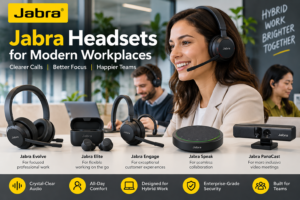
Jabra Headsets for Modern Workplaces
Professional headsets are arguably the clearest expression of Jabra’s current direction. The Australian office-headset catalogue includes products from the Evolve family, with current listings including the Evolve2 65 Flex, Evolve2 50, Evolve2 55, Evolve2 40 SE and Evolve2 30 SE. Jabra also promotes newer Evolve3 models on its Australian homepage, including the Evolve3 65 Flex, Evolve3 65 and Evolve3 45.
The appeal of an office headset is straightforward: it creates a dedicated communication environment. Instead of relying on a laptop microphone and speakers, you have microphones positioned specifically for voice capture and speakers designed for close-range listening. That can make meetings feel more controlled, particularly in shared offices, home offices or environments where background sounds are unavoidable.
Jabra’s professional headset range also reflects the reality of hybrid work. Employees may spend Monday in a corporate office, Tuesday at home, Wednesday in a café or travelling between locations. A fixed deskphone accessory no longer solves the entire communication problem. Modern headsets therefore need to balance portability, battery operation, wireless connectivity, microphone quality and comfort.
This is where product segmentation becomes useful. A lightweight headset may be preferable for someone who moves around constantly, while a more substantial stereo headset may be better for someone who spends most of the day at a desk. Some workers need strong noise isolation because they work in open-plan offices; others need awareness of their surroundings because they frequently interact with colleagues. There is no single perfect headset because workplace environments are different.
Evolve Series for Hybrid Work
The Evolve family is designed around professional communication and productivity. Current Australian listings include the Evolve2 65 Flex, which Jabra describes as a portable professional headset with active noise-cancellation capabilities, alongside Evolve2 50, Evolve2 55, Evolve2 40 SE and Evolve2 30 SE models.
The central idea behind these products is flexibility. Someone working remotely might need to switch quickly between a laptop meeting, a smartphone call and ordinary computer audio. Someone in an office might want to reduce distractions while remaining available for conversations. A good professional headset acts almost like a personal communication workstation: it combines listening, speaking and connectivity into one device.
When comparing Evolve products, shoppers should focus on practical differences rather than simply assuming the newest or most expensive model is automatically the right choice. Consider whether you need wireless operation, whether you prefer stereo or mono audio, how important active noise cancellation is, which computer ports you use and whether your organisation relies on a specific communications platform. Jabra’s product catalogue provides filters for connectivity and wearing style, which can help narrow the selection.
Comfort should also receive more attention than many buyers give it. If a headset is going to sit on your head for several hours every day, small differences in weight, ear-cup design, headband pressure and adjustment can become significant. A slightly cheaper model that you comfortably wear all day can be a better productivity tool than a technically superior model that becomes uncomfortable after an hour.
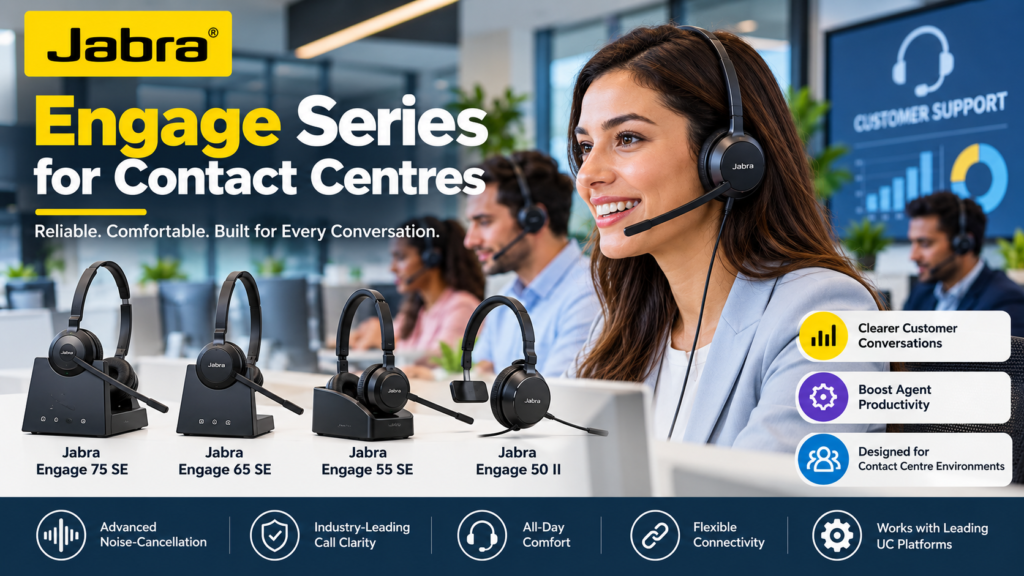
Engage Series for Contact Centres
Contact-centre environments create an entirely different set of requirements. Employees may spend most of their working day talking to customers, so microphone quality, durability, comfort, connectivity and call-management features become central considerations. Jabra’s Australian Engage portfolio includes products such as the Engage 75 SE, Engage 65 SE, Engage 55 SE, Engage 50 II, Engage 45 SE, Engage 40 and convertible versions of selected models.
These products are designed around customer communication rather than casual listening. In a busy call centre, a headset is effectively part of an employee’s workstation. If the microphone captures excessive background noise, the customer may struggle to understand the agent. If the headset is uncomfortable, employees may experience fatigue during long shifts. If connectivity is unreliable, productivity suffers.
Jabra also highlights programmable buttons on its Engage headsets for interaction with voice-driven workflows and agentic AI tools. This illustrates a broader trend in business communications: headsets are increasingly becoming interfaces for software, not merely audio output devices.
Businesses considering the Engage range should therefore evaluate the entire communication environment. Think about deskphones, computers, softphone applications, call-management software, USB connections and employee mobility. A headset should fit into the existing workflow instead of forcing the organisation to redesign everything around the device. That is one reason Jabra’s professional ecosystem can be more valuable to organisations than a collection of unrelated consumer headphones.
Jabra Earbuds and the Elite Legacy
For many consumers, the word Jabra still immediately brings to mind Elite earbuds. The Elite family became known for combining compact true-wireless designs with features aimed at everyday listening, calls, fitness and travel. Jabra’s support database continues to contain information for numerous Elite models, including Elite 4, Elite 5, Elite 7 Pro, Elite 8 Active and Elite 10.
The Elite range is particularly interesting because it demonstrates how quickly consumer audio technology can evolve. Earbuds that once seemed like premium products have become common accessories, and buyers now expect features such as active noise cancellation, transparency or hear-through modes, multipoint connectivity, customisable sound and strong microphone performance. Jabra competed directly in that environment with products that emphasised both audio and communication.
However, Australia’s current Jabra story needs to be understood alongside the 2024 decision to wind down the Elite and Talk consumer lines. GN’s annual report confirms that the wind-down was completed by the end of 2024. Therefore, people searching for Jabra earbuds today should distinguish between products that remain supported and a current, actively expanded consumer-earbud portfolio.
Elite 10 and Elite 8 Active
The Elite 10 Gen 2 and Elite 8 Active Gen 2 are among the most notable final-generation Jabra consumer earbuds. Jabra introduced both products in June 2024 and highlighted improvements including enhanced spatial sound, Dolby Audio, better active noise cancellation and Natural HearThrough. The Elite 8 Active Gen 2 was positioned particularly around durability and active lifestyles, while the Elite 10 Gen 2 targeted a more premium listening experience.
One of the most distinctive technologies introduced with the second generation was the LE Audio smart case. Jabra described it as enabling wireless streaming from devices with USB-C or 3.5mm connections. That idea is particularly useful when you encounter a device where ordinary Bluetooth pairing is inconvenient or unavailable. Instead of thinking only about the earbuds themselves, the case becomes part of the connectivity system.
Software support is another consideration. Jabra’s Australian release notes show that Elite 10 Gen 2 received firmware updates after launch, including fixes for reconnection behaviour and performance improvements. The support documentation also explains that LE Audio support depends on compatible smartphones and that iOS support was not available for that feature at the time of the cited release.
This is a good reminder that specifications on a product box are only part of the buying decision. Compatibility changes over time, and advanced features can depend on the phone, operating system and firmware version. Anyone buying an older Jabra earbud model should check the latest official support documentation before assuming every advertised feature will work with their particular device.
Jabra Speakerphones and Meeting Technology
Jabra’s professional ecosystem extends far beyond headsets. Its Australian product catalogue includes speakerphones and video-conferencing equipment designed for meeting rooms, hybrid teams and distributed workplaces. The company currently promotes the Speak family as its next generation of professional speakerphones and also offers PanaCast conferencing systems and personal cameras.
Speakerphones solve a different problem from headsets. Instead of giving one person a private audio channel, they allow several people around a table to participate in a conversation. That makes microphone pickup and echo management particularly important. Imagine a meeting room as a small theatre: everyone needs to hear the speaker, but the microphones also need to avoid turning every keyboard tap and chair movement into part of the conversation.
Jabra’s Speak products are designed around this type of shared communication. The Australian catalogue currently lists products including the Speak 750, while the company’s broader professional portfolio includes newer Speak-series products.
PanaCast products take the idea further by combining audio and video. Jabra’s Australian site currently presents complete video-conferencing solutions alongside personal cameras and room systems. For businesses, this creates an ecosystem approach: rather than purchasing a camera from one manufacturer, a microphone from another and a speakerphone from a third, organisations can standardise more of their meeting technology around one platform.
Speak Series and PanaCast Solutions
The best way to evaluate meeting technology is to start with the room, not the device. A small two-person meeting area needs different equipment from a large boardroom. A home office may need only a personal headset or camera, while a shared meeting room may require a dedicated speakerphone and camera system.
Jabra’s PanaCast range is positioned for professional conferencing, while the Speak family addresses shared audio. The company’s Australian product pages also highlight integrations and professional-use scenarios, reinforcing that these products are designed for workplace communication rather than ordinary entertainment.
For organisations planning meeting-room upgrades, compatibility should be evaluated at several levels. First comes the meeting platform itself. Then comes USB or network connectivity, room size, camera placement, microphone coverage, speaker performance and user controls. Finally, administrators should consider how easy it will be to deploy and maintain dozens of devices.
That last point can be overlooked. A conference device that sounds fantastic but requires complicated setup every time someone joins a meeting may create more frustration than value. Professional systems earn their place by reducing friction. The goal is for employees to walk into a room, connect to the meeting and start talking without needing to become audiovisual technicians.
Wireless Connectivity and Compatibility
Wireless convenience is one of the major reasons people choose modern headsets and earbuds. Removing cables makes it easier to move between desks, rooms, phones and laptops. However, wireless convenience is only useful when compatibility is predictable. A headset that connects beautifully to one device but creates problems with another can become a daily source of frustration.
Jabra’s current Australian catalogue includes products supporting Bluetooth, USB-C, USB-A and other connectivity configurations, depending on the model. Professional versions may also be offered in configurations tailored to particular unified communications environments. That makes it important to check the exact product variant rather than assuming two similarly named models have identical connectivity.
Software compatibility is equally important. Jabra maintains support pages containing software and app resources, compatibility guides, manuals, warranty information and product-specific troubleshooting. For organisations, compatibility with communication platforms can be particularly important because a device may need to integrate with Microsoft Teams or another workplace application.
Before buying, write down every device you expect to use. Include your primary laptop, smartphone, secondary computer and any office deskphone if relevant. Then verify the connection method for each. This simple exercise can prevent the common mistake of buying a headset based solely on its headline Bluetooth capability when your actual workplace setup requires USB connectivity, a specific adapter or a certified communications configuration.
Key Features to Look for in a Jabra Device
When comparing Jabra products, the feature list can become overwhelming. Instead of chasing every technical specification, start with the features that directly affect your daily use. For professional headsets, microphone performance, noise management, comfort, connectivity and software compatibility usually matter more than having the longest specification sheet. For earbuds, sound quality, ANC, battery behaviour, fit, water resistance and phone compatibility may matter more.
Jabra’s product catalogue allows users to filter according to connectivity and wearing style, which is useful because these basic characteristics immediately separate products designed for different situations. For example, a person who needs a USB-C headset for a laptop should not spend most of their research time comparing products built primarily around deskphone connections.
It is also useful to separate “features you will use” from “features that look impressive.” Advanced audio processing can be valuable, but if you rarely travel or work in noisy environments, paying extra for premium noise cancellation may not provide much practical benefit. Conversely, if you regularly take calls from busy locations, strong noise management can transform your experience.
Think of choosing an audio device like buying a pair of shoes. You do not choose running shoes because they have the longest feature list; you choose them because they match the terrain and activity. Audio equipment works in much the same way. Match the device to your environment first, then compare the technical details within that category.
Noise Cancellation and Call Clarity
Noise cancellation is one of the most commonly discussed audio features, but it actually covers several different technologies. Active Noise Cancellation, or ANC, primarily works to reduce external sounds reaching the listener. Microphone-based noise reduction, meanwhile, focuses on making the speaker’s voice easier for the other person to hear. Those are related but not identical goals.
For someone working in a busy office, ANC can make it easier to concentrate on a meeting. For a call-centre employee, microphone noise reduction may be even more important because the customer needs to hear the agent clearly. For a traveller, both can matter because the listener is dealing with environmental noise while also needing reliable voice communication.
Jabra has consistently incorporated noise-management technologies into products across its consumer and professional ranges. The company described improved ANC and Natural HearThrough as key elements of the Elite 8 Active Gen 2 and Elite 10 Gen 2 launch. Its professional headset catalogue similarly positions models around focused work, call quality and noise isolation.
The practical lesson is simple: do not judge noise cancellation only by whether a product has the letters “ANC” in its specification. Consider how it behaves in your actual environment. A person working beside traffic has different requirements from someone working in a quiet bedroom. The strongest feature is the one that solves your specific problem rather than the one that sounds most impressive in marketing material.
Jabra for Remote and Hybrid Workers
Remote work has changed the role of audio equipment. A headset is no longer merely an office accessory; for many employees, it is a primary communication tool. A home worker may spend the morning in a video conference, the afternoon on customer calls and the evening listening to music. The device therefore has to move smoothly between professional and personal tasks.
Jabra’s Evolve products are particularly relevant to this environment because they are designed around hybrid productivity. The Australian range includes portable models such as the Evolve2 65 Flex, as well as other Evolve2 and newer Evolve3 products.
The biggest benefit for remote workers is often consistency. Using the same headset every day means you become familiar with its controls, microphone position and connection behaviour. That sounds minor, but small reductions in friction add up. If joining a meeting takes seconds instead of minutes and colleagues can hear you clearly without repeated microphone adjustments, the headset becomes part of a smoother work routine.
Remote workers should also think about their physical environment. A person working in a dedicated home office may have very different needs from someone sharing a living room with family members. If your background is noisy, microphone performance becomes critical. If your workspace is quiet, comfort and battery life may matter more.
For hybrid employees who regularly commute, portability is another factor. A folding or flexible headset can be easier to store in a laptop bag than a larger fixed design. Jabra specifically positions the Evolve2 65 Flex around portability and professional use, making this type of product particularly relevant for workers who move between locations.
Jabra for Businesses and Professional Teams
Businesses often have different priorities from individual shoppers. An employee may ask, “Does this headset sound good?” An IT manager may ask, “Can I deploy 200 of these devices, support them remotely and keep them compatible with our communications platform?” Both questions are valid, but the second requires a broader view.
Jabra’s professional catalogue is built around that broader view. It includes office headsets, contact-centre headsets, speakerphones, conferencing equipment, personal cameras, accessories and software. This creates the possibility of standardising equipment across different teams while still choosing different form factors for different roles.
A sales employee may need a flexible wireless headset. A contact-centre agent may require an Engage model optimised for customer calls. A meeting room may need a Speak speakerphone or PanaCast conferencing system. The organisation can therefore build a communication environment rather than simply buying a single headset model for everyone.
Procurement and support also matter in Australia. Jabra maintains a list of authorised distributors, including established Australian technology distributors, which can be useful for business purchasing. Buying through authorised channels can make it easier to confirm product authenticity, access appropriate support and manage warranty requirements.
The right enterprise solution is therefore not necessarily the product with the highest specifications. It is the solution that fits the company’s infrastructure, employee needs and support model. That is one of the strongest reasons to examine Jabra as an ecosystem rather than as a collection of individual audio products.
Choosing the Right Jabra Product in Australia
The simplest way to choose a Jabra product is to begin with your primary use case. If your main requirement is office communication, start with the Evolve family. If you operate a contact centre, investigate the Engage range. If you need shared meeting audio, look at the Speak family. If your goal is room-based video conferencing, explore PanaCast solutions. Jabra’s Australian product catalogue is organised around these professional categories, making the selection process more manageable.
For buyers interested in earbuds, the situation requires more caution because of the consumer-line wind-down. Existing Elite products remain represented in Jabra’s support resources, but buyers should check current availability and support status rather than assuming a model is part of an expanding current-generation consumer range. GN’s annual report confirms that the Elite and Talk wind-down was completed in 2024.
A useful comparison framework looks like this:
Need | Jabra category to investigate | Main priorities |
Home-office calls | Evolve | Comfort, microphone quality, wireless connectivity |
Hybrid work | Evolve2 / Evolve3 | Portability, ANC, connectivity, battery |
Contact centre | Engage | Call clarity, durability, microphone performance |
Meeting room | Speak | Room coverage, speaker quality, microphone pickup |
Video conferencing | PanaCast | Camera, room coverage, meeting integration |
Existing Jabra earbuds | Elite support resources | Compatibility, firmware, warranty, availability |
Once you identify the category, compare models inside that category. This approach is much more reliable than starting with price or popularity because it prevents you from comparing fundamentally different devices. A $200 headset and a $700 conference-room system may both appear in the same broad “audio” category, but they solve completely different problems.
Pros and Potential Limitations
Jabra has several clear strengths. Its professional portfolio is broad, covering headsets, contact-centre products, speakerphones, cameras and conferencing systems. Its Australian support infrastructure is also substantial, with manuals, compatibility information, software resources, product-finder tools and troubleshooting documentation.
Another advantage is the brand’s experience with voice communication. Many consumer audio products prioritise music playback, while Jabra’s professional equipment is built around conversations, meetings and workplace collaboration. That emphasis can be valuable for people who spend much of their working day speaking with colleagues or customers.
The potential limitation is the changing consumer strategy. The Elite and Talk consumer product lines were wound down in 2024, meaning shoppers should not assume Jabra is continuing to build a traditional consumer-earbud portfolio in the same way it did previously. Existing products may still have support documentation, but availability and future product development need to be considered separately.
Another potential limitation is product complexity. A business headset may have several connection options, software settings, certifications and configuration choices. That is useful for professional users but can be unnecessary for someone who simply wants headphones.
Price can also vary substantially across the range. Professional conference-room equipment can cost considerably more than an individual headset, while higher-end headsets can also command premium pricing. Buyers should therefore compare the total solution they actually need rather than comparing Jabra with generic headphones on price alone.
Who Should Consider Jabra?
Jabra is particularly worth considering if communication is a significant part of your everyday life. Remote employees, hybrid workers, customer-service professionals, contact-centre agents, sales teams, managers and businesses conducting frequent video meetings can all benefit from equipment designed around clear communication.
The brand is also a strong candidate for organisations that want a broader workplace-audio ecosystem. Instead of buying unrelated products for employees, contact centres and meeting rooms, businesses can explore Jabra’s professional categories across headsets, speakerphones and conferencing technology.
Individual consumers should take a slightly more careful approach. If you are specifically searching for Jabra earbuds, check the exact model’s current availability and support situation because the consumer Elite and Talk lines were wound down. Jabra’s support pages continue to cover a number of earlier Elite products, but support documentation should not be confused with evidence that a model represents the company’s newest consumer strategy.
For professionals, however, Jabra’s current Australian direction is much clearer. The Evolve and Engage families, along with Speak and PanaCast solutions, form a substantial business communication portfolio. The Australian homepage currently promotes newer Evolve3 models while the product catalogue provides a wide selection of professional devices.
Ultimately, Jabra makes the most sense when you want audio equipment to do more than simply play sound. If your headset is part of your working day, your meetings, your customer conversations or your team’s communication infrastructure, professional features can provide value that basic consumer headphones may not.
Conclusion
Jabra Australia represents much more than a collection of headphones and earbuds. The company’s current Australian portfolio is strongly centred on professional communication, with Evolve headsets for office and hybrid work, Engage products for contact centres, Speak speakerphones for meetings and PanaCast solutions for video conferencing.
At the same time, Jabra’s Elite earbuds remain an important part of the company’s audio history, particularly models such as the Elite 10 Gen 2 and Elite 8 Active Gen 2. Their technology demonstrates Jabra’s ability to combine high-quality personal audio, noise management, connectivity and communication features. However, buyers should remember that GN completed the wind-down of the Elite and Talk consumer lines in 2024, making current availability and long-term consumer product direction important considerations.
For anyone researching Jabra in Australia today, the smartest approach is to start with the use case rather than the brand name. Decide whether you need an office headset, contact-centre device, meeting-room speakerphone, conferencing system or an existing consumer product. Then compare connectivity, comfort, microphone performance, noise management, compatibility, support and total cost.
That approach turns a potentially confusing catalogue into something much easier to understand. Whether you are working from a home office, managing a professional team or upgrading a meeting room, the right Jabra solution is ultimately the one that makes communication clearer, simpler and more reliable.
Read Also:
A Complete Guide to Improving Your Language Skills With italki
What You Should Know Before Using InVideo for Video Editing
How MEL Science Can Make STEM Education More Engaging
Everything You Need to Know About Ever—Pretty UK: A Complete Guide
How to Find the Right Accessories and Devices on eu.ugreen.com
Frequently asked questions
Yes. Jabra continues to operate an Australian website with a substantial professional portfolio covering headsets, speakerphones, video-conferencing equipment, personal cameras, accessories and software. The Australian site also provides product support and lists authorised distributors.
Jabra's Elite earbuds remain represented in its support ecosystem, including products such as Elite 10 Gen 2 and Elite 8 Active Gen 2. However, GN announced in 2024 that it would wind down the Jabra Elite and Talk consumer product lines, and its 2024 annual report states that the wind-down was completed by the end of that year.
The Evolve family is the main range to investigate for professional office and hybrid-work use. The Australian catalogue currently includes Evolve2 models and newer Evolve3 products, with options designed around different levels of portability, comfort, connectivity and workplace communication.
Yes. Jabra has a dedicated Engage portfolio for contact-centre environments, including Engage 75 SE, Engage 65 SE, Engage 55 SE, Engage 50 II, Engage 45 SE and Engage 40. These products are designed around customer calls, professional communication and workplace workflows.
Jabra's official support centre provides manuals, software and app information, compatibility guides, warranty information, product-finder tools, troubleshooting resources and other support material. Jabra also lists authorised Australian distributors for business purchasing.