Discover how italki can help you improve your language skills through personalized lessons, experienced tutors, conversation practice, and flexible learning options. This complete guide to italki explains how the platform works and shares practical tips to make your online language-learning journey more effective.
Table of Contents
ToggleWhat Is italki and How Does It Work?
Learning a language can feel like trying to assemble a puzzle without knowing where the final pieces belong. You may know vocabulary, understand basic grammar, and recognize familiar sentences, yet freeze when somebody asks you a simple question in real time. italki approaches this problem through live online language lessons that connect learners with individual teachers and tutors. Rather than forcing every student through one fixed curriculum, the platform lets learners choose instructors, lesson styles, schedules, and learning goals that suit their needs. This flexibility makes it useful for beginners, intermediate learners, advanced speakers, travelers, professionals, and students preparing for language examinations.
The important distinction is that italki is primarily a language-learning marketplace rather than a single standardized course. Your experience depends considerably on the teacher you select, the lesson you book, and how clearly you communicate what you want to accomplish. Teachers can focus on conversation, grammar, pronunciation, business communication, writing, exam preparation, or other specialized goals. Lesson lengths and formats can also vary, giving learners more control over how they organize their study time. This flexibility can be extremely useful if you have an unpredictable schedule or already know which language skills need improvement. Instead of spending an hour practicing material you already understand, you can use that time to attack your weakest areas directly.
How the italki Learning Model Works
The basic model is straightforward: choose a language, browse available teachers, compare their profiles, select a lesson, attend the online session, and use feedback from that lesson to guide your next practice. Teachers establish their own lesson prices, which means there is no single universal hourly rate across the platform. Their teaching styles, availability, specialties, and lesson structures can also differ considerably. This makes teacher selection one of the most important parts of the entire experience. Think of it like choosing a personal trainer: the platform gives you access to instructors, but your results depend heavily on whether the instructor understands your goals and knows how to challenge you appropriately.
Teachers, Tutors, and One-to-One Lessons
One of the strongest reasons learners turn to italki is the opportunity to interact with a real person rather than relying entirely on automated exercises. Professional teachers may provide structured instruction, while community tutors can be useful for conversation-oriented practice. The distinction matters because your needs may change as your ability improves. A beginner might benefit from someone who can patiently explain sentence structure, while an intermediate learner may gain more from a conversation partner who pushes them to speak naturally. One-to-one learning also allows teachers to identify individual weaknesses and adjust the lesson accordingly.
Why Choose italki for Language Learning?
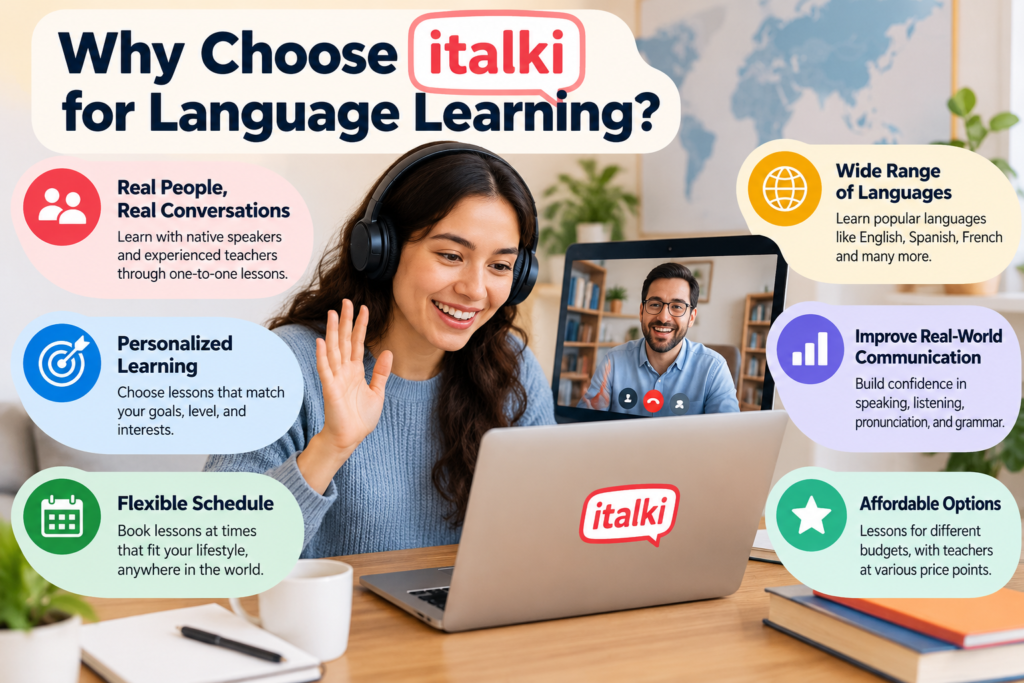
The biggest advantage of italki is personalization. Imagine learning to drive only by reading a driving manual. You could memorize every road sign and understand the theory, but eventually you need somebody beside you while you actually drive. Language works in much the same way. Reading vocabulary lists and completing grammar exercises can create knowledge, but speaking with another person forces you to retrieve that knowledge under pressure. A live teacher can notice when you repeatedly make the same mistake, ask follow-up questions, adjust the difficulty, and explain something differently when the first explanation does not click. That human feedback loop is the central attraction of italki.
The platform can also be useful for learners with very specific objectives. Someone preparing for an interview may want mock interviews and professional vocabulary, while a traveler might primarily need everyday conversation. Another student could be preparing for an exam and need writing corrections or speaking practice. Someone living abroad might simply want to become more comfortable talking with local people. This means the platform becomes much more powerful when you treat every lesson as a targeted training session rather than simply “an hour of language class.”
Personalized Learning for Different Goals
Before booking anything, ask yourself one deceptively simple question: What exactly do I want to be able to do in this language? “I want to improve my English” is a reasonable starting point, but it is too broad to guide an effective lesson. “I want to speak confidently during job interviews” gives a teacher something concrete to work with. “I want to understand movies without subtitles” points toward a completely different type of practice. “I want to write professional emails” suggests another lesson structure entirely. The clearer your destination, the easier it becomes for a teacher to build the right road.
Choosing the Right italki Teacher
Finding a teacher is arguably the most important decision you will make on italki. A platform can offer many options, but more choice is not automatically better. Teacher experience, qualifications, prices, teaching methods, availability, and specialties can vary. Instead of choosing the cheapest teacher or simply selecting the person with the most attractive profile, examine the instructor’s specialization, experience, reviews, availability, lesson description, and communication style.
Start by identifying the kind of support you actually need. If grammar explanations are confusing for you, look for someone who emphasizes structured teaching. If you understand grammar but cannot speak naturally, prioritize conversation specialists. If you need a particular accent, search for teachers who regularly work with that variety. If you are preparing for a professional situation, look for someone with relevant business or industry experience. This approach turns teacher selection from a popularity contest into a practical matching exercise. You are not looking for the “best” teacher in the abstract; you are looking for the best teacher for your current learning objective.
Professional Teachers vs. Community Tutors
The distinction between professional teachers and community tutors can be useful when deciding where to begin. Professional teachers generally offer more formal teaching experience or credentials, while community tutors can provide valuable conversational practice and interaction with fluent or native speakers. If you need detailed grammar instruction, structured exam preparation, or a carefully sequenced learning plan, a professional teacher may be the stronger starting point. If your primary objective is becoming comfortable talking with another person, a community tutor may provide a more relaxed and affordable environment.
Learning Need | Often Better Starting Point | Why |
Grammar foundations | Professional teacher | More structured explanation |
Casual conversation | Community tutor | Focus on natural interaction |
Exam preparation | Professional teacher | Goal-specific preparation |
Business communication | Specialized teacher | Relevant professional vocabulary |
Pronunciation practice | Teacher with pronunciation focus | Targeted correction |
Speaking confidence | Tutor or teacher | Frequent real conversation |
Advanced discussion | Experienced tutor/teacher | More challenging conversation |
How to Find a Teacher Who Matches Your Learning Style
Your personality matters more than many learners realize. Some students love being corrected every few minutes because immediate feedback helps them learn. Others become nervous when every sentence is interrupted and prefer corrections at the end. Some learners want homework and structured assignments, while others learn better through spontaneous conversation. The ideal instructor understands these differences instead of assuming every student should learn in exactly the same way. Use teacher profiles and lesson descriptions to understand their approach before booking rather than discovering the mismatch halfway through your first session.
You can also treat your first few lessons as experiments. Try one instructor who appears highly structured, another who emphasizes conversation, and perhaps a third who specializes in your specific goal. Then compare how comfortable you felt, how much you spoke, whether the corrections were useful, and whether you left the lesson knowing what to practice next. This is more productive than obsessing over ratings alone. A highly rated teacher can still be wrong for your learning style, while a less famous teacher may be exactly what you need. The goal is not to collect teachers; it is to find a sustainable learning relationship.
Setting Clear Language Goals Before Your First Lesson
Walking into an online language lesson without a goal is like entering a gym without knowing whether you are training for strength, endurance, or flexibility. You might still exercise, but your progress will be difficult to measure. Before an italki lesson, write down one primary objective and two or three supporting objectives. For example, your primary goal could be “speak more confidently in English,” while supporting goals could include using past tense accurately, expanding workplace vocabulary, and reducing hesitation.
A useful goal should describe an observable ability rather than a vague feeling. Instead of saying, “I want better pronunciation,” try, “I want to pronounce difficult sounds more accurately.” Instead of “I need better vocabulary,” try, “I want to learn and actively use 15 phrases for professional meetings.” Specific targets give your teacher something measurable to work with and give you something to review after class. Over time, these small targets become stepping stones toward fluency.
Improving Speaking and Conversation Skills
Speaking is where many language learners discover the gap between knowing a language and actually using it. You may recognize hundreds of words when reading but struggle to retrieve them when somebody is waiting for your answer. This happens because passive knowledge and active language production are different skills. italki’s live conversation format can help close that gap by putting you in situations where you have to listen, think, formulate an answer, and speak continuously.
To make these sessions effective, avoid turning every lesson into a simple question-and-answer routine. Ask your teacher to create realistic scenarios. Discuss a news topic, simulate a job interview, role-play a restaurant conversation, explain a technical project, debate an opinion, or describe a complicated experience. When you make mistakes, ask the teacher to identify patterns rather than correcting every isolated error. For example, if you repeatedly misuse articles, prepositions, or verb tenses, spend part of the next lesson specifically attacking that pattern. This turns conversation into deliberate practice rather than casual chatting.
Using Real Conversations to Build Confidence
Confidence grows through repeated successful experiences. The first few conversations may feel uncomfortable because your brain is trying to construct sentences while simultaneously monitoring pronunciation, vocabulary, grammar, and the other person’s reaction. That mental traffic gradually becomes lighter as frequently used expressions become automatic. Regular conversation therefore acts like a bridge between textbook knowledge and spontaneous communication. Instead of waiting until you feel confident enough to speak, use speaking practice to create the confidence you are waiting for.
Improving Listening, Grammar, and Pronunciation
Although speaking often receives the most attention, effective language learning requires multiple skills working together. A teacher can help you discover which sounds you consistently pronounce incorrectly, which grammatical structures repeatedly cause problems, and which spoken expressions you fail to recognize when people talk naturally. One useful strategy is to dedicate different sections of a lesson to different skills. You might spend the first part discussing a topic, the middle portion reviewing recurring grammar errors, and the final section practicing pronunciation or listening.
Ask your teacher to give you examples rather than abstract rules whenever possible. If you consistently make a grammar mistake, seeing several natural examples can help your brain recognize the underlying pattern. For pronunciation, recording difficult words or sentences for later practice can reinforce what you learned. For listening, ask your teacher to occasionally speak at a natural conversational speed rather than always slowing down. The objective is not to make lessons comfortable forever; it is to gradually make real-world language feel less intimidating.
Using italki for Business and Professional Language Skills
Language ability can become significantly more valuable when connected to a professional goal. If you need English for meetings, presentations, customer service, interviews, emails, or international communication, tell your teacher exactly what situations you encounter at work. A general conversation lesson may help, but a targeted professional lesson can be much more efficient. You can practice introducing yourself, explaining technical concepts, disagreeing politely, asking for clarification, participating in meetings, or responding to difficult questions.
One particularly effective method is role-play. Give your teacher a realistic scenario and ask them to act as your manager, customer, interviewer, colleague, or business partner. After the conversation, ask for feedback on grammar, vocabulary, clarity, pronunciation, and professional tone. Then repeat the same scenario using the corrections. This creates a miniature rehearsal room where mistakes are inexpensive. Instead of discovering your communication problems during an important meeting, you discover them while practicing.
Preparing for Language Exams With italki
Exam preparation requires a different approach because “being good at a language” and “performing well on a particular examination” are not identical goals. If you are preparing for a speaking examination, your teacher can simulate test conditions, time your answers, challenge you with follow-up questions, and identify recurring weaknesses. For writing-focused exams, you can submit practice responses and ask for detailed corrections. Listening and reading can also be incorporated into lessons when your teacher understands the examination format.
The key is to tell the teacher the exact examination and target score you are working toward. Do not simply say, “I need exam preparation.” Explain the test format, your current level, your deadline, and the sections causing the most difficulty. A specialized teacher can then make the lessons much more relevant. The more information you give the teacher, the more accurately the lessons can be adapted to your preparation needs.
Creating an Effective Weekly italki Study Routine
Consistency beats occasional enthusiasm. One three-hour study session followed by two weeks of inactivity is usually less useful than a manageable routine that you can maintain every week. A practical approach is to combine live lessons with independent study. For example, you might take two conversation lessons per week while spending short daily sessions reviewing vocabulary, listening to authentic content, and practicing sentences from previous lessons.
Day | Suggested Activity |
Monday | Vocabulary review + short listening |
Tuesday | italki speaking lesson |
Wednesday | Grammar practice + review corrections |
Thursday | Independent speaking practice |
Friday | italki conversation or focused lesson |
Saturday | Movies, podcasts, articles, or reading |
Sunday | Review progress and prepare next goals |
The exact schedule is less important than creating a repeatable rhythm. Flexible lesson options can make it easier to fit language practice around work, college, family responsibilities, or other commitments. If your schedule changes frequently, shorter sessions may be easier to maintain. If you have a stable routine and need deeper instruction, longer lessons may make sense. Build the habit first; optimize the schedule second.
Understanding italki Pricing and Lesson Options
One important thing to understand before using italki is that there is not one universal price for every learner. Teachers set their own rates, and the cost depends on factors such as the instructor, language, lesson type, lesson duration, and specialization. The pay-as-you-go model can give learners flexibility because they do not necessarily have to commit to one long course before determining whether a teacher suits them.
That model can be attractive because you can compare different instructors and lesson formats according to your budget. At the same time, budgeting matters. A low individual lesson price can become expensive if you book many sessions every week, while a slightly more expensive teacher may offer substantially more useful instruction for your particular goal. Compare the total learning value rather than focusing only on the cheapest number you see. Always check the current price, package conditions, and cancellation details shown at the time of booking.
Conclusion
italki can be a powerful tool for improving language skills because it places real human interaction at the center of learning. Its flexibility allows learners to choose teachers, lesson types, schedules, and goals instead of being locked into one universal curriculum. At the same time, the marketplace model means learners have to take responsibility for selecting the right instructor and maintaining a consistent learning routine.
The best way to approach italki is not to ask, “How many lessons should I buy?” Instead, ask, “What language ability am I trying to build, and what practice will get me there?” Find a teacher who understands that goal, begin with a focused lesson, review your mistakes afterward, and keep practicing between sessions. Whether you want to improve everyday conversation, professional communication, pronunciation, grammar, listening, or exam performance, the platform becomes more valuable when every lesson has a clear purpose. With patience, regular practice, and the right teacher, those awkward early conversations can gradually become comfortable, spontaneous communication.
Read Also:
Frequently asked questions
Yes. italki is particularly useful for learners who want personalized live interaction with teachers or tutors. Its one-to-one approach allows learners to select instructors according to their goals, level, schedule, and preferred teaching style. The results you achieve will depend heavily on the teacher you choose and how consistently you practice.
Yes. Beginners can benefit from one-to-one instruction because the teacher can adjust explanations, speaking speed, vocabulary, and lesson difficulty to the student's level. Beginners should look for teachers who explicitly offer structured lessons for new learners and should clearly communicate their current level before starting.
There is no single fixed price because teachers set their own rates. The cost can vary according to the teacher, language, lesson type, duration, and specialization. Learners should check the current teacher profile and booking information for the exact price before purchasing.
Choose based on your objective. A professional teacher may be more appropriate for structured grammar instruction, exam preparation, or specialized learning, while a community tutor can be useful for conversation practice and informal interaction. You can also try different instructors before deciding who fits your learning style best.
There is no universal schedule, but consistency is more important than occasional intensive study. One or two focused lessons each week, combined with independent practice between sessions, can create a sustainable routine. The best schedule is the one you can realistically maintain for months rather than only for a few weeks.