
Discover how Jobscan.co can help improve your resume and increase your chances of getting noticed by employers. This guide explains how Jobscan.co helps optimize resumes for Applicant Tracking Systems (ATS), identify important keywords, improve resume formatting, and tailor applications to specific job descriptions. Whether you are actively job hunting or preparing for your next career opportunity, learn how Jobscan.co can make your resume more effective and competitive.
Table of Contents
ToggleUnderstanding Jobscan and Modern Resume Screening
Searching for a job can sometimes feel like sending your resume into a giant black box. You may have the right education, relevant experience, and technical skills, yet applications can still disappear without a response. One reason is that many employers use Applicant Tracking Systems (ATS) to organize, search, and filter applications before recruiters review them. Jobscan is designed to compare your resume against a specific job description and identify areas involving keywords, formatting, skills, and other resume elements.
This is where Jobscan.co can become useful. Instead of treating your resume as a document that should look exactly the same for every employer, the platform encourages a more targeted approach. You provide your resume and the job description, and then examine the resulting report to see where your application could be stronger. The idea is simple: rather than guessing what an employer might be looking for, you can compare your existing qualifications with the language and requirements appearing in the vacancy.
Why Applicant Tracking Systems Matter
An ATS is recruiting software that helps companies manage large numbers of applications. These systems can parse information from resumes, allowing recruiters to search for skills, qualifications, job titles, and other relevant information. This does not necessarily mean that an ATS independently decides whether someone gets hired. Instead, it helps employers organize applications and identify candidates whose resumes appear relevant to a particular position.
For a job seeker, this creates an important distinction between having a good resume and having a job-targeted resume. A beautifully written resume may still perform poorly for a particular position if it does not clearly communicate the qualifications emphasized in the job advertisement. For example, suppose a web developer vacancy mentions JavaScript, Laravel, MySQL, REST APIs, Git, and responsive design. If your resume contains those skills but describes them using completely different language or buries them in an unclear format, the document may not communicate your suitability as effectively as it could.
How Jobscan Compares Your Resume With a Job Description
The basic Jobscan workflow is straightforward. You provide your resume and the text of the job description, and the platform generates a report showing how closely they correspond. The analysis can consider areas such as hard skills, education, job titles, soft skills, keywords, and industry terminology.
The important point is that Jobscan is not simply checking whether your resume contains a certain number of keywords. It provides a broader picture of alignment between the vacancy and your application. This can be particularly useful when you are applying for several positions that appear similar but have different requirements.
Key Ways Jobscan Can Improve Your Resume
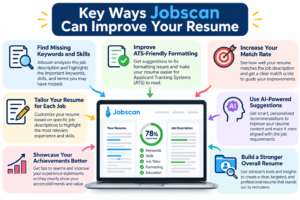
One of the biggest advantages of using Jobscan is that it turns resume optimization into a more measurable process. Without a tool, you might read a job description and think, “My resume looks relevant.” That is useful, but it is subjective. Jobscan can provide structured feedback that highlights missing skills, keywords, formatting problems, and other areas that deserve attention.
This matters because resume improvement is often less about rewriting everything and more about improving the connection between your experience and the employer’s requirements. A candidate might have several years of relevant experience but describe that experience too generally. Another candidate might possess the required technical skills but fail to mention them clearly enough. Jobscan can help expose those weaknesses, giving you a practical starting point for revisions.
Finding Missing Keywords and Skills
Keywords are an important part of modern resume optimization because recruiters and recruiting systems need to identify relevant qualifications efficiently. Jobscan compares your resume with the job description and can identify missing terms related to hard skills, soft skills, job titles, certifications, tools, methodologies, and industry language.
This can be especially helpful for technical professionals whose resumes contain many specialized technologies. Imagine applying for a frontend developer role that requests React, JavaScript, TypeScript, REST APIs, Git, testing, and responsive design. Your resume may say that you “developed modern web interfaces,” which sounds professional but does not communicate the technical details as clearly as mentioning the actual technologies you used.
If you genuinely possess those skills, adding the appropriate terminology can make the resume more precise. The goal should never be to insert random keywords simply to increase a score. Instead, Jobscan can help you notice legitimate qualifications that you may have overlooked.
Improving ATS-Friendly Resume Formatting
Content is only one part of resume optimization. Formatting can also affect how easily recruiting software extracts information from your document. Jobscan can check elements such as layout, fonts, page setup, section headings, tables, text boxes, headers, footers, graphics, and contact information.
This is particularly important because candidates sometimes design resumes like brochures. Multiple columns, decorative graphics, icons, charts, unusual section names, and information hidden inside headers may look attractive to a human but can create unnecessary complications for software.
A clean resume does not have to be boring. You can still create a professional document with strong hierarchy, spacing, typography, and concise achievement statements while keeping the underlying structure easy for both software and human readers.
Common Formatting Problems to Avoid
A practical ATS-friendly resume generally benefits from a simple structure. Potential problems can include excessive tables, text boxes, graphics, complex multi-column layouts, headers, footers, unusual section headings, and inconsistent formatting.
When improving your resume, focus on clarity first. Put your contact information somewhere the system can easily identify it, use conventional section titles such as Professional Experience, Education, and Skills, and keep employment history in a logical reverse-chronological order.
Standard fonts and sensible formatting can also make the document easier for both software and human readers. In other words, your resume should work like a well-organized website: the design should support the information rather than hiding it.
Understanding Jobscan's Match Rate
Jobscan’s Match Rate is one of its recognizable features. After comparing your resume with a specific job description, the system gives you a percentage intended to visualize the strength of the match. Jobscan recommends aiming for a 75% or higher Match Rate, while also emphasizing that the number is a measurement tool rather than a guarantee that you will receive an interview.
That distinction is important. A 90% score does not mean you are guaranteed a job, just as a lower initial score does not mean you are unqualified. The score should instead help you identify areas where your resume may not be aligned with the specific opportunity.
Once you make legitimate improvements, you can scan the resume again and observe whether the alignment has improved.
What a 75% Match Rate Means
A 75% Match Rate can be viewed as a useful target within Jobscan’s methodology. It suggests that your resume has a relatively strong alignment with the requirements and language being evaluated for that particular position.
However, the meaning of the score depends on the job description you are using and the qualifications you actually possess. You should never change your resume simply to chase a higher number if doing so would make your application inaccurate.
For example, if a job requires a certification you do not have, adding that certification merely because it increases your Match Rate would be misleading. Instead, use the report to distinguish between missing qualifications and missing wording.
If you have a skill but forgot to mention it, update your resume. If you genuinely do not have a mandatory qualification, the appropriate response may be to improve your qualifications or pursue a different role rather than manipulate the resume.
Why Match Rate Should Not Be Your Only Goal
A resume ultimately has to persuade a human being. A Match Rate is useful, but it should not become the only measurement of resume quality.
A 90% keyword match cannot compensate for weak achievements, unclear writing, inaccurate information, or irrelevant experience. Similarly, a lower score does not automatically mean that you are a poor candidate.
Strong applications still need clear achievements, accurate information, professional writing, relevant experience, and a convincing explanation of the value you can bring to the employer.
The strongest strategy is therefore to use Jobscan as a quality-control tool while keeping your genuine professional story at the center.
Tailoring Your Resume for Individual Applications
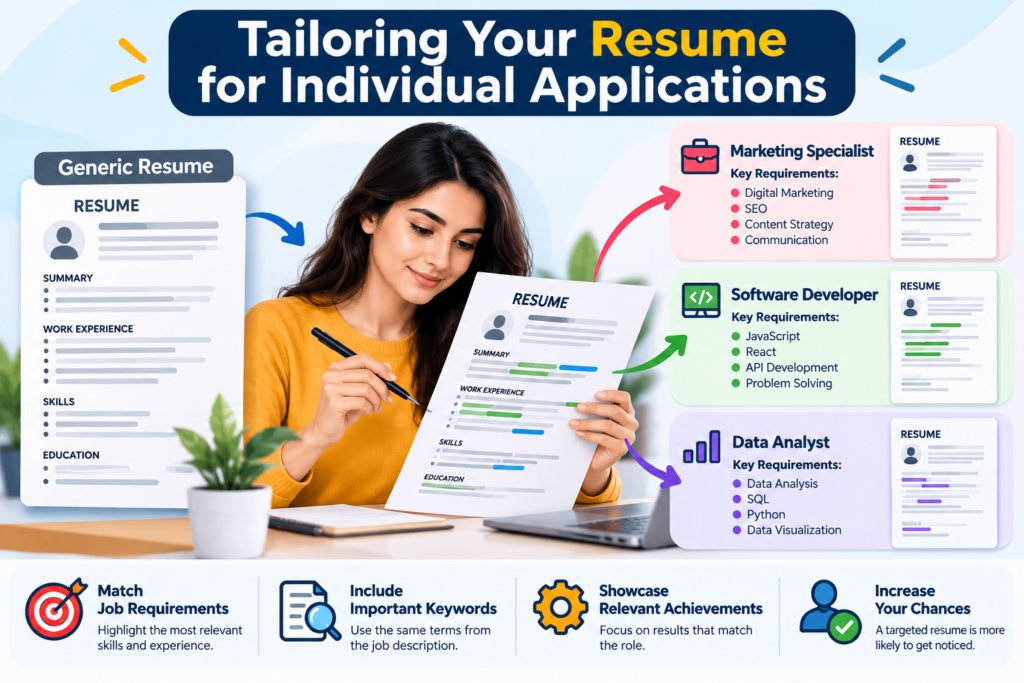
One of the most useful ideas behind Jobscan is that you should not necessarily send exactly the same resume to every employer. Different organizations emphasize different skills, responsibilities, technologies, and terminology.
A software developer position at one company might prioritize React and testing, while another might focus heavily on Node.js, cloud services, and API development. A generic resume may contain everything, but the most relevant information can become difficult to notice.
Jobscan’s tools are built around this concept of targeted applications. The platform compares a resume with an individual job description, allowing candidates to identify gaps and make changes for that particular opportunity.
Using AI-Powered Resume Optimization
Jobscan also provides AI-based optimization features that can suggest changes based on the requirements of a specific job description. Users can review suggested changes and decide whether to accept or reject them.
This gives candidates more control than simply allowing an automated system to rewrite the entire document without review. That control is valuable because AI should be treated as an assistant, not as the owner of your career story.
Suppose an AI tool suggests adding a skill you have never used. The correct response is to reject the suggestion. If it identifies an experience you already have but describes it more clearly using terminology from the job listing, that may be a useful improvement.
The best result comes from combining automation with human judgment.
Keeping Your Experience Authentic
Resume optimization should make your experience easier to understand, not change your professional history. This distinction becomes particularly important when using AI-based tools.
You can use Jobscan to discover that a vacancy emphasizes “project management,” for example, but you should only include that phrase prominently if your actual experience supports it.
A good resume tells the truth in the clearest possible language. If you coordinated tasks, deadlines, stakeholders, and deliverables, you can describe those responsibilities professionally.
However, you should not transform a minor participation role into leadership experience simply because the job description contains the word “leadership.” Authenticity protects your credibility during interviews, where recruiters may ask you to explain anything you included in your application.
Building a Stronger Resume With Jobscan
Jobscan is not limited to scanning an existing resume. Its platform also includes tools for creating and improving resumes.
This can be useful if your current resume has become difficult to manage. Perhaps you have changed careers, gained several new certifications, completed projects, or accumulated experience across multiple companies.
Instead of repeatedly editing an outdated document, you can create a cleaner base resume and then use targeted optimization for individual applications.
The combination of a foundational resume and job-specific tailoring creates a practical two-stage workflow: first build your professional foundation, then adapt it for the opportunity in front of you.
Using the Resume Builder
A resume builder can help candidates structure their information into recognizable sections and use templates designed with ATS compatibility in mind.
A useful approach is to think of this document as your master resume. Include your genuine experience, major accomplishments, education, certifications, technical abilities, and relevant projects.
Then, when you find a specific vacancy, create a tailored version that emphasizes the experience most relevant to that employer.
This prevents you from repeatedly rebuilding your career history while still allowing each application to feel customized.
Improving Resume Content and Achievements
A strong resume should not simply tell recruiters what you were responsible for; it should show what you accomplished.
Compare these two statements:
“Responsible for maintaining company website.”
and:
“Maintained and improved the company website, resolving front-end issues and improving page usability across desktop and mobile devices.”
The second statement provides more context about the actual contribution.
Where possible, measurable outcomes make the story even stronger. For example, you might mention reduced loading time, increased conversions, improved processing speed, reduced errors, or the number of users supported.
Numbers should always be truthful, but they can make achievements much easier for a recruiter to understand.
Using Jobscan Beyond Resume Optimization
Jobscan has expanded beyond its core resume scanner into a broader collection of job-search tools. These can include resume building, resume scanning, AI optimization, LinkedIn optimization, job application tracking, personalized job listings, and other career-related resources.
That broader ecosystem can be useful because job searching is rarely just a resume problem. You need to discover appropriate positions, customize applications, maintain your professional presence, track what you have submitted, and prepare for interviews.
Having tools that support different parts of this process can reduce the amount of information you need to manage manually.
Still, the most important factor remains your career strategy. Tools can organize and improve your process, but they cannot replace relevant skills, experience, preparation, and thoughtful applications.
LinkedIn and Job Search Features
Jobscan also offers features designed to help candidates improve their professional presence and discover potentially relevant job opportunities.
This creates an interesting workflow. Instead of searching randomly for hundreds of vacancies, you can focus on roles that are reasonably aligned with your experience, evaluate the job description, tailor your resume, and track the application.
The process becomes less like throwing dozens of resumes into the air and hoping one lands and more like aiming carefully at opportunities where your background has a genuine connection.
Creating a More Organized Application Strategy
Organization is an underrated part of a successful job search. When you apply to many positions, it is easy to forget which version of your resume you used, which keywords appeared in the job description, when you applied, or whether an employer has contacted you.
An application tracker can help candidates keep track of listings, applications, interviews, follow-ups, and other important details.
A structured approach can also reveal patterns. If you repeatedly receive strong Match Rates but few interviews, your issue may not be resume alignment alone.
Perhaps your experience level does not match the positions, your interview preparation needs work, or the roles are highly competitive.
On the other hand, if your Match Rates are consistently low, your resume may need better targeting. Tracking these patterns helps you make decisions based on evidence instead of frustration.
Best Practices for Getting More From Jobscan
The most effective way to use Jobscan is to treat it as a resume improvement assistant, not as a magic button.
Start with a truthful, well-written resume containing your actual experience. Then select a job that genuinely interests you and compare your resume with the vacancy.
Review the missing keywords, formatting recommendations, skills, and other feedback before deciding what changes make sense.
It is also useful to focus on the most important changes first. If the report shows that you possess several required skills but have not mentioned them, update those areas before worrying about small stylistic details.
If your formatting is difficult for ATS software to parse, simplify the structure. If your resume is full of responsibilities but lacks achievements, rewrite the strongest experience bullets to demonstrate results.
In short, use the tool to identify the biggest gaps, fix those gaps honestly, and then evaluate the document again.
Mistakes to Avoid When Optimizing
The biggest mistake is keyword stuffing. Repeating the same term dozens of times does not make a resume more convincing.
Another mistake is copying the job description word for word, which can make your resume sound unnatural and may create claims you cannot support.
A third mistake is optimizing solely for a Match Rate while ignoring readability, achievements, career progression, and recruiter appeal.
You should also avoid changing every resume for every job from scratch. Build a strong master resume first, then make targeted adjustments.
Most importantly, remember that the purpose of optimization is not to trick an ATS. The purpose is to make it easier for an employer to understand that your real qualifications match what they need.
When used correctly, Jobscan can help translate your genuine experience into clearer, more targeted resume language.
Conclusion
Jobscan.co can help improve your resume for job applications by making resume tailoring more systematic and measurable. Its resume scanner compares your document with a specific job description, identifies missing keywords and skills, checks ATS-related formatting issues, and provides a Match Rate that can help you evaluate your level of alignment.
Its broader tools can also support resume building, AI-powered optimization, professional profile improvement, job discovery, and application tracking.
The biggest lesson is that a resume should not be treated as a static document. Your career history stays the same, but the way you present the most relevant parts of that history can change depending on the position.
Jobscan gives you a practical way to identify those differences and make informed adjustments. Used thoughtfully, it can turn resume optimization from a guessing game into a repeatable process: understand the job, compare your qualifications, fix genuine gaps, improve clarity, and apply with greater confidence.
Read Also:
Jabra Australia Explained: A Guide to Headsets, Earbuds, and More
A Complete Guide to Improving Your Language Skills With italki
What You Should Know Before Using InVideo for Video Editing
How MEL Science Can Make STEM Education More Engaging
Everything You Need to Know About Ever—Pretty UK: A Complete Guide
Frequently asked questions
Jobscan.co is a job-search platform that provides tools for analyzing and optimizing resumes against specific job descriptions. Its resume scanner evaluates areas such as keywords, skills, formatting, job titles, education, and ATS compatibility.
Jobscan recommends aiming for a 75% or higher Match Rate. However, the score should be viewed as a helpful measurement rather than a guarantee of receiving an interview or job offer.
Yes. Jobscan can identify formatting and content elements that may affect ATS readability. These can include layouts, section headings, fonts, tables, graphics, headers, footers, and relevant keywords.
It is generally better to maintain a strong master resume and tailor important sections for individual opportunities. A targeted resume can highlight the experience and skills most relevant to each specific position.
No. A high Match Rate indicates stronger alignment with the job description according to Jobscan's analysis, but it does not guarantee an interview. Recruiters also consider experience, achievements, qualifications, communication, career progression, and many other factors.