

Planning a trip around South America can feel like putting together a giant puzzle. There are enormous distances between major cities, different countries with different travel systems, and plenty of destinations that are much easier to reach by air than by road. This is where LATAM Airlines becomes particularly relevant. LATAM has developed one of the most extensive airline networks in Latin America, connecting major cities, regional destinations, and international gateways through a combination of domestic, regional, and long-haul services. For travelers who want to explore places such as Brazil, Chile, Peru, Argentina, Colombia, or Ecuador, understanding how LATAM works can make the entire planning process much easier.
LATAM is not simply an airline for getting from one major city to another. Its network is designed around several important South American hubs, allowing passengers to build journeys that include multiple countries and destinations. The airline’s current destination information highlights extensive services across countries including Argentina, Brazil, Bolivia, Chile, Colombia, Ecuador, Paraguay, Peru, and Uruguay. At the same time, LATAM continues to promote new international connections, including recently announced direct services involving destinations such as Buenos Aires and Guayaquil.
Whether you are a first-time visitor to South America, a frequent business traveler, or someone planning a multi-city vacation, LATAM Airlines routes, services, and travel options are worth understanding before booking. This guide explains what the airline offers, how its fare structure works, what to know about baggage, how LATAM Pass fits into the picture, and how travelers can choose flights that match their needs rather than simply selecting the cheapest ticket.
Table of Contents
ToggleWhat Is LATAM Airlines?
LATAM Airlines is the principal passenger airline brand of the LATAM airline group and has a particularly strong presence throughout South America. The group operates domestic services in major South American markets while also providing regional and long-haul international connections. Its network has historically been built around major hubs such as São Paulo, Santiago, and Lima, giving travelers multiple ways to connect between countries and continents.
The scale of the network is one of the airline’s biggest advantages. LATAM’s corporate information has described the group as one of the largest airline groups in Latin America, with passenger operations covering a broad collection of countries and destinations. Its network strategy is especially useful for travelers whose journeys do not begin and end in the same country. Instead of thinking about LATAM as a simple point-to-point carrier, it is often more useful to think of it as a bridge connecting different parts of the continent. That distinction matters because a traveler might use the airline for a short domestic flight in Brazil, a regional flight from Chile to Peru, or a longer international itinerary connecting South America with North America.
LATAM’s Role in South American Aviation
LATAM’s importance becomes clearer when looking at the geography of South America. Countries such as Brazil, Chile, Argentina, Peru, and Colombia cover enormous areas, and some popular tourist destinations are separated by mountains, rainforests, deserts, or thousands of kilometers of road. Air travel therefore becomes an important part of exploring the region efficiently.
LATAM’s destination listings include major urban centers as well as tourism-oriented locations. In Brazil, for example, the airline lists destinations ranging from São Paulo and Rio de Janeiro to Manaus, Fortaleza, Recife, Florianópolis, and Foz do Iguaçu/Iguazu Falls. In Chile, the network reaches cities such as Santiago, Antofagasta, Calama, Puerto Montt, Punta Arenas, and Easter Island. This breadth means travelers can often use the same airline for several stages of a South American itinerary.
LATAM Airlines Route Network
One of the biggest reasons travelers consider LATAM is the breadth of its route network. Rather than concentrating only on a handful of international routes, the airline has a substantial domestic presence in several South American countries. That creates useful connection possibilities for passengers who want to visit more than one city.
The network changes over time because airlines add, remove, or adjust routes according to demand, aircraft availability, seasonality, and commercial strategy. That is why travelers should always check the current timetable when planning a trip instead of assuming that a route operated in a previous year will still operate on the same schedule. LATAM’s current online destination and flight pages provide the most useful starting point for checking available routes.
Domestic Routes Across South America
Domestic flying is one of LATAM’s strongest areas. The airline operates significant domestic networks in Brazil, Chile, Peru, Colombia, and Ecuador, making it particularly useful for travelers who want to explore one of these countries beyond its primary international gateway.
Brazil is especially important because of the country’s size. A traveler visiting São Paulo might want to continue to Rio de Janeiro, Brasília, Salvador, Recife, Fortaleza, Manaus, or another regional destination. Flying can save substantial travel time compared with long-distance ground transportation. Chile offers a similarly interesting situation, with a long north-to-south geography and destinations ranging from desert regions in the north to Patagonia and other southern locations.
Peru is another major example. International travelers frequently arrive through Lima and then continue to destinations elsewhere in the country. Colombia’s domestic network can also be useful for travelers moving between cities and regions that are geographically distant from one another. The exact availability of flights depends on the travel date and current schedule, but LATAM’s country destination pages provide a broad picture of its current network.
Key Regional Hubs
Several cities are particularly important when understanding how LATAM connects destinations. São Paulo, Santiago, and Lima have historically served as major connection points within the group’s network. These hubs can allow passengers to combine international and domestic flights within a broader itinerary.
For example, someone traveling from North America to a smaller South American destination may not find a convenient nonstop flight. Instead, the journey could involve a major gateway followed by a LATAM connection. Similarly, a traveler visiting multiple South American countries can potentially structure an itinerary around one or more of these major hubs.
This hub-based structure is one reason LATAM can be useful for multi-city travel. Instead of booking every flight independently with different airlines, travelers can investigate whether several parts of the trip can be coordinated through one airline or its associated network.
International and Long-Haul Connections
LATAM is also relevant for travelers entering or leaving South America. The airline operates international services connecting the region with destinations outside South America, with availability depending on the origin, destination, season, and schedule.
Current LATAM information also highlights newer route opportunities. For example, its U.S. website currently promotes direct services from New York to Guayaquil and Miami to Buenos Aires for specific 2026 travel dates. These examples demonstrate how the network continues to evolve rather than remaining fixed.
For international travelers, the key advantage is often connectivity rather than simply the existence of a nonstop route. A flight from a major international gateway can potentially connect into LATAM’s broader South American network, making it easier to reach secondary cities. Before booking, however, passengers should compare connection times, airport changes, baggage rules, and whether the entire itinerary is issued as one ticket.
Popular LATAM Airlines Destinations
LATAM’s network covers many different travel styles. Some passengers are looking for beaches and coastal cities, others want major business centers, while many are interested in natural attractions and cultural destinations. The airline’s current destination listings cover numerous cities across South America.
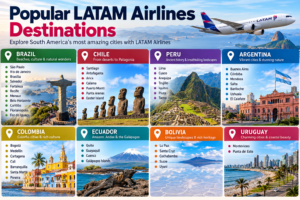
Brazil, Chile, Peru, and Argentina
Brazil is one of the most important markets for LATAM. São Paulo is a major business and aviation center, while Rio de Janeiro is one of the world’s best-known leisure destinations. Other Brazilian destinations listed by LATAM include Belo Horizonte, Brasília, Curitiba, Florianópolis, Fortaleza, Manaus, Porto Alegre, Recife, Salvador, and Iguazu Falls.
Chile provides a very different travel experience. Santiago is the country’s major metropolitan gateway, but LATAM also serves destinations such as Antofagasta, Arica, Calama, Puerto Montt, Punta Arenas, and Easter Island. This makes the airline potentially useful for travelers combining city sightseeing with desert, mountain, lake, or southern Patagonia experiences.
Peru is another major destination market, particularly for travelers interested in Lima and the country’s famous archaeological and cultural attractions. Argentina, meanwhile, offers Buenos Aires as a major international gateway along with destinations such as Córdoba, Mendoza, and Salta.
The beauty of these networks is that travelers can design different types of trips. A single vacation could focus on one country, while a longer itinerary could combine major cities across several nations.
Colombia, Ecuador, Bolivia, and Uruguay
LATAM also serves a variety of destinations in northern and central South America. Colombia offers important urban and regional connections, while Ecuador provides access to cities and tourism regions on the mainland. Bolivia and Uruguay add further possibilities for travelers building broader South American itineraries.
Travelers should remember that a destination appearing on an airline’s network page does not necessarily mean there is a nonstop flight from every international origin. Often, the practical route involves connecting through a major gateway. The best itinerary therefore depends on the starting city, travel dates, desired arrival time, and tolerance for connections.
LATAM Airlines Flight Options and Fare Types
One of the most important things to understand before buying a LATAM ticket is that the cheapest advertised fare does not necessarily provide everything a traveler expects. LATAM uses different fare families, and included services can vary according to the market, route, cabin, and ticket conditions.
LATAM’s current fare information describes Basic, Light, Plus, and Top options in applicable markets. The Basic fare is designed as the simplest option, while higher fare categories provide progressively more flexibility and included services.
Basic, Light, Plus, and Top Fares
The Basic fare can work well for travelers who are taking a short trip and want to keep the initial ticket price low. However, travelers should pay close attention to what is excluded. In the markets described by LATAM, the Basic fare may not include hold baggage and may have more limited cabin baggage provisions.
The Light option provides additional inclusions while still maintaining a relatively flexible approach to optional extras. Plus is positioned as a more complete fare, with features such as seat selection and checked baggage depending on the route. Top is designed for travelers who value flexibility and broader inclusions.
Fare type | General positioning | Best suited to |
Basic | Lowest-level fare with limited inclusions | Short trips and light packers |
Light | More inclusions while keeping optional extras | Travelers seeking value |
Plus | More complete travel package | Travelers carrying checked baggage |
Top | Higher flexibility and broader benefits | Business travelers and flexible itineraries |
The exact inclusions can differ by market and itinerary, so travelers should use the fare comparison displayed during booking rather than relying solely on a general table.
Cabin Experience and Onboard Services
A good airline experience is about more than reaching the destination. Seat comfort, cabin configuration, onboard service, entertainment, baggage handling, and the ability to manage a booking digitally can all affect how a journey feels.
LATAM operates different cabin products depending on aircraft and route. Economy is the standard choice for most travelers and is usually the most economical way to travel. Premium cabins are designed for passengers seeking additional space, service, or flexibility, with the exact offering depending on the aircraft and route.
Travelers should also pay attention to aircraft type when comparing flights. Two flights on the same city pair can offer different experiences if they use different aircraft. On a longer flight, the difference can matter considerably because seat configuration, storage, cabin layout, and available services may vary.
The airline has also invested in digital tools that allow travelers to manage reservations, check in, and handle various parts of their journey through digital channels. For frequent travelers, this can reduce the amount of time spent dealing with airport counters and make itinerary management easier.

LATAM Airlines Baggage Allowance
Baggage is one of the areas where travelers can accidentally spend more money than expected. The important lesson is simple: never assume that every LATAM fare includes the same baggage allowance.
LATAM currently states that passengers can bring a small personal item that fits under the seat. Its published maximum dimensions for this item are 45 × 35 × 20 cm. Depending on the fare and cabin, passengers may also have an additional small bag for the overhead compartment.
For applicable carry-on baggage, LATAM lists a maximum size of 55 × 35 × 25 cm. The published weight limit is 12 kg for Economy and 16 kg for Premium Economy or Premium Business.
Carry-On and Checked Baggage Rules
Checked baggage rules depend heavily on the fare and route. Where a 23 kg checked bag is included, LATAM’s baggage information indicates that the maximum linear dimensions are generally 158 cm, calculated by adding height, length, and width.
If your ticket does not include the baggage you need, adding it in advance can be a smarter choice than waiting until the airport. LATAM states that baggage can be added through the booking-management area and that advance purchase may provide savings compared with buying certain services later.
A practical packing strategy is therefore to decide what you need before selecting the fare. If you are traveling for three days with only a backpack, paying for a higher fare primarily because it includes checked luggage may make little sense. On the other hand, someone carrying a large suitcase for a two-week vacation should compare the total cost of the fare plus baggage rather than comparing headline ticket prices alone.
LATAM Pass Loyalty Program
Frequent travelers may want to look beyond individual ticket prices and consider LATAM Pass, the airline group’s loyalty program. LATAM Pass allows members to accumulate miles that can be used for rewards such as flights and other eligible products or services.
The program includes four current Elite categories: Gold, Platinum, Black, and Black Signature. LATAM says these categories can provide benefits such as additional mileage earning, priority services, upgrade-related benefits, and other travel privileges depending on status.
The important distinction is between miles and qualifying points. Miles are generally connected with redemption, while qualifying points are used for moving toward or maintaining Elite status. Understanding this difference can help frequent flyers avoid confusing the currency used for rewards with the measurements used for status.
For travelers who regularly fly within South America, a loyalty program can become more valuable over time. A single flight may not produce a dramatic benefit, but repeated travel can turn ordinary bookings into a longer-term rewards strategy.
Booking and Managing a LATAM Airlines Trip
Booking a LATAM flight is straightforward, but getting the right flight requires more thought than simply searching for the cheapest fare. Start by entering your actual travel dates and preferred origin and destination, then compare the available flight times. A slightly more expensive nonstop flight may be more convenient than a cheaper itinerary with a long connection.
Next, examine the fare conditions. Look at baggage, seat selection, changes, cancellation conditions, and mileage eligibility. If you are comparing two flights with different prices, calculate the final cost after adding any services you know you will need.
The airline’s digital tools can also help travelers manage reservations after purchase. If your plans change, check your booking before going to the airport rather than assuming that the original itinerary is still valid.
For international trips, leave enough time for immigration, security, and connections. This becomes particularly important when the itinerary involves separate tickets or a change between airlines. A cheap ticket is not necessarily a good deal if a missed connection creates additional costs.
Tips for Choosing the Right LATAM Flight
The best LATAM flight is not necessarily the cheapest one. It is the flight that provides the best combination of price, schedule, baggage, connection time, and flexibility for your particular trip.
If you are a light traveler, a lower fare may be perfectly reasonable. If you are carrying checked luggage, however, compare the complete price after baggage is added. Likewise, if your travel plans are uncertain, a more flexible fare can sometimes save money in the long run.
For multi-city trips, consider the entire itinerary rather than each flight individually. For example, if you plan to visit Santiago, Lima, and Buenos Aires, look at the complete sequence of flights and connection times. A schedule that looks inexpensive when viewed one segment at a time may become inconvenient when combined.
Another useful strategy is to compare different departure dates. Airline pricing can change significantly depending on demand, holidays, weekends, and seasonal travel patterns. If your schedule is flexible, checking nearby dates may reveal a better balance of price and convenience.
Finally, always review the current baggage and fare conditions before payment. LATAM’s published rules can vary by route and fare, and the airline specifically directs passengers to check the conditions applicable to their reservation.
Conclusion
LATAM Airlines offers travelers a broad way to explore South America, from major metropolitan destinations such as São Paulo, Santiago, Lima, and Buenos Aires to regional cities and tourism-focused destinations across the continent. Its network is especially useful for travelers who want to combine multiple countries or travel beyond the primary international gateway. Current destination information demonstrates the breadth of its South American network, while its continually changing international schedule creates additional opportunities for long-distance travelers.
The key to getting good value from LATAM is understanding what you are actually purchasing. Fare families can differ significantly in terms of baggage, seat selection, flexibility, and other inclusions, so the cheapest advertised ticket is not automatically the cheapest overall trip. Baggage deserves particular attention because LATAM has specific size and weight requirements for personal items, carry-on bags, and checked luggage.
For occasional travelers, the airline’s route coverage and fare choices can make trip planning easier. For frequent flyers, LATAM Pass adds another dimension by offering miles and Elite-status benefits. Whether your goal is a short domestic flight, a South American adventure, or a long-haul journey with regional connections, understanding LATAM’s routes and services can help you make a more informed booking decision.
Read Also:
How Jobscan.co Can Help Improve Your Resume for Job Applications
Jabra Australia Explained: A Guide to Headsets, Earbuds, and More
A Complete Guide to Improving Your Language Skills With italki
What You Should Know Before Using InVideo for Video Editing
How MEL Science Can Make STEM Education More Engaging
Frequently asked questions
LATAM has an extensive network across South America, with current destination listings covering countries including Argentina, Brazil, Bolivia, Chile, Colombia, Ecuador, Paraguay, Peru, and Uruguay. The exact routes and schedules depend on the departure city and travel date.
LATAM can be particularly useful for South American travel because of its extensive domestic and regional network. Its connections through major hubs can make it easier to combine multiple cities or countries in one itinerary.
It depends on the fare, route, and cabin. Some fare types include checked baggage, while lower fares may require passengers to purchase additional baggage separately. Always check the baggage allowance shown for your specific reservation.
LATAM Pass is LATAM's loyalty program. Members can earn LATAM Pass Miles for eligible activities and redeem them for flights and other rewards. The program also includes Elite categories with additional benefits for qualifying members.
Compare multiple travel dates and examine the complete fare rather than only the advertised ticket price. Include baggage, seat selection, flexibility, and other services you expect to use. A slightly higher fare can sometimes provide better overall value if it includes services you would otherwise purchase separately.