

Affiliate marketing has become one of the most practical ways for publishers, bloggers, content creators, and digital marketers to monetize an audience. Instead of building a product from scratch, marketers can connect people with products they genuinely need and earn a commission when a successful transaction occurs. Udemy APAC – CPS fits directly into this model by giving marketers an opportunity to promote online learning products to audiences across the Asia-Pacific region. For anyone already working with education, technology, careers, professional development, or personal growth content, the campaign can be particularly relevant.
Table of Contents
ToggleThe interesting thing about promoting online education is that the audience is often driven by a strong intention. Someone searching for a Python course, digital marketing training, graphic design lessons, or cybersecurity education is usually not browsing randomly. They are actively looking for a solution. That makes educational affiliate campaigns different from many impulse-driven ecommerce offers. A well-targeted recommendation can connect a learner with relevant training while creating an opportunity for the marketer to earn through a Cost Per Sale (CPS) model.
Udemy’s official affiliate program currently operates through Impact and allows approved partners to promote thousands of courses and selected promotional offers using tracking links and deep-linking capabilities. The program also provides promotional resources and performance reporting for affiliates.
This guide explains what Udemy APAC – CPS means, how the affiliate structure works, what marketers should understand before joining, and how to build campaigns that focus on audience relevance rather than simply dropping affiliate links everywhere.
What Is Udemy APAC - CPS?
The term Udemy APAC – CPS generally refers to a Cost Per Sale affiliate campaign associated with Udemy and targeting or operating within the Asia-Pacific market. APAC, short for Asia-Pacific, represents a broad collection of markets with different languages, purchasing behaviors, education systems, digital adoption levels, and professional development needs. For marketers, this diversity creates both opportunity and complexity. A campaign strategy that performs well in India may require significant adjustments before it can succeed in Japan, Australia, Singapore, Indonesia, or other APAC markets.
The CPS portion is much easier to understand. Cost Per Sale means the advertiser pays when a qualifying sale occurs. Unlike CPM advertising, where revenue may be based on impressions, or CPC campaigns that reward clicks, a CPS model focuses on completed customer transactions. This structure creates a strong relationship between traffic quality and earnings. Sending thousands of irrelevant visitors may produce almost no revenue, while sending a smaller number of highly motivated users can generate meaningful conversions.
For marketers, this means the campaign should not be approached as a traffic-generation contest. The real objective is to understand search intent, audience needs, and course relevance. Think of yourself less like a billboard owner and more like a knowledgeable guide. If someone asks for the best beginner course to learn Excel, sending them to a random programming course makes little sense. But recommending a carefully selected Excel course that matches their experience level can create a much better experience for both the user and the advertiser.
Understanding the Cost Per Sale Model
A CPS campaign follows a relatively straightforward journey. A marketer creates content, promotes an offer, or shares a tracked recommendation. A potential customer clicks the affiliate link and visits the advertiser’s website. If that customer completes a qualifying purchase within the applicable attribution conditions, the affiliate may receive a commission. The simplicity of the model is attractive, but successful execution requires considerably more strategy.
Imagine two different websites. The first publishes a generic article titled “Best Online Courses” and lists dozens of unrelated affiliate links. The second publishes a detailed guide titled “Best Python Courses for Beginners in 2026,” compares learning outcomes, discusses prerequisites, and recommends relevant options for different learner types. Which website is more likely to convert visitors? In most cases, the second approach has a clear advantage because it addresses a specific problem with useful information.
CPS marketing rewards relevance. The marketer’s goal should be to reduce the distance between the visitor’s problem and the product being promoted. When the recommendation feels natural, conversion becomes easier. When the recommendation feels forced, users lose trust.
Udemy’s affiliate structure officially allows approved affiliates to earn commissions from valid paid course purchases generated through their tracking links, subject to program terms and attribution rules.
Why APAC Matters for Udemy Marketers
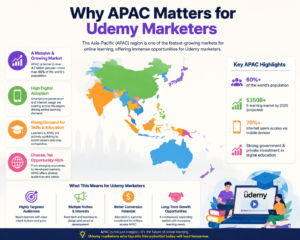
The Asia-Pacific region represents an enormous digital audience with growing interest in professional skills, technology education, remote work capabilities, entrepreneurship, and career development. However, APAC should never be treated as one single audience. A successful marketer needs to think locally while understanding the broader regional opportunity.
For example, an Indian audience may show strong interest in software development, competitive examinations, digital marketing, data analytics, and career-oriented certifications. An Australian audience might respond differently to course recommendations based on professional development or workplace skills. Japanese and Korean audiences may have different content preferences and localization expectations. The key lesson is simple: regional targeting works best when it becomes audience targeting.
Udemy itself has emphasized international expansion and localization, with its investor materials noting availability across more than 180 countries and courses in dozens of languages. Its APAC business strategy has also involved regional partnerships and localized approaches.
For affiliate marketers, this creates an opportunity to build content around specific geographic and linguistic audiences rather than using a one-size-fits-all approach.
How the Udemy Affiliate Program Works
The Udemy affiliate program gives approved publishers the ability to promote eligible Udemy offerings using affiliate tracking links. According to Udemy’s official affiliate information, marketers can choose from thousands of courses, subscriptions and promotional offers, use tracking assets, and monitor performance through the affiliate network account. The official program is operated through the Impact Network.
The process generally begins with an application. Once approved, an affiliate gains access to promotional tools and tracking capabilities. These may include text links, banners, course-specific links, and deep-linking options. The affiliate then places these promotional assets within approved marketing channels such as websites, blogs, content platforms, and qualifying social media properties.
The most important part of this system is attribution. Without tracking technology, the advertiser would not know which marketer referred a customer. Affiliate links contain information that helps connect the referral with the publisher responsible for generating it. This is why marketers should avoid manually modifying tracking links unless the affiliate platform specifically supports the modification.
The Role of Impact Network
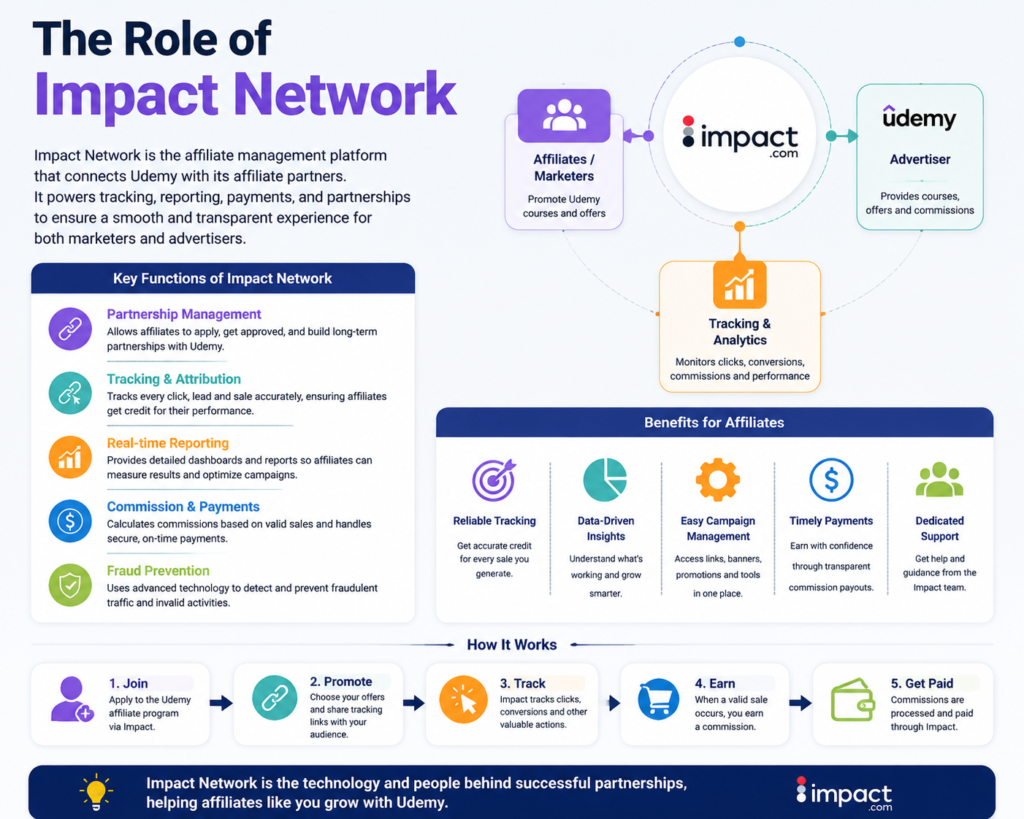
Impact serves as the affiliate network used for the Udemy affiliate program. This means marketers typically interact with the affiliate infrastructure through Impact for application processes, tracking, reporting, and payment-related functions. The platform acts like the control room behind the campaign. Instead of trying to manually calculate clicks and sales, affiliates can access reporting systems designed to track campaign activity.
Udemy’s affiliate support documentation states that Impact is the network through which potential publishers apply for the affiliate program. It also explains that approved affiliates can access different tracking links and promotional tools through the network.
For a beginner, the dashboard can feel technical at first. But the important metrics are relatively familiar: clicks, conversions, commissions, and performance by marketing channel. Over time, these numbers help marketers understand which content generates actual business results.
Tracking Links and Attribution
Affiliate links are the backbone of any CPS campaign. A standard URL may take someone to a course page, but a tracked affiliate URL helps the network recognize where the visitor came from. This allows the advertiser to attribute qualifying sales to the correct publisher.
Udemy supports different promotional link types, including deep links that can direct users toward specific pages. Deep linking is particularly valuable because generic homepage traffic often has weaker purchase intent than traffic directed toward a highly relevant product page.
For example, imagine someone searches for “best beginner Photoshop course.” Sending that person to Udemy’s general homepage adds unnecessary steps. Sending them to a relevant course or carefully selected category page may create a smoother customer journey. Fewer unnecessary decisions can often mean less friction.
Commission Structure and Cookie Duration
Commission is naturally one of the first things marketers want to understand. According to Udemy’s affiliate support documentation, the program has historically listed a baseline commission of 10% on valid affiliate sales, with potential performance-based increases. The same documentation states that the standard attribution cookie lasts 7 days. Because affiliate terms can change, marketers should always verify the commission details visible in their current network account before launching a campaign.
The seven-day cookie window means timing matters. If a visitor clicks your affiliate link but waits too long before purchasing, the sale may fall outside the attribution period. On the other hand, the documentation explains that the cookie can apply broadly to qualifying purchases made during the valid period rather than being limited only to the first course originally clicked.
This creates an interesting marketing opportunity. Your content might introduce a visitor to one course, but their final purchase behavior may involve additional eligible courses during the attribution window. That is why attracting genuinely interested learners can be more valuable than simply chasing one-click purchases.
Understanding Valid Affiliate Sales
Not every transaction automatically results in an affiliate commission. Affiliate programs typically define qualifying conditions, and marketers need to understand them before estimating potential revenue. Udemy states that commissions apply to valid paid course purchases referred through eligible affiliate tracking links, while certain purchases and promotional methods may not qualify.
Marketers should avoid building financial projections based solely on clicks. A campaign with 10,000 clicks does not necessarily produce 10,000 commissionable actions. Refunds, attribution windows, payment behavior, excluded products, and program restrictions can all affect final earnings.
This is why experienced affiliates focus heavily on conversion quality. A smaller audience of people actively searching for professional training may outperform a massive audience with no interest in education.
Commissionable and Non-Commissionable Purchases
Udemy’s published affiliate documentation identifies several situations where commissions may not apply. Free courses, purchases using certain unapproved codes, and some subscription-related purchases may be excluded from standard commission eligibility. Mobile app purchases are also described separately because affiliate tracking for app transactions may not be supported in the same way as purchases completed through the mobile website.
The lesson for marketers is straightforward: always read the current campaign terms. Never assume that every product on a website produces the same commission structure.
A good affiliate strategy includes compliance as part of the planning process. Before promoting a course, promotion, or subscription, check whether it is eligible for commission and whether the campaign allows the promotional method you intend to use.
Who Can Join the Udemy Affiliate Program?
Udemy’s affiliate program is designed for marketers, website owners, publishers, and businesses with established promotional channels. The company also allows qualifying social media publishers to apply, although approval depends on meeting the program’s requirements.
The program is not simply designed for someone who creates an empty website and immediately begins posting affiliate links. Udemy’s published requirements indicate that applications are reviewed for factors such as audience engagement, content quality, traffic consistency, thematic relevance, and alignment with the Udemy brand.
Website and Social Media Requirements
Udemy’s affiliate requirements state that applicants should have an established website, blog, or active social media presence. The published criteria mention engaged audiences and thresholds such as at least 500 unique monthly website visitors over the previous three months or at least 500 social media followers, while also considering content quality and traffic consistency.
This requirement makes sense when you think about the advertiser’s perspective. Brands want to work with publishers who can create useful exposure rather than simply generating low-quality traffic. An established content platform also provides evidence that the marketer understands an audience.
Another important detail is that Udemy says it does not currently accept affiliates whose channels solely talk about Udemy or those operating exclusively as paid advertising affiliates.
The strongest application usually demonstrates a real audience and a clear content niche.
Why Marketers Should Promote Udemy
The primary advantage of promoting Udemy is product diversity. Instead of being limited to a single category, marketers can potentially find courses relevant to technology, business, design, marketing, productivity, personal development, and numerous other subjects.
This flexibility allows affiliates to integrate promotions naturally into existing content. A technology blogger can discuss programming courses. A marketing publication can recommend SEO or advertising training. A career-focused website can feature professional development resources.
A Large Catalog Across Popular Niches
A broad catalog gives marketers the ability to match products with audience intent. This matters because affiliate marketing works best when the offer feels like a logical continuation of the content.
Consider an article explaining how to start learning data analysis. After providing useful free advice, the article could recommend beginner-friendly structured training for readers who want a deeper learning experience. The affiliate recommendation becomes part of the educational journey rather than an interruption.
Udemy officially highlights its extensive range of courses and learning products as one of the core benefits available to affiliate partners.
Promotional Offers and Creative Assets
Promotions can be powerful conversion catalysts. Udemy provides affiliates with promotional information and creative resources, including links and banners. The company also runs promotional campaigns during which discounted offers may be available for limited periods.
For marketers, promotions should be integrated carefully. Avoid creating misleading urgency. Instead, explain the offer clearly and update content when promotions expire.
A useful strategy is to maintain evergreen educational content while adding campaign-specific promotional sections when legitimate offers are available. This allows a single article to generate long-term organic traffic while remaining flexible enough to support time-sensitive promotions.
Best Marketing Strategies for Udemy APAC - CPS
The best marketing strategy depends on the audience, but several approaches consistently align well with education-focused affiliate campaigns. The common principle is simple: help first, promote second.
People searching for courses are often making an important decision. They want to know whether a course is suitable, what they will learn, how difficult it is, and whether it provides value. Marketers who answer these questions honestly can build significantly more trust than marketers who simply publish promotional slogans.
Content Marketing and SEO
SEO is one of the strongest long-term channels for course affiliate marketing because educational searches often reveal clear intent. Keywords such as “best Excel course for beginners,” “learn Python online,” or “digital marketing course review” indicate that the user is actively researching solutions.
The goal should not be to stuff an article with keywords. Instead, build content around the complete decision-making process. Explain who the course is suitable for, what skills learners may develop, possible alternatives, prerequisites, and realistic expectations.
A useful article can attract visitors for months or even years. That makes SEO content similar to planting a tree. The early work requires patience, but once the content gains visibility, it can continue generating traffic without requiring payment for every click.
Social Media and Influencer Promotion
Social media can be highly effective when the marketer has an audience that already trusts their recommendations. A LinkedIn creator focused on professional development, for example, may naturally discuss courses related to leadership, analytics, or business skills.
Short-form video can also introduce course topics, but marketers should avoid making exaggerated promises. Instead of saying, “This course will make you rich,” create useful content around the skill itself.
For example, a creator could publish a quick tutorial about Excel shortcuts and then recommend additional structured learning resources for viewers who want a complete curriculum.
Udemy allows qualifying affiliates to use approved promotional channels and requires applicants to disclose the channels they intend to use.
Email Marketing and Audience Segmentation
Email marketing can work extremely well for education offers when subscribers have explicitly chosen to receive relevant content. The most effective campaigns are usually segmented.
A beginner learning programming should not receive the same course recommendations as an experienced developer exploring cloud architecture. Audience segmentation allows marketers to match recommendations with knowledge levels and interests.
Instead of sending a generic “Buy this course” email, consider creating educational sequences. Teach something useful, identify the next learning challenge, and recommend a relevant course as a potential solution.
Trust remains the most valuable currency in email marketing. One aggressive promotion can damage a relationship that took years to build.
How Deep Linking Can Improve Conversions
Deep linking allows marketers to send users directly to a relevant page instead of a generic destination. Udemy’s affiliate resources specifically describe deep-linking capabilities that can be used to direct visitors toward selected pages.
This can improve the customer journey dramatically.
Imagine entering a large library and asking for a book about machine learning. If someone simply points toward the front door, you still have work to do. But if a librarian walks you directly to the correct shelf, the experience becomes easier.
Deep links perform the same function digitally. They reduce friction by connecting the user’s intent with the most relevant destination.
However, relevance is critical. Do not deep link simply because a course has a higher price or looks attractive. Choose products that genuinely fit the content and the audience’s needs.
Common Mistakes Marketers Should Avoid
One of the biggest mistakes in affiliate marketing is promoting products before understanding the audience. A marketer may see an attractive commission and immediately begin posting links everywhere. This usually produces weak engagement and low conversion rates.
Another mistake is ignoring program rules. Affiliate programs can restrict promotional methods, and violating those restrictions can result in rejected commissions or account problems. Marketers should review the current affiliate operating agreement and network policies before launching campaigns.
Outdated content is another major issue. Course availability, promotions, pricing, commission structures, and affiliate policies can change. A review written years ago may contain inaccurate information today.
Finally, avoid pretending that every product is perfect. Honest reviews are more sustainable. Mention potential limitations when relevant and help readers decide whether a course matches their situation.
The Future of Udemy Affiliate Marketing in APAC
Online learning is closely connected to broader changes in work and technology. As industries evolve, professionals increasingly need to update skills throughout their careers. This creates continuing demand for accessible education.
APAC presents an especially interesting environment because the region includes rapidly growing digital economies, large populations of students and professionals, and diverse local markets. However, marketers who succeed will likely be those who focus on localization rather than treating the entire region as a single audience.
Language, currency, purchasing behavior, and preferred learning topics all matter. A localized article can outperform a generic global article because it speaks directly to a specific reader.
Udemy’s international strategy has emphasized localization, regional partnerships, local currencies, and market expansion, reinforcing the importance of adapting educational offerings to different regions.
For affiliate marketers, the future opportunity is not simply “more traffic.” It is better targeting.
Conclusion
Udemy APAC – CPS can be an attractive opportunity for marketers who operate in the education, career development, technology, and professional skills space. The Cost Per Sale model rewards successful conversions, making audience quality and product relevance more important than raw traffic volume.
The strongest campaigns begin with understanding the audience. Identify what people are trying to learn, create genuinely useful content, and recommend relevant courses through approved affiliate channels. Use tracking data to understand performance and continuously improve your approach.
According to Udemy’s official affiliate information, approved partners can access tracking links, deep-linking capabilities, promotional resources, and performance reporting through its affiliate infrastructure, currently operated via Impact. Published affiliate documentation also lists a baseline 10% commission and a seven-day cookie window, although marketers should always verify current terms before promoting.
The biggest advantage is not simply the possibility of earning commissions. It is the ability to connect people with knowledge that may help them develop valuable skills. When a marketing campaign genuinely helps someone find the right learning resource, the conversion becomes more than a transaction. It becomes a useful recommendation—and that is the foundation of sustainable affiliate marketing.
Read Also:
How Businesses Can Explore Gaming Opportunities Through Razer (CPS)
Understanding the Benefits of Alibaba CPS for Online Marketing Campaigns
Key Benefits of Exploring Products Through AliExpress (Global) – Deeplink
How ASUS Singapore Helps Consumers Find the Right Technology for Their Needs
How Ruparupa (ID) Is Transforming the Online Home Shopping Experience the Superfood Industry
Frequently asked questions
Udemy APAC - CPS generally refers to a Cost Per Sale affiliate campaign connected with Udemy and focused on Asia-Pacific audiences or markets. CPS means that affiliate compensation is tied to qualifying completed sales rather than simply impressions or clicks.
Udemy's published affiliate documentation lists a baseline commission of 10% on valid affiliate sales, with possible performance-based increases. Commission structures can change, so marketers should confirm the current rate in their affiliate network account.
Udemy's affiliate support documentation states that the standard cookie duration is 7 days. This means qualifying purchases generally need to occur within the applicable attribution period for the affiliate to receive credit.
Udemy states that affiliates outside the United States can apply, provided they meet program requirements and complete the required application and tax-related information through the affiliate network.
The most sustainable approach is to create helpful, audience-focused content. SEO articles, honest course reviews, tutorials, social media education, newsletters, and deep-linked recommendations can all work when they match user intent and comply with current affiliate program rules.