

Discover how CoolBoard can help your business achieve better results by improving workflow management, team collaboration, productivity, and overall operational efficiency. In this detailed guide, you will learn practical strategies to use CoolBoard effectively for organizing projects, tracking tasks, automating repetitive processes, and making smarter business decisions. Whether you run a small business, startup, or growing company, CoolBoard provides a structured way to manage daily operations, improve communication between teams, and create a more productive work environment. Explore the best practices, common mistakes to avoid, and growth strategies that can help you maximize the benefits of CoolBoard and build a more efficient, scalable, and successful business.
Table of Contents
ToggleUnderstanding CoolBoard and Its Role in Modern Business Growth
Running a successful business today requires more than just good products and services. Companies need efficient systems that help teams communicate, organize work, understand performance, and make faster decisions. This is where platforms like CoolBoard can become valuable assets for businesses looking to improve productivity and create smoother workflows. In a competitive environment where customers expect faster responses and employees need better collaboration tools, having a centralized workspace can make a significant difference. Modern business platforms are increasingly focusing on combining collaboration, project organization, automation, and data visibility into one connected environment. Similar trends can be seen across the business software industry, where companies are adopting unified platforms to reduce tool overload and improve operational efficiency.
Think of CoolBoard as a digital control center for your business. Instead of searching through scattered emails, spreadsheets, messages, and separate applications, teams can create a more organized approach where important information is easier to access. However, simply purchasing or adopting a business tool does not automatically create better results. The real value comes from understanding how to use the platform strategically. Businesses that clearly define their goals, customize workflows, and encourage employee participation usually gain much stronger benefits than those that only use basic features.
The first step toward getting better results with CoolBoard is recognizing that technology should support your business strategy, not replace it. A tool works best when it is connected to real business needs. Whether your goal is improving team productivity, managing projects more effectively, increasing customer satisfaction, or making smarter decisions, CoolBoard should be configured around those priorities.
Many businesses make the mistake of focusing only on features. They ask questions like, “What can this platform do?” instead of asking, “What problems can this platform solve for us?” Changing this mindset helps companies use technology with purpose. A business platform becomes powerful when it removes obstacles, creates transparency, and helps people focus on important tasks rather than administrative struggles.
Why Businesses Need Smarter Collaboration and Management Tools
Business operations have become more complex than ever before. Teams often work remotely, customers interact through multiple channels, and managers need real-time information to make decisions. Traditional methods of managing work through spreadsheets and disconnected communication channels can create confusion and slow progress.
A modern collaboration system helps businesses create a single source of truth. When employees know where information exists, who is responsible for each task, and what deadlines matter most, productivity naturally improves. Many modern work management platforms now combine features such as dashboards, automation, project tracking, and communication tools to help organizations operate more efficiently.
CoolBoard can support this approach by helping businesses create structured processes. Instead of relying on individual working styles, companies can establish repeatable systems that improve consistency. This is especially useful for growing businesses where communication problems often increase as more employees, customers, and projects are added.
Imagine your business as a large machine. Every department represents a different part of that machine. If each part works independently without coordination, the entire system becomes slower. A platform like CoolBoard acts like the connection system that keeps everything moving in the same direction.
Setting Clear Business Goals Before Using CoolBoard
Before you start creating boards, adding tasks, or inviting team members, it is important to understand what you want CoolBoard to achieve for your business. Many organizations adopt new technology with excitement but fail to define clear goals. As a result, the platform becomes just another tool instead of a system that creates measurable improvements. The most successful companies begin with questions like: What challenges are slowing our growth? Where are our teams losing time? Which processes need better visibility? When you answer these questions first, you can build a CoolBoard environment that directly supports your business strategy.
A simple way to approach this is to treat CoolBoard like a business roadmap rather than a digital storage space. Every board, workflow, and dashboard should have a purpose. For example, a marketing team may use CoolBoard to manage campaigns, track content schedules, and monitor performance. A sales team may use it to organize leads, follow customer interactions, and improve follow-up processes. A project management team may use it to track deadlines, assign responsibilities, and reduce delays. The goal is not to add more information but to create better visibility and control.
Businesses that connect their software tools with strategic goals usually experience better adoption and stronger returns. Modern work platforms increasingly focus on connecting daily activities with larger business objectives through dashboards, goals, automation, and performance tracking. CoolBoard users should follow the same principle by making sure every feature contributes to a specific outcome.
For example, instead of creating a general board called “Marketing Tasks,” create a board designed around a measurable objective such as “Increase Monthly Website Leads by 30%.” This small change creates a different mindset. Team members understand why the work matters, managers can measure progress, and everyone works toward the same destination.

Aligning CoolBoard Features With Your Business Objectives
The next step is matching CoolBoard capabilities with your operational requirements. Different businesses have different priorities, so there is no universal setup that works for everyone. A startup might need simple task management and communication, while a larger company may require detailed workflows, reporting systems, and department-level collaboration.
A useful approach is to categorize your needs into four main areas:
- Productivity improvement: Reducing unnecessary meetings, repetitive tasks, and manual tracking.
- Team collaboration: Helping employees share updates, files, feedback, and responsibilities.
- Business visibility: Giving managers clear information about progress and performance.
- Customer improvement: Creating faster and more reliable customer service processes.
Once these priorities are clear, CoolBoard can be structured around them. A company struggling with missed deadlines may focus on project boards and automated reminders. A company dealing with communication gaps may create shared dashboards where teams can see updates instantly. A company looking for growth opportunities may focus on analytics and performance tracking.
The key idea is customization. A powerful business platform should adapt to your workflow instead of forcing your team to completely change how they work. Businesses often fail when they create complicated systems that employees find difficult to follow. Simplicity, consistency, and clear ownership are usually more valuable than having dozens of unused features.
Creating an Effective CoolBoard Workflow
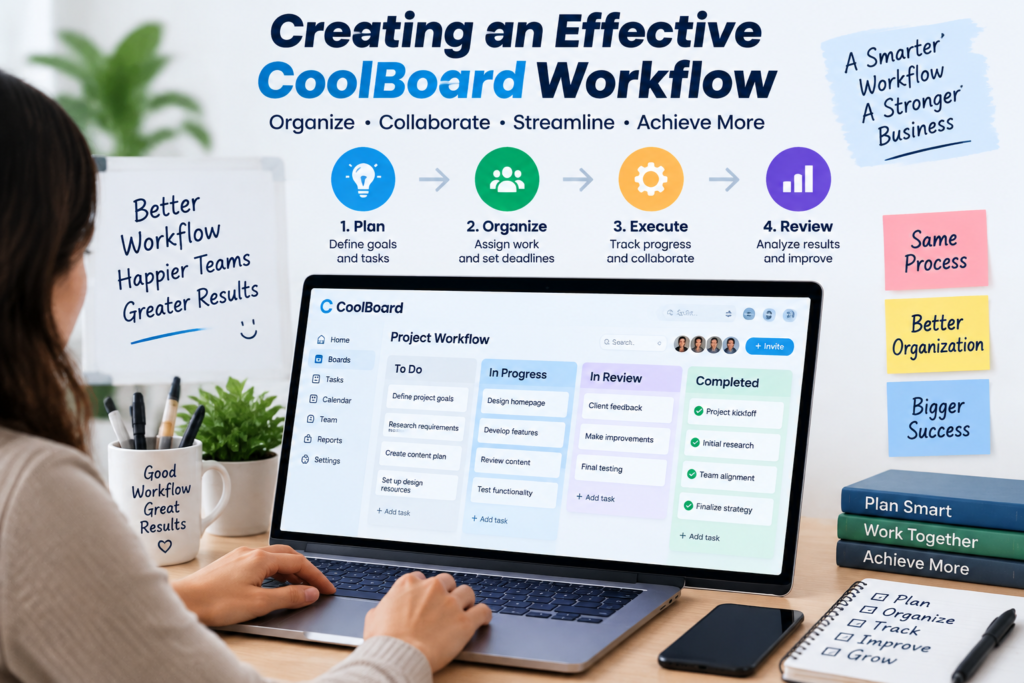
An organized workflow is the foundation of better results with CoolBoard. Without a clear structure, even the best business platform can become confusing. A workflow defines how work enters your system, who manages it, what steps it follows, and when it is considered complete.
Think of a workflow like a highway system. Without signs, lanes, and directions, traffic becomes chaotic. In the same way, businesses need clear processes that guide tasks from beginning to completion. CoolBoard can help visualize these processes, but the strategy behind the workflow must come from understanding your business operations.
Start by mapping your existing processes. Identify the steps involved in completing common activities. For example, a content marketing workflow might include planning, writing, editing, approval, publishing, and performance review. A customer support workflow might include receiving requests, assigning responsibility, solving issues, and collecting feedback.
After understanding the process, create boards that reflect real business activities. Avoid creating too many boards because excessive complexity can reduce productivity. Instead, focus on creating meaningful spaces where employees can quickly find what they need.
A well-designed CoolBoard workflow should answer important questions:
- Who owns this task?
- What is the current status?
- What is the deadline?
- What action should happen next?
- How does this task contribute to business goals?
When employees can answer these questions without searching through multiple systems, productivity improves naturally.
Organizing Tasks, Projects, and Team Responsibilities
One of the biggest advantages of a structured board system is improved responsibility management. Many business problems happen because tasks exist without clear ownership. Someone assumes another person is handling the work, deadlines are missed, and projects slow down.
CoolBoard can help solve this problem by making responsibilities visible. Each task should have a clear owner, expected completion date, and defined priority level. This creates accountability without creating unnecessary pressure. Employees understand their responsibilities, while managers gain a better understanding of project progress.
A good task structure should include enough information for people to act quickly. A task title alone is rarely enough. Adding descriptions, important documents, deadlines, and related discussions creates a complete picture.
For example, instead of creating a task called:
“Update website”
A better task might be:
“Update homepage design to improve customer conversions by adding new service sections and testing improved call-to-action buttons.”
The second version provides context and purpose. Team members understand not only what needs to happen but also why it matters.
Modern collaboration platforms often include different visual views such as boards, timelines, calendars, and dashboards because teams understand information differently. Some employees prefer seeing tasks in a visual workflow, while managers may prefer reports and summaries. Using the right view for the right purpose can make CoolBoard much more effective.
Improving Team Collaboration Through CoolBoard
A business cannot achieve long-term success when employees work in isolated environments. Even highly talented individuals struggle when communication is unclear, information is scattered, and teams do not understand how their efforts connect with larger goals. Collaboration is the engine that keeps a company moving forward, and CoolBoard can help create a more connected working environment when implemented correctly.
Effective collaboration is not simply about sending more messages or holding more meetings. In fact, excessive communication without organization can create more problems. The real goal is to make information available at the right time, to the right people, in a way that supports decision-making. A well-designed CoolBoard system allows teams to share updates, track responsibilities, and maintain visibility without creating unnecessary confusion.
Many businesses today are moving toward centralized digital workspaces because employees need access to information from different locations and devices. Modern business platforms increasingly focus on connecting teams, workflows, and operational data in one place. This approach reduces dependency on disconnected tools and helps teams spend more time completing valuable work.
One of the best ways to improve collaboration with CoolBoard is to create shared project spaces. Instead of keeping project details inside personal notes or private conversations, teams can create transparent boards where everyone understands progress. Marketing teams can monitor campaigns, sales teams can follow customer opportunities, and operations teams can coordinate daily activities.
Transparency creates trust. When employees know what is happening, they feel more confident making decisions and supporting each other. Managers also gain a clearer picture of challenges and can provide assistance before small issues become major problems.
Another important factor is encouraging team participation. A platform only creates value when people actually use it. Businesses should establish simple guidelines, such as updating task statuses regularly, adding important notes, and keeping project information organized. When these habits become part of company culture, CoolBoard becomes a natural part of everyday operations.
Building Better Communication Between Departments
Many companies face a common challenge: departments often operate like separate islands. Marketing may not know what sales needs, sales may not understand customer service problems, and leadership may lack complete visibility into daily operations. This lack of connection can slow growth and create unnecessary misunderstandings.
CoolBoard can help break down these barriers by creating shared environments where different departments can collaborate. For example, a product development team can work closely with customer support by tracking customer feedback and identifying improvement opportunities. The marketing department can coordinate with sales by sharing campaign information and lead updates.
The key is creating workflows that encourage cross-functional cooperation. Instead of departments only communicating when problems occur, they can create systems where information naturally flows between teams.
For example:
- A sales team can update customer requirements.
- Product teams can review feedback and prioritize improvements.
- Marketing teams can use insights to create better campaigns.
- Leadership teams can review overall performance.
This creates a connected business ecosystem where every department contributes to shared success.
Using Data and Insights to Make Better Decisions
Successful businesses are not built only on experience and intuition. While leadership knowledge is valuable, companies that use accurate data often make faster and smarter decisions. CoolBoard can support better decision-making by organizing important information and making progress easier to understand.
Business decisions become easier when managers can see what is working and what needs improvement. Instead of asking, “Are we making progress?” leaders can look at measurable indicators and identify specific opportunities.
For example, a company managing multiple projects can use CoolBoard information to understand:
- Which projects are moving forward.
- Which tasks are delayed.
- Which employees need additional support.
- Which processes are creating problems.
This visibility helps managers focus on solutions rather than spending hours collecting updates.
Data-driven management is especially important for growing businesses. When a company is small, leaders may personally understand almost everything happening inside the organization. However, as teams expand, personal knowledge alone becomes impossible. Systems like CoolBoard provide the structure needed to maintain control while scaling.
Automating Repetitive Business Processes
Time is one of the most valuable resources in any business. Employees often lose hours completing repetitive tasks that could be simplified or automated. These activities may seem small individually, but together they can reduce productivity significantly.
Automation helps businesses remove unnecessary manual work. With a properly configured CoolBoard workflow, companies can create processes that automatically organize information, update statuses, and remind team members about important actions.
Imagine a customer onboarding process. Without automation, employees may need to manually create tasks, send reminders, update records, and notify different departments. With an organized workflow, many of these steps can happen automatically.
Automation does not replace employees. Instead, it allows people to focus on higher-value activities that require creativity, problem-solving, and human judgment.
Saving Time Through Smart Workflows
Smart workflows create consistency. Instead of depending on individual memory, businesses can create repeatable systems that work every time.
For example, a company managing customer inquiries can create a workflow like:
- Customer request received.
- Request assigned to the responsible team member.
- Priority level determined.
- Solution provided.
- Customer feedback collected.
This structure reduces mistakes and improves customer satisfaction.
The same approach can be applied to marketing campaigns, employee onboarding, inventory management, and project delivery.
A major advantage of automation is that it creates scalability. A business that handles 50 customers today may need to handle 500 customers tomorrow. Without efficient systems, growth can create chaos. With smart workflows, companies can expand while maintaining quality.
Enhancing Customer Experience With CoolBoard
Customers are the foundation of every successful business. Even companies with excellent products can struggle if their customer experience is poor. Modern customers expect quick responses, personalized communication, and reliable service.
CoolBoard can help businesses organize customer-related activities and ensure that important information is not lost. When teams have better visibility into customer needs, they can provide faster and more effective solutions.
Customer experience improves when businesses understand the complete customer journey. Every interaction matters, from the first inquiry to after-sales support.
A structured CoolBoard system can help teams track:
- Customer requests.
- Sales opportunities.
- Feedback.
- Service issues.
- Follow-up activities.
This creates a smoother experience for customers because employees have access to the information they need.
Managing Customer Needs More Efficiently
Customer expectations are constantly changing. People no longer judge businesses only by the quality of their products or services; they also evaluate how quickly and effectively a company responds to their needs. A delayed response, missing information, or poor communication can easily push customers toward competitors. This is why businesses need systems that help them understand customer requirements and deliver consistent experiences.
CoolBoard can support customer-focused operations by helping teams organize customer information, track conversations, and manage follow-up activities. When customer-related tasks are visible and properly assigned, employees are less likely to miss important requests or forget critical details. This creates a smoother experience where customers feel valued and understood.
A strong customer management workflow should connect different departments. For example, when a customer provides feedback about a product issue, the information should not remain only with the support team. The product team should be able to review it, the marketing team should understand customer preferences, and leadership should recognize larger trends. A connected system transforms individual customer interactions into valuable business insights.
Think about a restaurant receiving repeated feedback that customers want healthier options. If that information remains hidden inside customer service conversations, the business loses a growth opportunity. However, if the feedback is organized and visible, decision-makers can use it to create new offerings. CoolBoard can help businesses turn everyday information into strategic advantages.
Customer loyalty is built through consistency. Customers appreciate businesses that remember their preferences, solve problems quickly, and communicate clearly. By creating organized customer workflows, companies can improve satisfaction while reducing internal confusion.
Best Practices for Maximizing CoolBoard Results
Adopting CoolBoard successfully requires more than creating boards and assigning tasks. Businesses need a thoughtful implementation strategy that encourages employees to use the platform effectively. The best results come from combining technology with proper planning, training, and continuous improvement.
One important practice is starting small. Many companies make the mistake of trying to move every process into a new platform immediately. This often creates confusion and resistance. Instead, businesses should begin with one or two important workflows, evaluate the results, and gradually expand.
For example, a company could start by managing its marketing projects through CoolBoard. After employees become comfortable with the system, the business can introduce sales tracking, customer management, or operational workflows. This gradual approach makes adoption easier and reduces unnecessary disruption.
Another important practice is maintaining simplicity. A complicated system can discourage employees from using it. Every board, task, and workflow should have a clear purpose. Remove unnecessary information and focus on what helps teams work better.
Businesses should also regularly review their CoolBoard setup. As companies grow, their needs change. A workflow that works perfectly today may become inefficient after expansion. Regular reviews help organizations update their systems and maintain productivity.
Training Employees for Better Adoption
Employee adoption is one of the biggest factors that determines whether a business tool succeeds or fails. Even the most advanced platform provides little value if team members do not understand how to use it.
Training should focus on practical benefits rather than technical instructions alone. Employees need to understand how CoolBoard will make their daily work easier. Instead of saying, “You need to update this system,” explain how the system reduces repeated communication, prevents missed deadlines, and improves teamwork.
A good training approach includes:
- Demonstrating real business examples.
- Creating simple usage guidelines.
- Encouraging questions and feedback.
- Providing ongoing support.
Different employees learn differently, so businesses should offer multiple learning methods. Some people prefer step-by-step demonstrations, while others learn through practical experience.
Leadership involvement also matters. When managers actively use CoolBoard and encourage their teams to follow the system, employees are more likely to accept the change. Technology adoption often starts from the top because employees follow the behavior they see from leaders.
Common Mistakes Businesses Should Avoid
While CoolBoard can provide many advantages, poor implementation can limit its effectiveness. Understanding common mistakes helps businesses create a stronger strategy from the beginning.
One common mistake is using CoolBoard as just a digital task list. A business platform can provide much more value than simple task tracking. Companies should use it to improve workflows, increase visibility, and support decision-making.
Another mistake is creating too many unnecessary boards. When employees have to search through dozens of unrelated spaces, productivity decreases. A good structure should make information easier to find, not harder.
Poor responsibility management is another challenge. Tasks without clear ownership often become delayed. Every important activity should have someone responsible for completion and progress updates.
Businesses should also avoid ignoring employee feedback. The people using CoolBoard daily often understand workflow problems better than anyone else. Their suggestions can reveal opportunities for improvement.
Preventing Poor Implementation Problems
Successful implementation requires patience. Changing business processes is not always easy because employees may already have established habits. Organizations should focus on creating positive experiences rather than forcing immediate changes.
A practical implementation plan may include:
- Identifying the most important business challenges.
- Creating simple workflows to solve those challenges.
- Training employees.
- Measuring results.
- Improving the system over time.
This approach creates long-term success because it focuses on sustainable improvement rather than quick adoption.
Remember, CoolBoard itself is not the solution. The real solution comes from how effectively the business uses the platform. Technology is like a powerful vehicle; it can take you far, but only when you know where you want to go and how to drive it.
Future Growth Strategies Using CoolBoard
Businesses that want long-term success must prepare for future challenges. Markets change, customer expectations increase, and competition becomes stronger. Companies that build flexible systems are better prepared to adapt.
CoolBoard can support future growth by creating scalable processes. Instead of rebuilding workflows every time the company expands, businesses can develop systems that grow with them.
For example, a small company may initially use CoolBoard for managing internal tasks. As the company grows, the same platform can support larger projects, multiple departments, and more complex operations.
Scalability is especially important for startups and growing businesses. Rapid growth can create operational problems if systems are not prepared. A company may have excellent products and strong customer demand but struggle because internal processes cannot handle expansion.
A well-organized CoolBoard environment provides structure during growth periods. Teams can maintain communication, managers can monitor progress, and leadership can make informed decisions.
Scaling Your Business With Better Management Systems
Growth requires more than increasing sales. A successful business must also improve efficiency, customer satisfaction, and internal coordination.
CoolBoard can help companies build a foundation for sustainable expansion by supporting:
- Better project management.
- Faster communication.
- Improved accountability.
- Clear performance tracking.
- More organized customer processes.
The future of business management is moving toward connected digital ecosystems. Companies that use technology strategically will have stronger advantages because they can respond faster and operate more efficiently.
The most successful organizations do not simply adopt tools; they create systems that help people perform better. CoolBoard becomes valuable when it becomes part of the company’s culture and daily operations.
Conclusion
Getting better results with CoolBoard for your business requires more than simply using its features. The real value comes from creating purposeful workflows, improving collaboration, organizing information, and connecting daily activities with business goals. When companies use CoolBoard strategically, they can reduce confusion, improve productivity, and create stronger processes for growth.
The key is to start with clear objectives. Understand what problems you want to solve, design workflows around those challenges, and encourage employees to participate actively. A well-planned system can transform the way teams communicate and operate.
Businesses should also remember that technology is constantly evolving. Regular reviews, employee feedback, and continuous improvement are essential for maintaining success. CoolBoard should not be viewed as just another software tool but as a foundation for building a smarter, more connected organization.
When implemented correctly, CoolBoard can help businesses work more efficiently, serve customers better, and prepare for future opportunities. The companies that combine effective strategy with the right technology will be the ones best positioned for long-term success.
Read Also:
Key Benefits of Using Envato Placeit for Digital Marketing Campaigns
Building Better Digital Experiences With Creative Resources From Envato Market
A Complete Guide to Understanding Udemy APAC – CPS for Marketers
How Businesses Can Explore Gaming Opportunities Through Razer (CPS)
Understanding the Benefits of Alibaba CPS for Online Marketing Campaigns
Key Benefits of Exploring Products Through AliExpress (Global) – Deeplink
Frequently asked questions
CoolBoard can be used to organize business workflows, improve team collaboration, manage projects, track responsibilities, and create better visibility into daily operations. Businesses can customize it according to their specific goals and processes.
CoolBoard improves productivity by helping teams organize tasks, assign responsibilities, track deadlines, and reduce communication gaps. Employees spend less time searching for information and more time completing important work.
Yes, small businesses can benefit from CoolBoard because it helps create organized systems without requiring complex processes. It can support startups as they grow by improving workflow management and collaboration.
Companies can improve adoption by providing training, creating simple workflows, explaining benefits clearly, and encouraging managers to actively use the platform themselves.
Yes, CoolBoard can support business growth by creating repeatable processes, improving visibility, and helping teams manage increasing workloads more effectively.