
Discover everything you need to know about PADI and start your scuba diving journey with confidence. Learn about beginner courses, essential diving equipment, safety tips, certification requirements, and how to choose the right dive center for an unforgettable underwater adventure.
Table of Contents
ToggleUnderstanding PADI and Scuba Diving
Have you ever imagined swimming alongside colorful fish, exploring beautiful coral reefs, or discovering an underwater world that feels completely different from everyday life? Scuba diving can turn that dream into a real adventure, and PADI is one of the world’s best-known organizations for scuba diving education. PADI stands for the Professional Association of Diving Instructors. It provides training programs that help beginners learn essential diving knowledge, practice underwater skills, and develop confidence under the guidance of qualified instructors.
Starting your diving journey with PADI does not require previous scuba diving experience. You can begin with an introductory diving experience if you simply want to try breathing underwater, or you can work toward a full beginner certification if you want to explore diving more independently. The right starting point depends on your interests, available time, budget, and comfort in the water. With appropriate instruction and regular practice, those first unfamiliar moments can become the beginning of a rewarding lifelong hobby.
What Makes PADI Popular Among Beginners?
One reason beginners choose PADI is its structured approach to scuba education. Courses generally combine theoretical learning, practical exercises in a swimming pool or confined-water environment, and open-water training when required. This progression helps students understand what they are doing before encountering the changing conditions of the ocean. PADI also offers digital learning options, allowing students to study essential concepts before beginning practical training.
Another advantage is the opportunity to continue learning after your first certification. You might eventually explore underwater photography, improve your buoyancy, learn about marine life, or develop rescue skills. However, a certification does not automatically qualify you for every type of dive. Divers must stay within the limits of their training, experience, equipment, and environmental conditions. Think of your first PADI course as learning the fundamentals of driving: it provides a valuable foundation, but experience and responsible decision-making remain essential.
Choosing the Right PADI Course
Choosing your first course is one of the most important decisions in your diving journey. The best option is not necessarily the longest course or the one that promises the quickest experience. Instead, consider what you want to achieve. Are you curious about what breathing underwater feels like, or do you want a certification that allows you to plan recreational dives with an appropriately qualified buddy? Understanding your goal will help you choose the most suitable program.
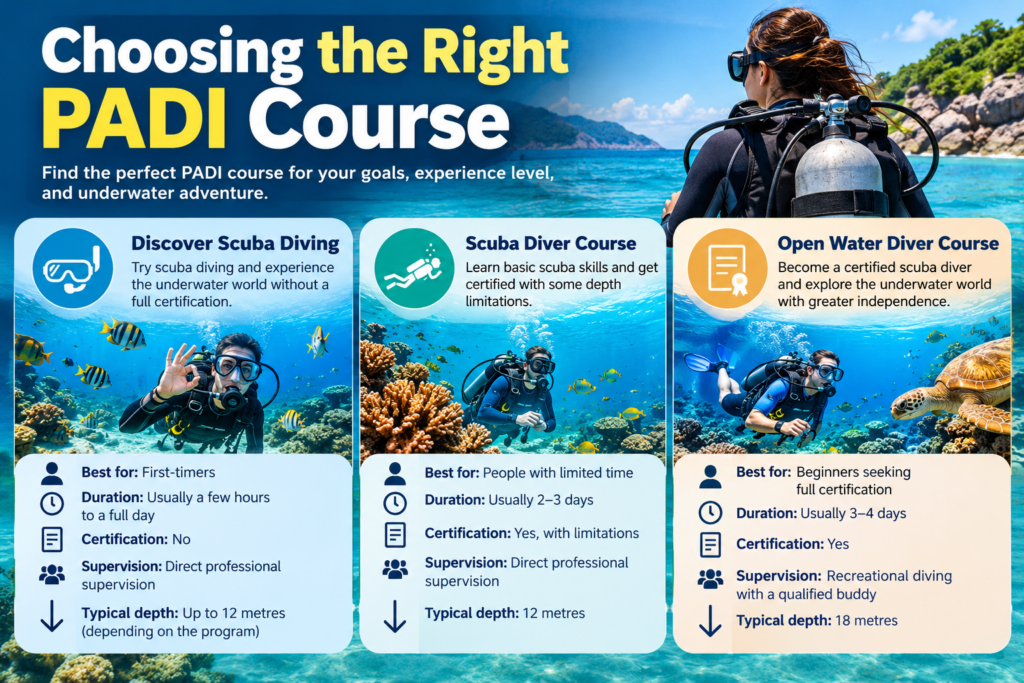
PADI offers several entry-level options, including Discover Scuba Diving, the Scuba Diver course, and the Open Water Diver course. Each serves a different purpose, so it is worth understanding the differences before paying for a booking. Review what is included in the course fee, how much time the training requires, and whether equipment rental and certification costs are included.
Discover Scuba Diving vs. Open Water Diver
Discover Scuba Diving is designed for people who want to experience scuba diving without immediately committing to a complete certification course. Under professional supervision, participants receive an introduction to scuba equipment, basic underwater procedures, and essential safety skills. Depending on the program and location, the experience may include a confined-water session and a supervised open-water dive. It is a useful way to discover whether you enjoy scuba diving before investing in a longer course.
The PADI Open Water Diver course, by contrast, is designed for people who want to become certified recreational scuba divers. It includes knowledge development, confined-water skill practice, and open-water training dives. Once you successfully complete the course, you can plan and conduct recreational dives with a certified buddy within the limits of your certification and experience. The standard Open Water Diver certification generally allows diving to a maximum training depth of 18 metres (60 feet), subject to applicable standards and conditions.
Feature | Discover Scuba Diving | Scuba Diver course | Open Water Diver course |
Main purpose | Try scuba diving | Learn basic scuba skills | Earn an entry-level certification |
Full certification | No | Yes, with limitations | Yes |
Supervision | Direct professional supervision | Direct professional supervision | Recreational diving with a qualified buddy |
Typical maximum depth | Up to 12 metres, depending on the program | 12 metres | 18 metres |
Best suited for | Curious first-timers | People with limited time | Beginners seeking greater independence |
Course requirements and permitted activities depend on applicable training standards, age, location, and instructor guidance.
If you are serious about learning to scuba dive, the Open Water Diver course is usually the most useful starting point. If you are uncertain about how you will feel underwater, Discover Scuba Diving may be a sensible first step. There is no need to rush. Choosing a course that suits your comfort level will make the experience more enjoyable and productive.
Requirements for Becoming a Scuba Diver
Before enrolling, you should understand the basic requirements for scuba training. PADI’s entry-level programs generally require participants to meet a minimum age requirement, demonstrate appropriate swimming and water-comfort skills, and complete medical screening. The exact conditions differ between introductory experiences and certification courses, so confirm the requirements with your instructor before making travel arrangements.
The minimum age for many introductory PADI programs is 10. Standard Open Water Diver certification is generally available from age 15, while eligible younger students can earn a Junior Open Water Diver certification. These age categories are important because younger divers may have additional restrictions on depth and supervision. Always confirm the current requirements with your chosen training provider.
Swimming ability is another important consideration. Open Water Diver training generally includes water-skill assessments, which may involve swimming 200 metres without stopping and floating or treading water for 10 minutes. An alternative assessment may involve swimming 300 metres using a mask, snorkel, and fins. These assessments are intended to establish basic water competence rather than competitive swimming ability. If you need to improve your confidence, consider practicing in a safe swimming environment before beginning your course.
Medical fitness also matters. Before training, students complete a diver medical questionnaire designed to identify conditions that may require further assessment by a medical professional. Certain heart, lung, ear, or other medical conditions can affect diving safety. A positive answer does not automatically mean you cannot dive, but it may mean that you need medical clearance before participating. Answer every question honestly, and never hide symptoms or assume that a medical condition is harmless underwater.
You do not need to be an elite athlete to start learning. Reasonable fitness, comfort in water, patience, and a willingness to follow instructions are more useful than trying to impress your instructor. If you are nervous about swimming or unfamiliar with deep water, discuss your concerns before the course begins. A responsible instructor can explain what to expect and help you determine whether additional preparation would be beneficial.
How to Get Started With Your First Course
Once you have chosen a course, the next step is finding an appropriate PADI dive center or instructor. Investigate the provider’s qualifications, student feedback, facilities, equipment, and course arrangements. Do not make your decision based solely on the lowest advertised price. Training quality, equipment condition, instructor attention, and safe operating practices are much more important than saving a small amount of money.
After selecting a provider, ask for a clear explanation of the course schedule. Find out whether theory lessons can be completed online, how many practical sessions are planned, what equipment is included, and what happens if weather or water conditions delay a dive. Ask whether certification fees, taxes, boat transfers, and other charges are included in the quoted price. Written confirmation can help prevent misunderstandings, particularly when booking a course during a holiday.
Prepare Before Your First Session
Your preparation can begin at home. Read the course information carefully, complete the required paperwork, and start studying the basic concepts if your course includes digital learning. Learning about pressure, buoyancy, breathing equipment, and underwater communication beforehand can make practical sessions feel less overwhelming. You should also get enough rest, stay hydrated, and avoid arriving at training after a long night of travel.
For your first day, pack swimwear, a towel, sunscreen suitable for marine environments, drinking water, and any personal items requested by your instructor. Most beginner programs provide or arrange essential scuba equipment, but confirm this in advance. If you use prescription medication or have concerns about ear pressure, breathing, or motion sickness, speak to the appropriate healthcare professional and your instructor before diving.
Most importantly, communicate openly. Tell your instructor if you are anxious, have difficulty clearing your ears, or need more time to practice a skill. Scuba training is not a race. You should never feel pressured to enter the water, descend, or continue an exercise when you are uncomfortable. A good learning experience allows you to ask questions, repeat skills when necessary, and build confidence at an appropriate pace.
Essential Scuba Diving Equipment
Scuba equipment makes it possible to breathe underwater, control your movement, and monitor important aspects of your dive. When you start your PADI journey, your instructor will explain how the equipment works and how to check it before entering the water. You do not need to buy an entire set of equipment immediately. Most beginner courses offer rental equipment or include it in the course package, making it easier to discover your preferences before investing in personal gear.
The most familiar item is the diving mask, which allows you to see clearly underwater. A well-fitting mask is important because water entering it can distract you and make the experience uncomfortable. Fins help you move through the water more efficiently, while a snorkel allows you to breathe at the surface when conditions and the activity make it appropriate. A wetsuit or other exposure protection helps you stay comfortable according to the water temperature and local conditions.
The regulator is another essential component. It delivers breathing gas from the scuba cylinder at a pressure you can breathe, while the buoyancy control device (BCD) helps you manage your position in the water. A cylinder provides the breathing gas, and a dive computer or other approved instruments help you monitor dive information. Depending on the equipment setup, you may also use a pressure gauge, weight system, and other safety accessories.
Equipment | Main purpose | Beginner tip |
Mask | Allows underwater vision | Choose a comfortable, well-fitting mask |
Fins | Help you move through the water | Practice controlled fin movements |
Regulator | Delivers breathing gas | Learn the pre-dive checks with your instructor |
BCD | Helps control buoyancy | Practice adjustments under supervision |
Scuba cylinder | Supplies breathing gas | Use only with appropriate training |
Dive computer | Displays important dive information | Learn to understand its warnings and limits |
Exposure suit | Helps manage temperature and environmental exposure | Match the suit to the water conditions |
Before every dive, you and your buddy should conduct the appropriate equipment checks. Check that the equipment fits correctly, the air supply is adequate, and all required components are functioning properly. Never assume that rented equipment is ready simply because it has been supplied by a dive center. Ask your instructor to explain anything you do not understand, and never attempt to repair or modify life-support equipment without the appropriate training.
Understanding Diving Safety and Training
Scuba diving can be an enjoyable recreational activity, but it involves real risks that require preparation and responsible decisions. Underwater pressure changes how gases behave in the body, and divers must understand how to breathe, manage buoyancy, equalize pressure, and monitor their limits. Training exists to help you recognize potential problems and respond appropriately instead of relying on guesswork. The goal is not simply to reach an impressive depth; it is to complete every dive safely and return to the surface with control and confidence.
One of the most important beginner rules is to breathe continuously and never hold your breath while scuba diving. Changes in pressure during ascent can cause serious lung injuries if a diver holds their breath. You will also learn to equalize pressure in your ears and other air spaces as you descend. If you cannot equalize comfortably, stop descending and tell your instructor or buddy. Never force your way through ear pain or continue a dive just because other people are moving ahead.
Buoyancy control is another fundamental skill. It helps you remain at the intended depth without constantly kicking upward or sinking toward the seabed. Good buoyancy makes diving more comfortable, conserves energy, and helps prevent accidental contact with coral or other fragile marine life. Beginners often need time to coordinate breathing, body position, and BCD adjustments. Practice makes these movements more natural, so focus on smooth, controlled actions rather than trying to master everything immediately.
A reliable buddy system is equally important. Recreational divers should understand their roles, agree on communication signals, monitor one another, and follow a dive plan appropriate to their qualifications. Before entering the water, discuss the planned route, maximum depth, gas-management procedures, separation response, and circumstances that would cause either person to end the dive. Never treat your buddy as a substitute for learning the required skills yourself.
Environmental conditions can also change quickly. Currents, waves, visibility, water temperature, boat traffic, and marine life can affect a dive. Listen to local briefings, follow the instructor’s directions, and cancel or postpone the dive when conditions are unsuitable. You should also follow appropriate ascent procedures and respect guidance about flying after diving. If you feel unwell or uncomfortable, communicate immediately rather than pushing yourself to continue.
What to Expect During Open Water Training
The PADI Open Water Diver course is designed to build knowledge and practical ability in stages. Rather than being expected to manage everything at once, you gradually learn the theory, practice fundamental skills in controlled conditions, and apply those skills during open-water training. The exact schedule depends on the course format, training location, your progress, and local conditions.
Knowledge Development
Your learning begins with the principles behind safe scuba diving. You study how pressure changes underwater, why buoyancy matters, how to use equipment, and how to plan dives within the appropriate limits. You also learn about gas consumption, dive planning, environmental awareness, and common risks. Digital lessons can allow you to study at your own pace, but completing the theory is only one part of becoming a competent diver.
Take your time with the lessons and quizzes. If a concept is confusing, ask your instructor to explain it with practical examples. Understanding why a safety procedure matters is more useful than memorizing an answer without understanding its purpose. Good theoretical knowledge gives you a foundation for making sensible decisions underwater.
Confined-Water Training
Next, you practice in a swimming pool or another suitable confined-water environment. This is where equipment starts to feel familiar and basic skills become more manageable. Under your instructor’s guidance, you may practice breathing through a regulator, clearing a mask, recovering a regulator, managing buoyancy, and responding to simulated situations. These exercises are introduced according to the course standards and your progress.
It is normal to find some skills difficult at first. Water may enter your mask, your fins may feel awkward, or your buoyancy may seem unpredictable. Instead of judging yourself, focus on listening carefully, practicing each skill, and asking for help when needed. You should be able to demonstrate the required skills to the instructor’s satisfaction before moving forward.
Open-Water Dives
Open-water training is where you apply your developing skills in a natural environment. Your instructor will select an appropriate training site and supervise the required exercises. You will become familiar with entering and exiting the water, following a dive plan, communicating with your buddy, and monitoring your equipment and surroundings. Depending on the location, the experience may involve a boat, a shore entry, or a combination of both.
Natural conditions introduce variables that may not exist in a pool. Visibility can change, currents may be present, and the seabed may have uneven terrain. This is why following the briefing and staying close to your instructor are so important. Your first open-water dives should be about learning and building confidence, not trying to swim the farthest or go the deepest.
After successfully completing all course requirements, you can earn your certification. Remember, however, that passing a course is the beginning of your diving education rather than the end. Regular diving within your qualifications, ongoing practice, and honest self-assessment will help you develop into a more confident and responsible diver.
Costs, Travel, and Choosing a Dive Center
The cost of starting your diving journey varies considerably according to the country, training provider, course format, and location. Some courses include equipment rental, digital learning, training dives, and certification fees, while others charge for these separately. Travel, accommodation, boat transfers, marine park fees, meals, and personal equipment can also increase your overall budget. For that reason, comparing the total package cost is more useful than comparing a single advertised price.
Expense | What to check |
Course tuition | Is the full training program included? |
Online learning | Is digital learning included in the package? |
Equipment rental | Are all required items covered? |
Certification fees | Are registration and certification charges included? |
Transport | Are boat transfers or travel to training sites extra? |
Accommodation | Will you need to stay overnight near the dive center? |
Additional fees | Are taxes, park fees, or extra training sessions charged separately? |
When choosing a dive center, look beyond promotional photographs and discounts. Confirm that your instructor is appropriately qualified, that the equipment is maintained, and that the center explains its safety procedures clearly. Ask about the number of students per instructor and how the provider supports people who need additional practice. You should feel comfortable asking questions before paying a deposit.
Choosing a Diving Destination
Your first course does not have to take place in an exotic international destination. A reputable local dive center may offer convenient access to training facilities, making it easier to complete the course without the expense of a long holiday. If you want to learn while traveling, consider water conditions, visibility, seasonal weather, transport connections, and how much time you have available.
In India, diving operators offer training opportunities in locations including the Andaman Islands and other coastal destinations. Choose a destination based on the quality of training rather than scenery alone. A beautiful reef cannot compensate for rushed instruction or inadequate supervision.
If you plan to complete your certification during a short holiday, leave enough flexibility for bad weather, skill practice, or schedule changes. You should also follow your instructor’s advice about flying after diving, since flying too soon after scuba diving can increase decompression-related risk.
Continuing Your Diving Journey
Earning your first PADI certification opens the door to many new underwater experiences. Once you become a certified diver, you can gradually explore different environments, improve your skills, and discover which aspects of diving interest you most. Some people enjoy observing tropical fish and coral reefs, while others become interested in underwater photography, wreck diving, or marine conservation. The important thing is to build experience gradually rather than moving into challenging dives before you are ready.
One possible next step is the PADI Advanced Open Water Diver course, which helps divers expand their experience through supervised adventure dives. Other options include specialty courses that focus on buoyancy, underwater photography, fish identification, and other skills. As you gain experience, you may also decide to learn rescue skills or pursue professional training. Each course has its own prerequisites, so check the requirements before enrolling.
Another useful habit is maintaining a dive log. Record details such as the date, location, depth, duration, equipment, environmental conditions, and lessons learned. Reviewing your logs can help you recognize improvements in buoyancy, air consumption, and comfort in different conditions. Your instructor or dive buddy may also offer feedback that helps you identify areas for improvement.
Remember that your certification does not replace regular practice. If you have been away from diving for a long time, consider a refresher program before returning to the water. A refresher can help you review important procedures and regain confidence, especially if you have forgotten basic skills. Always dive within your current abilities and seek additional training when necessary.
Finally, make marine conservation part of your diving routine. Avoid touching coral, disturbing animals, collecting marine life, or damaging the seabed with your fins. Secure loose equipment so it does not drag across the reef, and follow local rules for wildlife encounters. Responsible divers understand that the underwater world is not an amusement park; it is a living environment that deserves care and respect.
Conclusion
Starting your diving journey with PADI can introduce you to an extraordinary world beneath the surface. Whether you begin with a Discover Scuba Diving experience or enroll directly in the Open Water Diver course, the most important steps are choosing suitable training, understanding the requirements, and learning to dive responsibly.
Prepare yourself by studying the basics, practicing your swimming skills, selecting a reputable dive center, and asking questions whenever something is unclear. Take your time with equipment, buoyancy, underwater communication, and safety procedures. There is no need to rush toward deeper dives or advanced certifications before you have developed a strong foundation.
Your first underwater breath may feel unfamiliar, but with proper instruction and practice, it can become the start of a memorable adventure. Choose a course that matches your goals, respect your limits, and let your diving experience grow one safe dive at a time.
Read Also:
Improving Computer Performance With IObit: Features and Benefits
How Lightinthebox Connects Shoppers With Affordable Global Products
Understanding LATAM Airlines: Routes, Services, and Travel Options
How Jobscan.co Can Help Improve Your Resume for Job Applications
Jabra Australia Explained: A Guide to Headsets, Earbuds, and More
Frequently asked questions
Yes. PADI offers beginner-friendly programs for people with no previous scuba diving experience. You can start with Discover Scuba Diving to try scuba under professional supervision or enroll in the Open Water Diver course to work toward an entry-level certification. You must meet the applicable age, swimming, medical, and training requirements.
The course can often be completed in several days, although the exact duration depends on the training provider, course schedule, weather, and your progress. Completing the theory before your practical sessions may help you use your time more efficiently. You must still demonstrate the required knowledge and skills before receiving certification.
No. Many beginner courses provide equipment rental or include essential gear in the course fee. You can decide whether to buy personal equipment after learning what fits you comfortably and what suits your diving plans. Always confirm which items are included before booking.
You need to meet the swimming and water-comfort requirements for your chosen course. Open Water Diver training generally includes swimming and floating or treading-water assessments. If you are not comfortable in the water, consider improving your swimming skills before enrolling, and ask your chosen dive center about the current requirements.
PADI scuba certifications generally do not expire. However, your practical skills and confidence can decline if you stop diving for an extended period. If you have not dived recently, a refresher course may help you review essential procedures and prepare for your next dive. Always dive within your current abilities and seek additional training when necessary.